Deflection in a floor is not fun. When I built the joists, I made sure to overdimension (set at cc30 with 195 joists instead of cc60 with 220), install nogging pieces, and use glued double plasterboard. Span of 4 meters. A substantial overdimensioning, but when I compare it with a concrete joist, the concrete is much more stable. The wooden floor flexes a bit if you jump hard. However, much less than many other wooden joists I've seen.
If I were to do it again, I would consider incorporating some glulam beams among the studs just to stiffen it up further.
Did you have nogging at cc 120 also on the side at 3 meters?
Do you have an idea of how much difference the noggings make?
Yes, there are noggings on both sides of the bearing beam, and they are at c/c1200 mm with an offset between the sections of 600 mm.
It's not easy to say how much of a difference it makes other than that before the noggings were installed, it felt a bit unsteady to walk on the beams. Not that I thought they would break, but it was wobbly, and they swayed when walking back and forth across the floor structure. After they were in place, it was much more stable to walk around.
Also a difference in the feeling of walking on the laid-out OSB boards on the new floor before and after the noggings were in place.
tobbew said:
I will probably try with noggings, as you say, mostly for peace of mind.
But it's a "regular" house, but I'm a bit picky with creaks and other movements. I want to do my utmost to make things unnecessarily solid. That's just how I am...
But I'll likely be sloppy with the noggings and use the material I have, so sometimes they'll be 220, but also 120 and a few other dimensions. They should all be helpful, as long as they fit tightly, I think. Or I could be serious and buy some extra floor beams for this purpose, but I have a lot of small pieces of mixed dimensions of the larger types.
Thanks for the input anyway, hope more experiences come in the thread!
I agree with Autodidak1 about not using too narrow pieces for the noggings, as you won’t get the desired function. They should be as high (or almost) as the beams to provide the best result.
If you really don't want to buy some supplementary wood when your wide scraps are gone, then put two narrower ones on top of each other in height. More work and more screws, but maybe that's more important than the hundred bucks it saves?
For maximum effect, noggings should not be staggered but should be in straight rows, as a stagger can cause a "bending" of the floor joist when it is point-loaded. How significant the effect is in reality might be another matter
For maximum effect, noggins should not be staggered but placed in straight lines since staggering them causes a "bend" in the floor joist when it is point-loaded. How significant the effect is in reality might be another matter
True! That was something "my" workers were apparently not familiar with
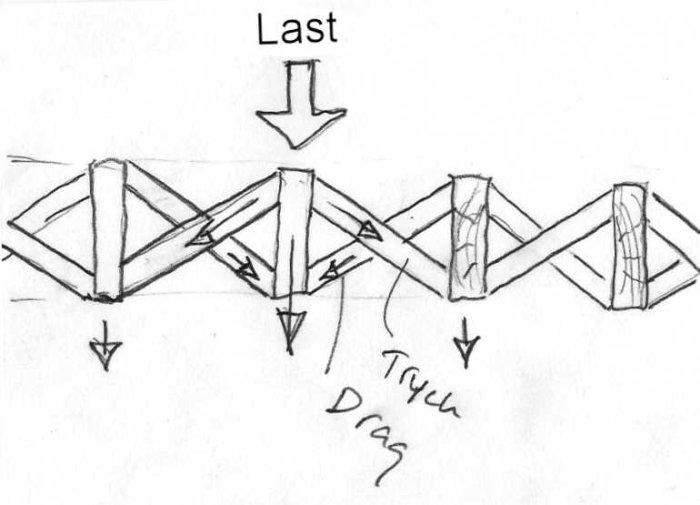
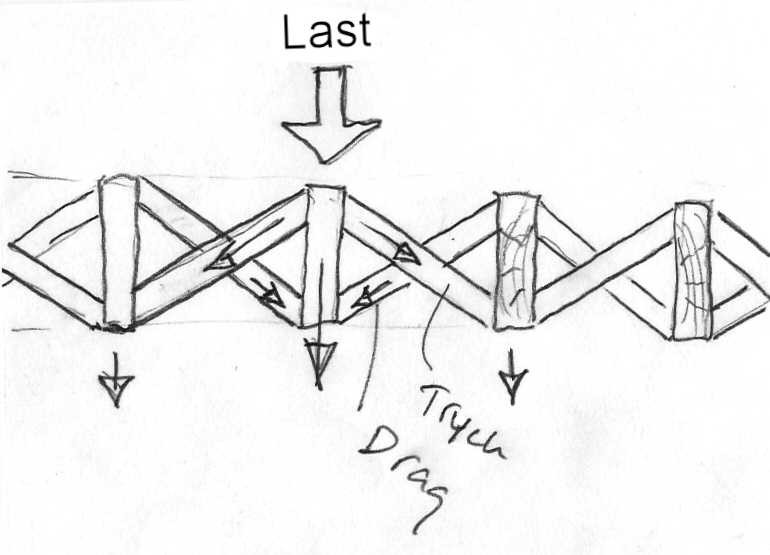
Sure, it makes a difference! In principle, one can imagine laying beams in both directions! However, that principle doesn't hold because we don't have full beams, only short "shortlings." Attached is a small sketch showing how the forces are distributed if you "crossbrace." The forces will spread similarly even if you have whole pieces instead of diagonals. - The advantage of diagonals instead of shortlings is likely that a skilled carpenter can pre-tension them.
Cross battens are for cooperation AND to prevent the floor joist from twisting during deflection. I offset the cross batten by 45 mm on every other one so I can screw it through the joist into the cross batten. It becomes rigid and good.
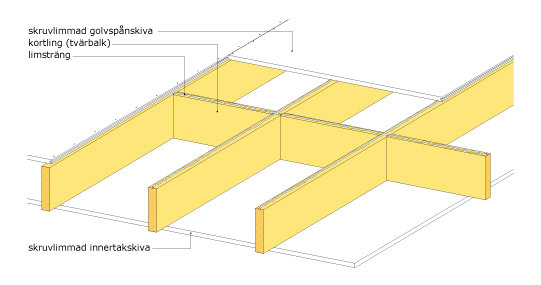
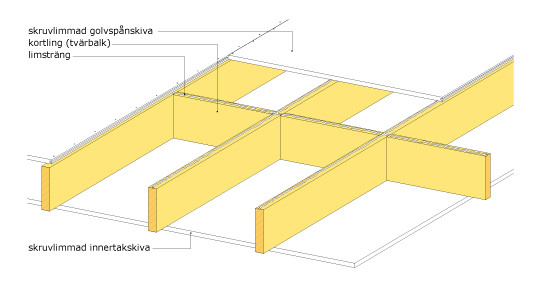
Additionally, in the picture above, the flooring chipboard (tongue) should be mounted across the floor joists.
Whoever came up with this solution cannot be a real designer. The joists should lie as continuous beams on top of the glulam beam that acts as a beam to best utilize the material. In this situation, one cannot guess but must calculate. Then one might think that 45x220 on cc 300 should handle a normal distributed load. Chipboard as subfloor is a fairly useless material, at least from a strength standpoint. Construction plywood is much stiffer. Cross bracing and similar are emergency solutions when there is no height space. Should be avoided here.
The person who came up with this solution cannot be a real designer. The joists should lie as continuous beams on top of the glulam beam that serves as the main beam to utilize the material optimally. In this situation, guessing is not an option; calculations must be made. Then one might think that 45x220 at cc 300 should handle a normal distributed load. Chipboard as a subfloor is quite a worthless material, at least from a strength perspective. Construction plywood is much stiffer. Cross bracing and similar are emergency solutions when there is no height space. Should be avoided here.
Hi
You are right that no real designer has drawn the solution. But there were quite dramatic limitations regarding heights if one did not want to build the floor below right in the groundwater. But that's another story.
So, given the current circumstances, do you have any concrete ideas on what should be done? Or do you think the density of the joists should be good enough and that the bridging doesn't add anything?
justus; Which glulam beam? The illustrations from the wood research are apparently calculated by a designer. And, for a standard floor structure with a clear span, 45x220 other timber is used for 3.6 m cc 60 cm, 3.9 m for T20, and 4.2 m for T30. Additionally, 2 rows of noggings are recommended. Noggings are not an emergency solution but distribute the loads over the floor structure. If the floor chipboard is glued and screwed, a good panel-effect structure is obtained. All according to the old Building Research.
senior consultant: You have misunderstood me. I was commenting on the image that tobbew first published in this thread, not on the Träforskningen image. I have had great confidence in Träforskningen for a long time. I often use their Träguide for quick calculations. I also share your opinion about the value of noggings in general. However, in this case, no noggings are necessary as the floor joists are fully sufficient as they are. In the Träguide, there are no tables with c/c 300 between the joists, but one can extrapolate the information available for c/c 600 and see that the current construction (45x220 c/c 300 4 m long) results in lower design bending moments than comparable 45x220 c/c 600 3.5 m. This assumes that the timber used is of the construction class C24. Additionally, it is essential that the glulam bearer beam is correctly dimensioned.
What are the dimensions of the chipboards, you mentioned that you would have 2 layers? With 22mm chipboard, you don't quite meet the deflection criteria according to standards. To meet the requirements with 22mm, you would need to add quite a few noggings.
What are the dimensions of the chipboard, you mentioned you would have 2 layers? With 22mm chipboard, you don't quite meet the deflection criteria according to the standard. To meet the requirements with 22mm, you'll need to add quite a few supports.
Can you explain this reasoning a bit more?
Vi vill skicka notiser för ämnen du bevakar och händelser som berör dig.