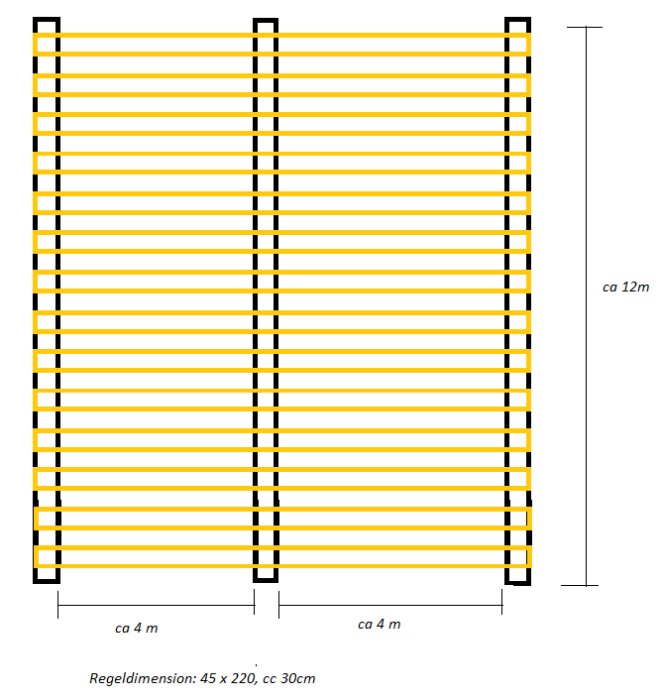
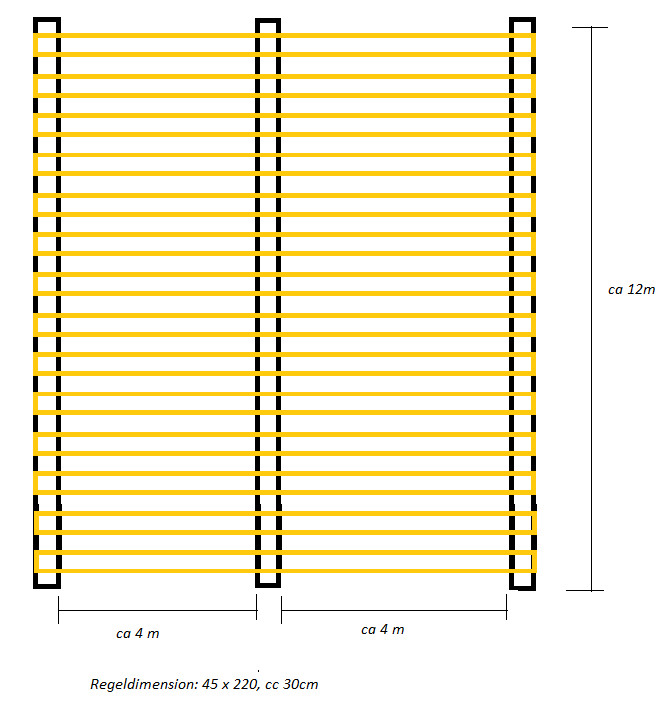
I have a floor that is about 8 x 12 meters. The joists span the short distance, 8 meters.
In the middle, there is a supporting beam where joints are made, so the free span is about 4 meters on each side.
The joists are made of 45x220 studs installed at 30 cm centers.
Should I add blocking/cross bracing in the middle of these, or what would a wise person do?
Right now, the chipboard sheets are loosely laid across the entire floor to allow for other work, and if I jump on the floor in the middle between the walls, i.e., the maximum distance from the supporting beams below, there is a noticeable bounce. It feels completely stiff if you jump over the wall or beam at the ends.
The underside of the beams currently has double gypsum, and the top side will have double layers of chipboard.
It looks roughly like this.
I also attach an old photo that shows the reality.
So, should I put something between the studs? Does it make a big difference?
There will be all types of rooms above, kitchen, bathroom, and everything in between. Maybe extra support where tiling is planned?
Only shortlings make no difference as they cannot transfer vertical forces from one beam to the next. However, a hanging ledger perpendicular to the beams can make a difference. It should be hung at the 2 m position and be rigidly screwed with joist hangers to the beams. It can transfer/distribute vertical forces between neighboring beams. Helps against swaying but not for the total load.
Shorten and screw glue the chipboards properly. The plasterboards do not contribute much to the stiffness of the floor structure; if you still feel it is flexing, it might be better if you instead screw up type plywood on the ceiling. Flex in floor structures is not fun and can be difficult to fix afterward.
Only noggings make no difference because they cannot transfer vertical forces from one beam to the next. However, a hanging support beam across the beams can make a difference. It should hang at the 2 m position and be rigidly screwed with joist hangers to the beams. It can transfer/distribute vertical forces between neighboring beams. Helps against swaying but not for the total load.
I'm not going to say you're wrong, but this is how it was explained to me, which I think sounds reasonable:
If you use noggings and do it with an extremely precise fit, then, for one beam to fall down, but not the one next to it, it requires the nogging to be slightly tilted, which creates a diagonal force that thus transfers forces to the adjacent beam.
Isn't it relevant in mathematics? Even more difference, it seems, would be made by crossing what I have read on the forum.
But maybe I'm thinking incorrectly.
I'm not going to say you're wrong, but this is how it was explained to me, which I think sounds reasonable:
If you brace and do it with an extreme fit, then, for one beam to fall down, but not the one next to it, it requires the brace to be tilted slightly, which creates a diagonal pressure thus transferring forces to the adjacent beam.
.
I completely agree with this! The fit must then be less than a millimeter to achieve a good seating. I can't do it myself, but if someone else can...
I have a similar problem with a future bathroom. Maybe the idea with a rigid OSB underneath could work well!
Then I will make cross braces of world-class quality. I have a good saw... Under a millimeter will be a challenge to the extent that the studs are warped, but it will be tight after parts of the stud and not otherwise.
But say you have cross braces in the traditional sense, without this enormous precision, do you mean that they don't serve any purpose at all when it comes to deflection? I'm prepared to argue that they must serve some purpose. After all, you bind one stud to another, even if it's a "weaker relationship" than the previous example.
Why do we cross brace the joists so often otherwise? If you Google around, people do it in large quantities, and it's hardly to splice their particle boards on, because in my world, that's a cross brace you make in other ways and at other times.
But what the heck, cc30 and double layers of chipboard and nogging in addition? Screw-glue the first layer of chipboard to the joists and then screw-glue the second layer on top of the first and you shouldn't need to think about nogging after that.
Nogging pieces (properly executed) are very useful as they distribute the load over more beams. They should be thoroughly dry and require a bit of force to fit in place (not too short).
We have a side of our newly built upper floor that has about a 4m span where the designer calculated and concluded that 45x220 at c/c600 was sufficient. Then we have blocking of 45x220 at about c/c1200 between these, which are tight and screwed at the top and bottom. On the other side of the bearing beam, there is a span of about 3m.
When it was time to lay the floorboards, we found that there was some flex when jumping on a joist or when laying a board loosely over 2-3 joists on the side with the 4m span; on the other side, there was not the same flex at all.
The solution was to notch the blocking and screw/glue a 45x95 along the joists, which stiffened the structure considerably. It corresponded to setting the 220s at c/c 450-470 somewhere when we calculated it. Then we screwed/glued a layer of floorboards onto this and will screw/glue a layer of grooved floorboards for the underfloor heating.
Original construction with 45x220 at c/c600 was sufficient for deflection and strength but not for the flex. If you have 45x220 with c/c300, it must be enough!
Of course, you can get it to flex if you jump on it with the point load that occurs; it is not as rigid as a concrete slab, but the screw/glue of the floorboards made a huge difference, and how rigid does it need to be for "normal" use?
If it's an office/public space, there are different requirements than for a family home, but will you have many rave parties with an old vinyl player that requires it not to flex? Or will you "just" walk on the floor?
On the question of cross bracing vs. blocking, they serve the same function; you have a diagonal unloading from one joist's top edge to the adjacent joists' bottom edge, and the loads are distributed on multiple joists. If you cut blocking of 45x220 and place them in a row in the middle of the span with screws at the top and bottom, it will significantly stiffen the structure. The joists will also not be able to "sway" sideways, especially in combination with screwed/glued floorboards, which strongly contribute to the rigidity.
If I were you, I would take the extra time to put in a row of blocking, not because I think it's needed but more for peace of mind. Then just go ahead with your joists!
We have one side of our newly built upstairs that has about a 4m span where the engineer calculated and concluded that 45x220 on c/c600 was sufficient. Then we have noggings of 45x220 about c/c1200 between these that are tight and screwed in at the top and bottom. On the other side of the load-bearing beam, there is a span of about 3 m. When it was time to lay the floorboard, we noticed that it gave way when jumping on a joist or if a board was placed loosely over 2-3 joists on the 4m span side, on the other side there was not the same flex.
Did you have noggings on cc 120 on the 3-meter side as well?
Do you have an idea of how much difference the noggings make?
Testarn said:
If I were you, I would take the extra time to set a row of noggings, not because I think it's needed but more for peace of mind. Then you can proceed with your joist system!
I will probably try with noggings, as you say, mostly for peace of mind.
But it's a "regular" house, but I'm a bit particular with creaking and other movements. I want to do my utmost to make things unnecessarily sturdy. That's just how I am...
But I will likely mess around with the noggings and use the material I have, so sometimes it will be 220, but also 120 and some other dimensions. They should all be beneficial, as long as they are tight, I think. Or I'll be serious and buy some additional floor joists for this purpose, but I have a lot of small pieces of mixed dimensions of the larger types.
Thanks for the input anyway, hope more experiences come into the thread!
Cross-bracing doesn't provide as good an effect as placing noggins, but it is easier to perform. I suspect that if you tried after glue-screwing the floor particle boards, you would have been satisfied with the flex as well. Without glue-screwing the floor particle boards, you don't achieve the desired synergy.
I have done several floors with cc600 and a 4.2 span with noggins (usually double) without any issues with flex.
But your floor is solid and good, no doubt about it!
But I'll probably end up being careless with the noggings and use the material I have, so sometimes it'll be 220, but also 120 and some other dimensions. They should all serve their purpose, as long as they fit tightly, I think. Or maybe I'll be serious and buy a few floor joists for this purpose, but I have a lot of small pieces of various larger dimensions.
Well, if you're going to use noggings, shouldn't it be with 45x220 anyway? Especially if you're being picky...
Did you use noggins at cc 120 also on the side of 3 meters? Do you have any idea how much difference the noggins make?
I will probably try with noggins, as you say, mostly for peace of mind.
But it's a "regular" house, though I am a bit picky about creaking and other movements. I want to do my utmost to make things unnecessarily sturdy. That's just how I am...
But I will probably be sloppy with the noggins and use the material I have, so sometimes it will be 220, but also 120 and some other dimensions. All will likely be useful, as long as they are tight, I think. Or I might be serious and buy some floor joists for this purpose, but I have a lot of small pieces of mixed dimensions from bigger ones.
Thanks for the input anyway, hope more experiences come into the thread!
Don't use noggins at 120, they don't have nearly the same effect as 220, sometimes I use 195 to avoid having to drill holes in the noggins for wiring, but almost always 220.
Vi vill skicka notiser för ämnen du bevakar och händelser som berör dig.