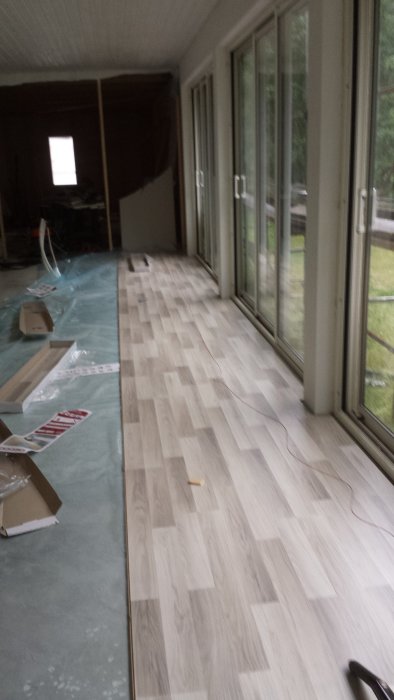
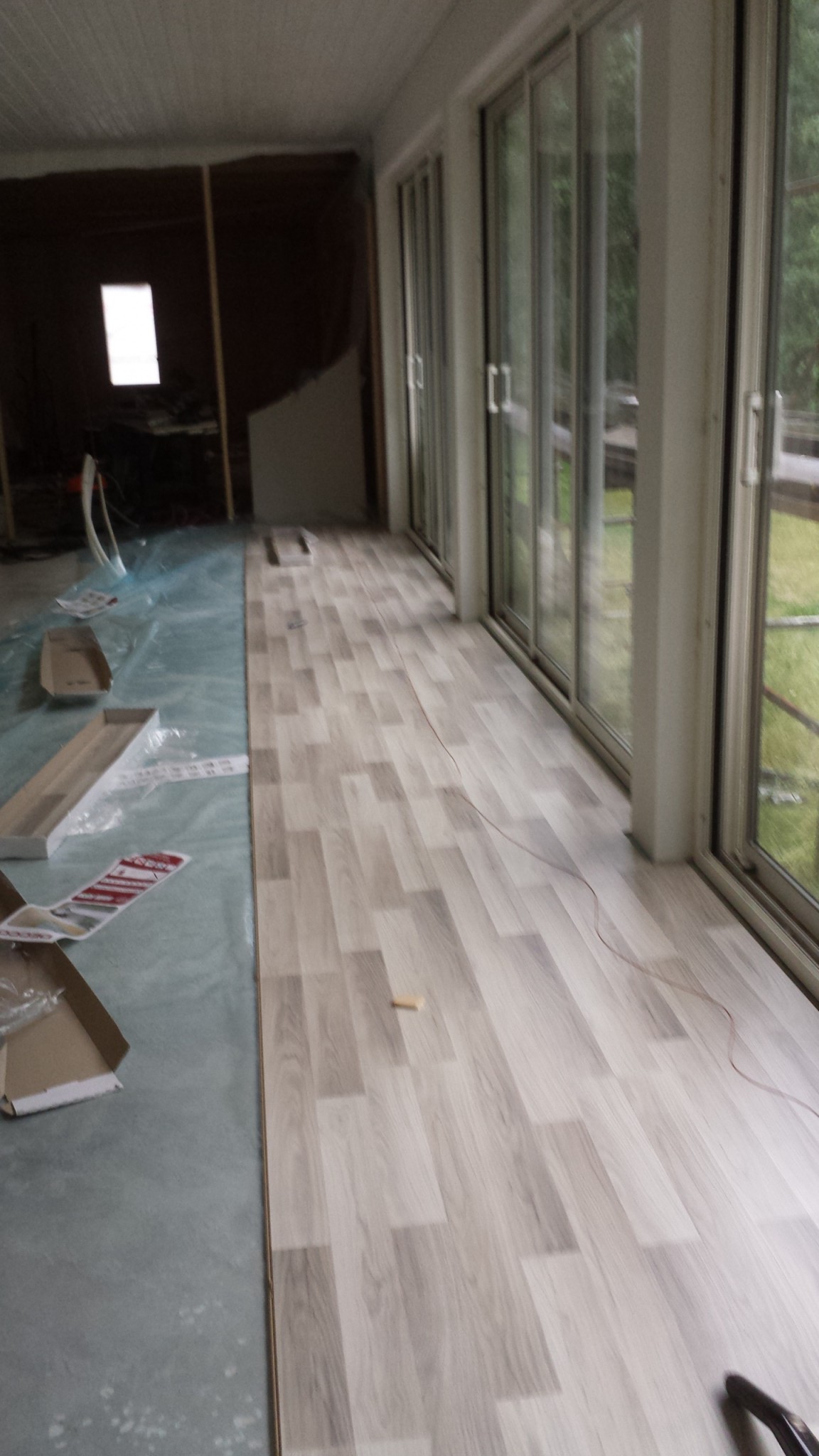
In our conservatory (heated to about +10 in the winter), we have a wall that is about 11 meters long, of which about 9.5 m is glass. There are also five posts along this stretch.
The floor is laminate (intentionally not according to the supplier’s temperature requirements) and thus there is a gap of almost 15mm along the glass wall. This could be covered with a regular skirting board, but we have decided on a threshold instead.
First thought was to get 3 pieces of oak about 3.5m and cut out for the posts. Then splice these a little artfully behind the posts. It’s not realistic to get 11 meters of oak board. Maybe it’s possible with 2 pieces of 5.40 and have one joint, but I’d rather splice at a post than right in front of a glass where people walk through, I thought.
But then I thought it might be possible to cast. First, a layer of plastic against the laminate floor so the threshold doesn’t hold the floor (half the point is that the floor should be able to move underneath) and then place a beam as a stop towards the room, thus forming a mold against the glass section’s frame.
One complication is that we’re considering that the threshold should be movable. We’ve decided to build in lighting in its underside (and it rests on a strip of something like plexiglass + LED strip). An 11 meter long concrete threshold I’m afraid might crack if you start moving it, perhaps? Otherwise, I have to try to cast the lighting directly into it, but then you have to accept the situation if the strip breaks, instead of just pulling out the threshold, turning it upside down and replacing the LED strip and then it works again.
The electricity for the strip will be solved by the threshold meeting a skirting where the electricity can be managed on the backside.
Requirements
- Lighting underneath (solved by building a compartment along the entire stretch where an LED strip fits and a strip of plexiglass or other plastic facing the room that lets out some light)
- Color: White (even if it’s oak, it will be white)
- The depth should be so that it doesn’t just go between the posts but also beyond, since the floor leaves a gap around the posts too, and it would look terrible with skirting on the posts.
- (Wish): Removable for changing the lighting, relaying the floor, or other unexpected reasons.
My hope:
Cast an 11m long threshold, reasonably with reinforcement. It’s heavy, but it can be moved by having one person at each end and pulling it out of its hole. You can turn it upside down and glue plexiglass and an LED strip under it (LED strip in the gap of a plexiglass shelf at the front and any material at the back, against the glass section’s frame). Once this is glued on, you can turn the whole thing over again, kind of paint it and then slide it into its mold tightly against the posts and glass frame again.
I would have made 3 thresholds out of some wood material, attaching them with some kind of clips or similar fastening underneath. Put floor moldings around the pillars. You will spend an enormous amount of time trying to cast and fix as you describe. Wood weighs the least, easy to remove and simple to drill/mill for cables, LED strip, etc.
Even if there are three thresholds made of wood, they will extend past the pillars, into the room. So there most likely won't be any baseboards around the pillars. I'd rather waste a lot of time on thresholds than put up baseboards. I don't mind baseboards, but I think they look ugly on the pillars, they become so narrow and odd.
But I agree with you on your thoughts. However, one advantage of concrete is that it is so heavy that it reasonably stays perfectly in place without needing to be fastened. Its weight and its fit due to being cast on-site make it likely to always stay close to the floor, even where the floor is uneven.
Wood has the advantage of being attachable. I've been thinking about some track in the threshold and something sticking out from the pillars, e.g., a plate or maybe just milling out a couple of mm from the pillars and sliding the threshold underneath.
However, there is a risk that the threshold will rise in the middle (3-meter stretch in front of the windows) and that gaps and gravel, etc., will get in there. I assume you aren't "allowed/supposed" to seal against the floor given the floor's movement. As mentioned, the floor should be able to move under the threshold, according to my understanding from the floor's supplier. Whether the floor will move or not, I have no idea.
Ok, yes it will probably look nice with a cast variant. Do you have experience with casting? You can use a flex seal or whatever it's called that can withstand movement if you go with a wooden threshold.
So Flexfog. Interesting, so it still seals against the floor, and "glues" the threshold, but can move?
I've cast before, but not to the point where I can claim I'm good at it. For example, I can't predict what happens if you manage to cast this and then try to pull it out and turn it upside down. Will it crack?
I suppose it's important to reinforce it. Maybe with something thin. Previously, I've done some footings for the house, etc., but there should be thinner reinforcement than 10 and 8mm, which I've used before.
But I'm still not sure if concrete is the right solution. Maybe it's completely crazy, so I'm super grateful for any thoughts!
I don't know if it works, but I thought of wood composite that is used for decking, facades, and fences, etc. It's available in white, but I don't know if it's the right shade of white, and the maximum length of 6 m is the longest I've seen.
I want a tiled surface. So, you can't tile directly on laminate, so maybe I'll do it like this:
I'll cut long strips of particle board, about 10mm. Then I'll add another layer on top with offset seams and glue everything together. Then tile on that. That should be a stable surface of about 20mm and then the tiles on top.
It should be simple to both deliver and build. It will lie completely loose, but should stay in place by itself.
The important thing is that the laminate floor underneath can move freely but that the threshold stays in place.
It can be screwed down into the concrete under the laminate, and a significantly larger hole can be drilled into the laminate than in the concrete. For example, drill 30mm in the laminate and 10mm in the concrete so it can move 10mm in any direction.
On the other hand, I dare to believe that it will stay quite still, but I could be wrong. It would be unfortunate if a lot of gravel collects underneath over time, causing a lot of crunching and wobbling when you walk on the threshold.
I don't know, I'm glad people share their concerns and thoughts.