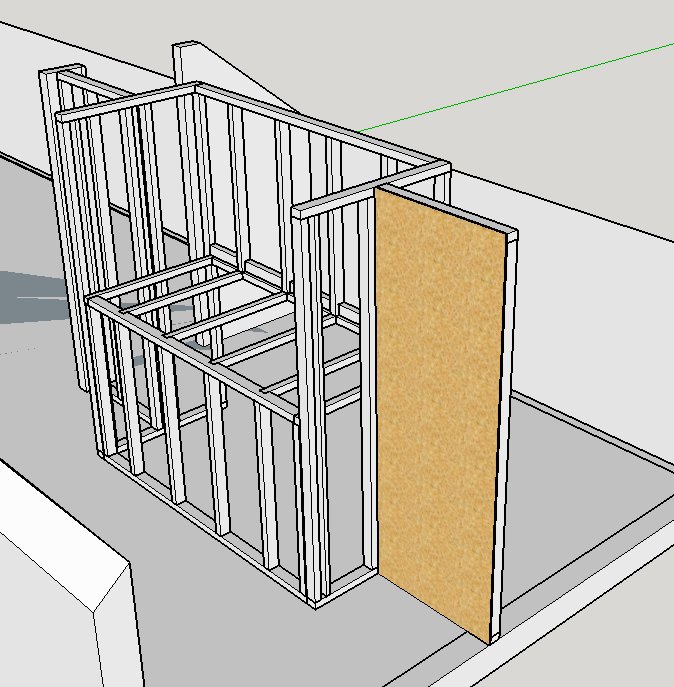
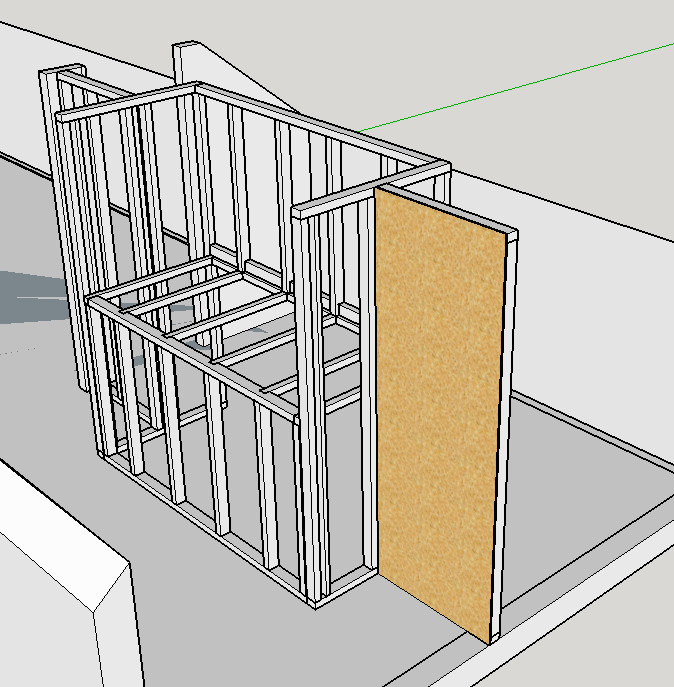
To make it all more concrete, here is the drawn-in piece I am trying to calculate the dimensions of. The nearer wall is removed in the picture:
The pipe is a radiator pipe running along the floor at the bottom.
It's true that this could be made simpler, but the math problem was a welcome break in the work and I thought I could afford it since I would still manage to do everything that needs to be in place before the electrician arrives.
If anyone is wondering what I'm building, it's a combined built-in bunk bed and partition wall. The room isn't very large and needs to be divided into two, so instead of having two beds taking up two square meters in each half of the room, I'm placing the beds above each other. The lower one is accessed from one half of the room, and the upper one from the other.
As stated above, you can't determine the angles with just the 4 measurements. You need more information. But do as mentioned above. Use the cross laser and measure from it. In it, you have both a plumb line and a spirit level.
Then I'm on the whole train
The theory says to divide into triangles, preferably right-angled as they are the easiest to calculate/understand
The practice says "Don't measure, compare instead"
It's wonderful when theory and practice agree. If they don't, practice prevails!
Back to the original question
To calculate the diagonals, the four sides are not enough. You must have at least one of the angles or one diagonal to proceed. One diagonal would be preferable for accuracy.
Now that the problem is solved, I think the important question is why there are no right angles when you're building everything new yourself?
In that particular case, it's ONE of the walls I've built, and it is plumb. I haven't straightened either the floor or the ceiling, and the outer wall is as it is...
Right angles only exist on drawings. The most elementary thing in measurement technology is that there are ALWAYS deviations. If you think something is exact, you have poor measuring instruments. It's more important that it looks straight than that it is straight!
As I understand it, there's a difference of a few mm in width and height. Why not just press a square board there? A gap of a few millimeters between the OSB boards in the corner shouldn't matter, right? Up to 11 mm is covered by the boards on the adjoining walls...
Why not just put in a square board? A gap of a few millimeters between the OSB boards in the corner shouldn't matter, should it? Up to 11 mm is covered by the boards on the adjoining walls...
It's only one of the walls that will have OSB -- the other is already plastered and finished... End of factual arguments.
But then there's that wonderful feeling when you install something that fits perfectly...
Click here to reply
Vi vill skicka notiser för ämnen du bevakar och händelser som berör dig.





MathiasS said:

useless said: