

Complete novice with a circular saw. Looks like I got one with the wrong hole dimension.
I guess I can use it as long as I screw it on tightly, but is it better to go in and exchange it?
In one of the pictures, the new blade is directly over the old one. With the new blade's larger hole, it could end up off-center.
I guess I can use it as long as I screw it on tightly, but is it better to go in and exchange it?
In one of the pictures, the new blade is directly over the old one. With the new blade's larger hole, it could end up off-center.




Summarizing the thread:
Insert ring, sometimes also called reducing ring, reduction ring, or bushing, and measurements can be specified in mm or inches. When specified in tenths of a mm like 12.7 mm, it is probably a fraction of an inch (1/2 inch in this case).
It turned out that the machine, a Black & Decker DN227, was from the 50s-60s (inherited from grandpa in 2015) and requires a ring of dimensions that are rare today. Perhaps better to keep the wrongly purchased blade with modern dimensions if the saw breaks before the blade. The few blades I found for the DN227 were crazy expensive or hard to buy.
To get a reduction ring, I happened to first email Bosch (instead of B&D), but it was lucky because they replied with a ring of the closest dimensions they could find, which I then ordered from one of their subcontractors when it turned out that B&D only had unorderable blades.
Just need to assemble it. The feeling of sawing now is absolutely wonderful. Grandpa's pioneering spirit from the post-war era is still completely preserved in the saw and my grandchildren will likely read this post and understand that emailing the wrong manufacturer to mount future dimension blades leads to the same joy for them
Insert ring, sometimes also called reducing ring, reduction ring, or bushing, and measurements can be specified in mm or inches. When specified in tenths of a mm like 12.7 mm, it is probably a fraction of an inch (1/2 inch in this case).
It turned out that the machine, a Black & Decker DN227, was from the 50s-60s (inherited from grandpa in 2015) and requires a ring of dimensions that are rare today. Perhaps better to keep the wrongly purchased blade with modern dimensions if the saw breaks before the blade. The few blades I found for the DN227 were crazy expensive or hard to buy.
To get a reduction ring, I happened to first email Bosch (instead of B&D), but it was lucky because they replied with a ring of the closest dimensions they could find, which I then ordered from one of their subcontractors when it turned out that B&D only had unorderable blades.
Just need to assemble it. The feeling of sawing now is absolutely wonderful. Grandpa's pioneering spirit from the post-war era is still completely preserved in the saw and my grandchildren will likely read this post and understand that emailing the wrong manufacturer to mount future dimension blades leads to the same joy for them
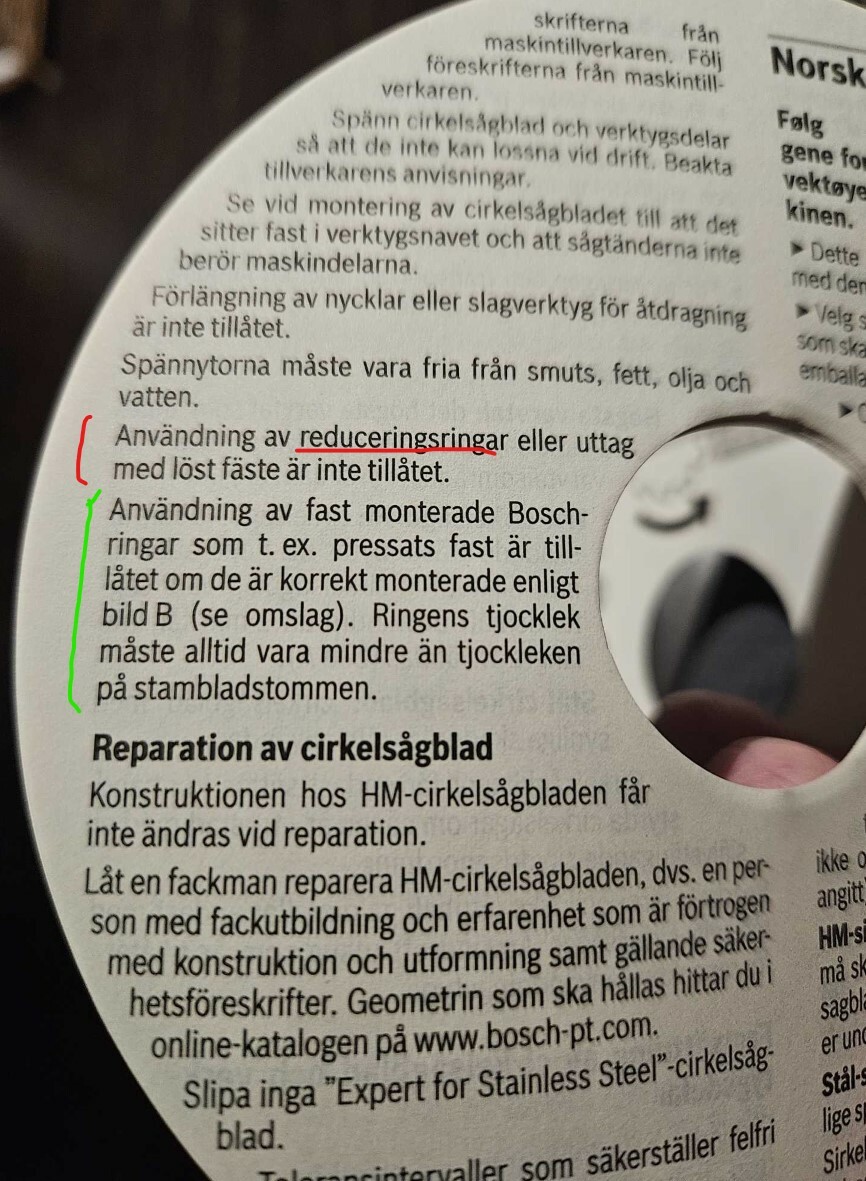
Okay just before I was about to throw away the packaging for the blade, I found an instruction manual in it.
Good to keep in mind: reduction rings are not always allowed and the thickness matters, installation instructions for fixed bush rings that are pressed in place according to one of the images here.
Good to keep in mind: reduction rings are not always allowed and the thickness matters, installation instructions for fixed bush rings that are pressed in place according to one of the images here.

Click here to reply