
5,376 views ·
15 replies
5k views
15 replies
wood studs in 90x38 and 95x38, what are they good for?
I have taken apart a lot of packing crates from work and now have a substantial pile of lumber, but unfortunately, the dimensions are a bit odd in the wrong direction, so to speak. They are 90x38 and some 95x38, with the measurements varying by a few mm both plus and minus.
I plan to build a freestanding shed/woodshed about 10x3m with a simple slanted roof (don't know what it's called) covered with sheet metal. I have no idea what lumber dimensions are used for such a shed, but I had hoped to use this lumber; the question is if it's too flimsy. I live in southern Dalarna, so it needs to handle some snow.
So my question is simply what this lumber is suitable for?
I plan to build a freestanding shed/woodshed about 10x3m with a simple slanted roof (don't know what it's called) covered with sheet metal. I have no idea what lumber dimensions are used for such a shed, but I had hoped to use this lumber; the question is if it's too flimsy. I live in southern Dalarna, so it needs to handle some snow.
So my question is simply what this lumber is suitable for?
Ok, I didn't think of that
I assume it is pine or spruce, but since they come from abroad, I am not sure, but as I said, it looks like "normal" stud wood.
Available in lengths of 5m, 4m, 3.5m and 1.5m. Mostly 3.5m and 1.5m.
I assume it is pine or spruce, but since they come from abroad, I am not sure, but as I said, it looks like "normal" stud wood.
Available in lengths of 5m, 4m, 3.5m and 1.5m. Mostly 3.5m and 1.5m.
Must at least be good enough for walls (studs), not exterior cladding.


I'm in the process of closing off one of the garage doors and removed some on both sides. I have vertical wood paneling with asfaboard underneath. Between the paneling and the board, there are 38x60 battens where the paneling is nailed. (38 mm between the board and panel). So this seems to be a possible application area.
I couldn't find anything with a thickness of 38mm when I quickly checked with my hardware store, is this a common measurement? It was new to me anyway. Now I wouldn't need much and it was easy to split from some of the beams I had left over.
I couldn't find anything with a thickness of 38mm when I quickly checked with my hardware store, is this a common measurement? It was new to me anyway. Now I wouldn't need much and it was easy to split from some of the beams I had left over.
Hello!
45x90 is a common dimension in small sheds and similar structures, and it's quite sufficient for such buildings. Almost all houses in Sweden are structurally overbuilt, with thick studs used to accommodate insulation. 38x90 doesn't make a significant difference, but lateral buckling does worsen. Attach drywall with screws on the outside, and that will take care of it.
A tip - Google small sheds and holiday homes to see how they are constructed. Use a light roof (=metal sheet), and there shouldn't be any problems with 38x95. Reinforce with diagonal braces and metal bands. If you are not insulating, you can also use c-c 45 and use 90 drywall.
Best regards,
Anders
45x90 is a common dimension in small sheds and similar structures, and it's quite sufficient for such buildings. Almost all houses in Sweden are structurally overbuilt, with thick studs used to accommodate insulation. 38x90 doesn't make a significant difference, but lateral buckling does worsen. Attach drywall with screws on the outside, and that will take care of it.
A tip - Google small sheds and holiday homes to see how they are constructed. Use a light roof (=metal sheet), and there shouldn't be any problems with 38x95. Reinforce with diagonal braces and metal bands. If you are not insulating, you can also use c-c 45 and use 90 drywall.
Best regards,
Anders
Last edited:
If I understand correctly, 38x90-95 works for wall studs, but to be on the safe side, you should screw together two studs to make them 76x90-95 or brace for lateral forces by attaching drywall sheets.
If you nail together double studs everywhere, it unfortunately uses a lot of timber. But how would it work if you used double studs in the corners and on the short sides and then every 2.5 meters on the long side?
If you nail together double studs everywhere, it unfortunately uses a lot of timber. But how would it work if you used double studs in the corners and on the short sides and then every 2.5 meters on the long side?
Hello!
I would probably use simple 38x90 as a standing rule and attach gypsum or asfaboard to stiffen the side. Another method is to use windproof fabric and horizontal battens that also function as nail battens for the vertical wooden paneling. Place horizontal battens on the inside as well.
If you have a table saw and plenty of time, you can split your 38x90 into 2 pieces of 17x90 or so, giving you free paneling too. Then split some 17x90 into 17x42 or whatever it becomes and paint with Falu Rödfärg from Ö&B, and it will definitely be a budget build
I can't be bothered to open the truss book program right now, but damn if 38x95 isn't enough for the trusses as well if you set them at c-c 60....... If you have a router, buy a couple of blades and make your own rough tongue and groove for the roof, depending on how much timber you have.
Best regards,
Anders Nilsson
I would probably use simple 38x90 as a standing rule and attach gypsum or asfaboard to stiffen the side. Another method is to use windproof fabric and horizontal battens that also function as nail battens for the vertical wooden paneling. Place horizontal battens on the inside as well.
If you have a table saw and plenty of time, you can split your 38x90 into 2 pieces of 17x90 or so, giving you free paneling too. Then split some 17x90 into 17x42 or whatever it becomes and paint with Falu Rödfärg from Ö&B, and it will definitely be a budget build
I can't be bothered to open the truss book program right now, but damn if 38x95 isn't enough for the trusses as well if you set them at c-c 60....... If you have a router, buy a couple of blades and make your own rough tongue and groove for the roof, depending on how much timber you have.
Best regards,
Anders Nilsson
Thanks for the great tips!Anders_Nilsson said:Hi!
I would probably use simple 38x90 as standing studs and put gypsum or asfaboard to stiffen up the sides. Another method is weatherproofing paper and then horizontal studs that also work as nail battens for the standing wood paneling. Place horizontal studs on the inside too.
If you have a table saw and plenty of time, you can split your 38x90 into two 17x90 or so and get free paneling too. Then split some 17x90 into 17x42 or whatever it becomes and paint with Falu Rödfärg from Ö&B for a guaranteed budget build
I can't open the roof truss book program right now, but damn if 38x95 isn't suitable for the roof trusses as well if you place them c-c 60....... If you have a router, buy a couple of cutters and make your own decking for the roof, depending on how much wood you have.
Best regards,
Anders Nilsson
Unfortunately, I don't have a table saw, but luckily, there's a lot of 20x100 wood from the boxes. I didn't mention these before because I was only considering the frame itself. But as you said, I have plenty of 20x100 in the same lengths as the studs, and I had planned to use them for paneling and under roofing.
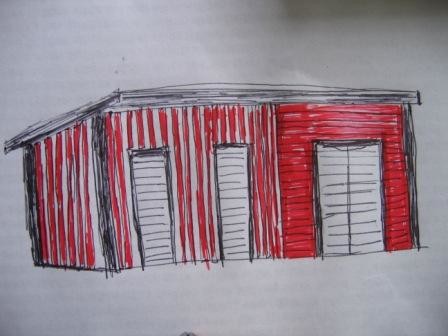
But back to the frame, I'm including a small sketch of how I plan it to look, since it's a bit hard to explain with words, although art wasn't my best subject in school, so take the proportions with a grain of salt.
The plan is for it to be 10x3m and the height 2.5m at the front. Wood storage on the left with two entrances and the shed on the right with double doors.
Since the main house has horizontal paneling, I'm thinking of using that on the shed part as well, but for the wood storage, I'll use sparsely nailed standing paneling since I assume it's not ideal to nail it horizontally, considering water might collect on each plank.
If I use horizontal paneling on the shed part, does it work as lateral stabilizers, or do I need boards/studs on the inside as well?
For the wood storage part, I can't use boards, but instead, I can use horizontal studs which I then nail the paneling onto. Do these need to be 38x90, or is 20x100 sufficient?
Then Anders, if you could kindly look in the roof truss handbook and check if 38x95 is sufficient, the span is just over 3m. d^_^b
Lastly, I have found drawings for sheds on byggbeskrivningar.se, but I can't find a shed with a sloping roof. If anyone can suggest a drawing of a shed with such a roof, I would be very grateful.
Hello!
First of all, I would go with a gabled roof for the shed, especially if there's a risk of a lot of snow, it kind of feels like the snow slides off more easily with a steeper roof.
Then, if you're going with horizontal paneling, it has to be beveled paneling, that is, fjällpanel. Parts of packing crates you have must be mounted vertically for drainage reasons. So, go with vertical paneling for the entire building. Paint with some sensible paint.
I would probably settle for free timber and then use gypsum board as windproofing on the entire building to brace it. Then use 20x100 planks as paneling. Horizontal paneling nailed directly to the studs (possibly with intermediate battens for increased ventilation) is a classic way to brace a building without using gypsum, but with today's prices, I would probably spend on gypsum.
NOTE! Even with gypsum, it's not a bad idea to put horizontal studs on the inside for additional rigidity. Place them, for example, at 60 cm c-c height on the inside.
I checked in the truss book but 95 mm is not listed as an option, I would probably go with 120 mm that I bought at Byggmax, built triangular trusses, and placed them 60 c-c with a metal roof. I also think the snow slides off more easily on metal.
First of all, I would go with a gabled roof for the shed, especially if there's a risk of a lot of snow, it kind of feels like the snow slides off more easily with a steeper roof.
Then, if you're going with horizontal paneling, it has to be beveled paneling, that is, fjällpanel. Parts of packing crates you have must be mounted vertically for drainage reasons. So, go with vertical paneling for the entire building. Paint with some sensible paint.
I would probably settle for free timber and then use gypsum board as windproofing on the entire building to brace it. Then use 20x100 planks as paneling. Horizontal paneling nailed directly to the studs (possibly with intermediate battens for increased ventilation) is a classic way to brace a building without using gypsum, but with today's prices, I would probably spend on gypsum.
NOTE! Even with gypsum, it's not a bad idea to put horizontal studs on the inside for additional rigidity. Place them, for example, at 60 cm c-c height on the inside.
I checked in the truss book but 95 mm is not listed as an option, I would probably go with 120 mm that I bought at Byggmax, built triangular trusses, and placed them 60 c-c with a metal roof. I also think the snow slides off more easily on metal.
The alternative as I see it is Reglelstomme, asfaboard, luftspalt panel.
I find Asfan a bit nicer to handle than gypsum.
Metal is slippery and allows snow to easily slide off a metal roof.
I also recommend a simple gable roof. You can get away with using lighter wood than you would need for a shed roof.
I find Asfan a bit nicer to handle than gypsum.
Metal is slippery and allows snow to easily slide off a metal roof.
I also recommend a simple gable roof. You can get away with using lighter wood than you would need for a shed roof.