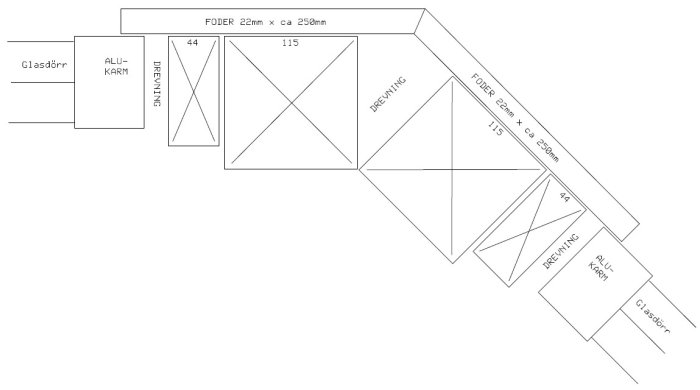
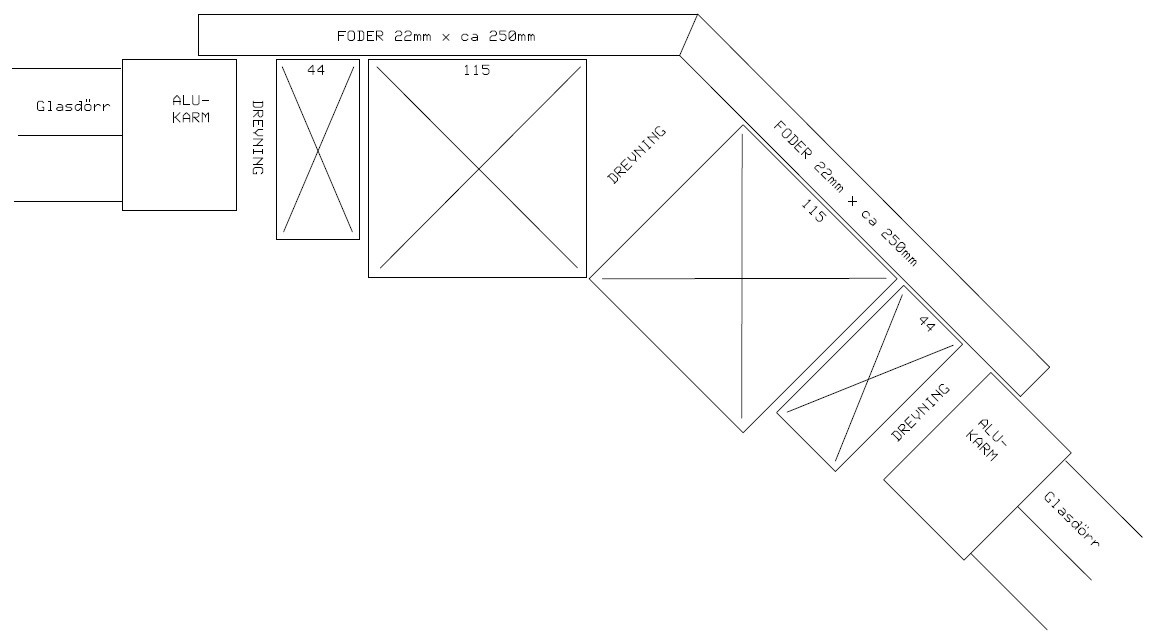
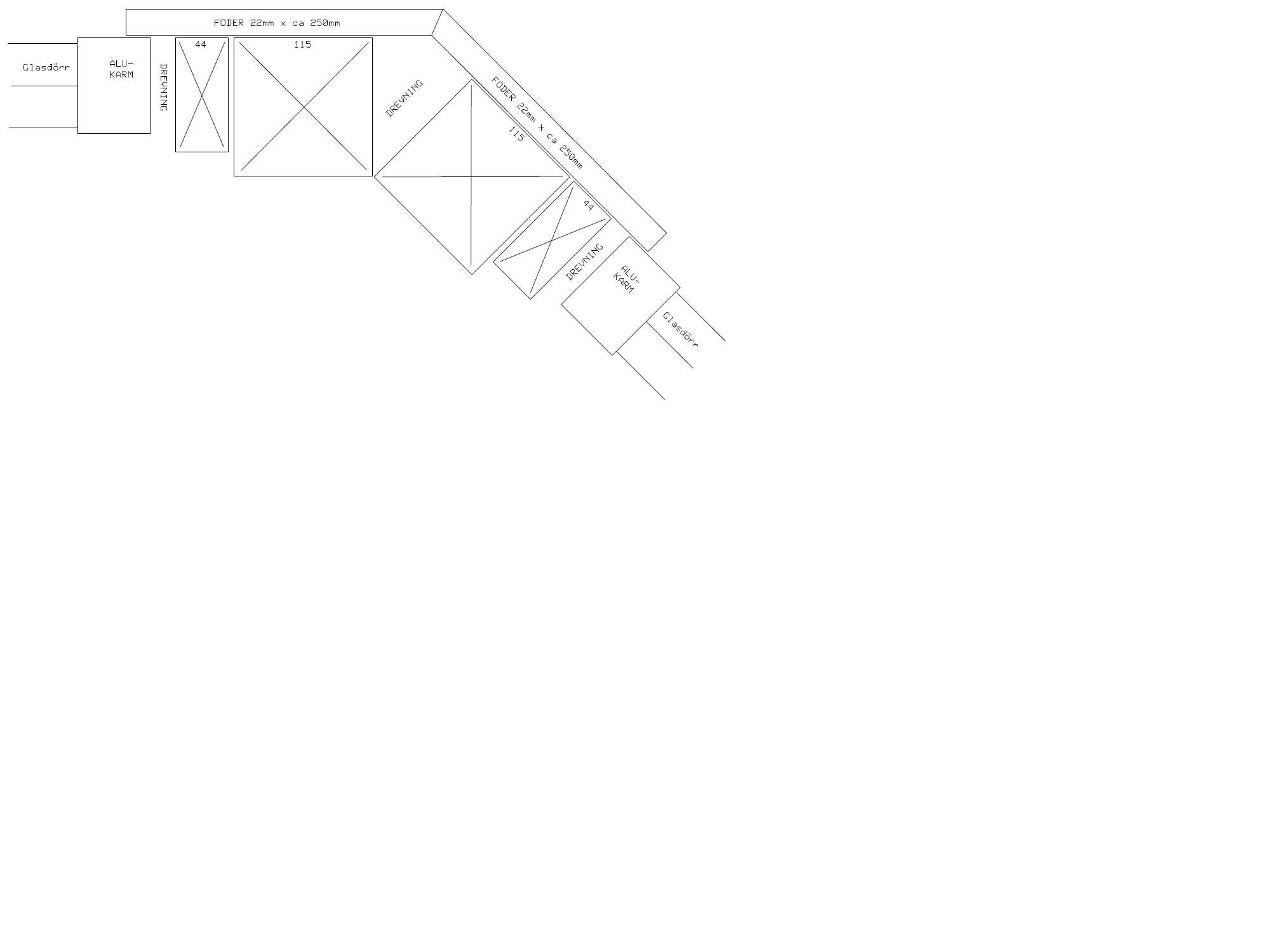
I have a type of sunroom that is winter-insulated with argon-filled sliding doors. The outer corner of the room is beveled, so it forms two 135° corners with an additional sliding door between the corners. I am now considering how to make the trims on the outside between the sections around the posts. On the rest of the house, there are quite wide trims, about 160mm x 21mm. But if I were to put board trims on the window section's 135° corners as well, they would be very wide boards. The trims need to extend from a couple of centimeters onto the frame, past the packing gap, a 44mm stud, a 115mm laminated post, and out to the outer corner where it meets the opposite board. That is, it requires two pieces of about 250mm for the trims to meet at an outer corner. See the picture below that shows a 135° corner. What should be done? I have considered a few different options: 1. Skip the board trims and instead order a white V-bent sheet metal that would cover from frame to frame. 2. First, put a flat metal strip from a few centimeters on the frame to a bit in so that the 44mm stud is covered (about 80-100mm wide), and from there, with a little overlap, continue out to the outer corner with a trim board, which then does not need to be as wide. Maybe 2 pieces of 170mm would suffice. 3. Glue together two or three 22mm boards to create a wider board, about 250mm, like making your own laminated board, but unplaned. And make two of those against each other. 4. Maybe there are ready-made wide unplaned boards or panels that are about 22mm thick?
But... the question is what looks best—and is easiest. Tips—other ideas?
I first looked at your drawing and thought of my suggestion; it was the same as your option 2 and maybe have alu-sheet with the same surface treatment as the frame??
I first looked at your drawing and thought of my suggestion, it was the same as your option 2 and maybe have aluminum sheet with the same surface treatment as the frame ??
Yes, option 2 is the proposal I've thought about the most. But at the same time, I'm unsure how nice it will look. Especially on the sheet metal joint, which will more or less be visible on the frame outside the board cladding. To make the joint as inconspicuous as possible, I would think you'd need a very thin sheet, about 0.6mm, kind of like "window flashing," with the same glossy white surface as the frames, which are powder-coated. But that type of sheet is usually quite matte white, from what I've seen at least. However, I have seen aluminum sheet with a similar glossy white surface, but it is then significantly thicker, about 1.5-2mm, which I assume means the joint on the frame would be very visible. But maybe there is thinner sheet metal with a kind of powder coating, or with an "enameled" white surface?
One can naturally also consider a proposal 5, where a separate corner trim is made on the outside, and a separate trim board alongside the frame. In the small gap between the corner trim and window trim, there is the horizontal paneling. However, both trims must be quite narrow, which greatly deviates from the rest of the house, where the corner trims are about 145 and the window trims about 160-170. Also, it becomes very fussy with many short horizontal panel pieces.
Board (instead of strips of horizontal paneling) underneath painted the same color as the house, 160mm molding in the same color as the house's woodwork/molding.
The lower/underlying boards are cut to the corner and glued, prefabricated before installation, cut at 22.5 degrees, right...? Glue and nail the corner with brads or something...
The moldings are installed as usual.
Boards (instead of short pieces of lying panel) underneath painted in the same color as the house, 160mm casing in the same color as the house's woodwork/casing. The bottom/underlying boards are cut to fit in the corner and glued, prefabricated before assembly, cut 22.5 degrees, I guess...? Nail and glue the corner together with finishing nails or so... The casings are mounted as usual.
Kind of like cover panel...
Have I understood you correctly if you mean that you make the corner casing underneath, or inside the window casings, and in the same color as the house? That is, the corner point will be green in my case, and the 160 smooth casings by the windows white? That might be an idea! Thanks for the tip - it will definitely be considered!
Exactly what I meant, because it will probably be "cleaner" than a lot of panel scraps/stripes, and you (according to my taste) avoid getting a big white blotch in the corner...
It feels like a good idea and I will probably go with it
Since you make the corner piece green and if you get a tight seam, you might not see it as a corner trim, but as a "curved" panel. The fact that I have horizontal paneling otherwise, I also don't see as a problem, since this becomes a bit special and can be seen as a "decorative feature."
Then it's a matter of figuring out how to best glue together 3.5m long trims at that angle.
It's probably quite important that the boards lie flat during gluing, as the finished package becomes quite inflexible afterward.
Either temporarily attach it in place and use the wall as a template during gluing, or some kind of fixture.
Then it's important to get a straight glue edge. If you cut with a circular saw with a guide, the board needs to be straight from the start. Maybe cut with a guide rail, to be independent of the board's straightness?
Tips?
(I have a plunge saw with a rail and guide, but no table saw)
Calm down - things aren't moving so fast here
But I wanted to have the whole picture clear to me at an early stage, because it also affects other parts that are being made and have been made at an earlier stage. I'm currently working on finishing the parts that require the scaffolding that I've borrowed. But it's not so easy to paint when it rains as soon as you open the can... :|
I'll get to the fodren eventually...
Anyway, I'm going to go with your suggestion
Click here to reply
Vi vill skicka notiser för ämnen du bevakar och händelser som berör dig.