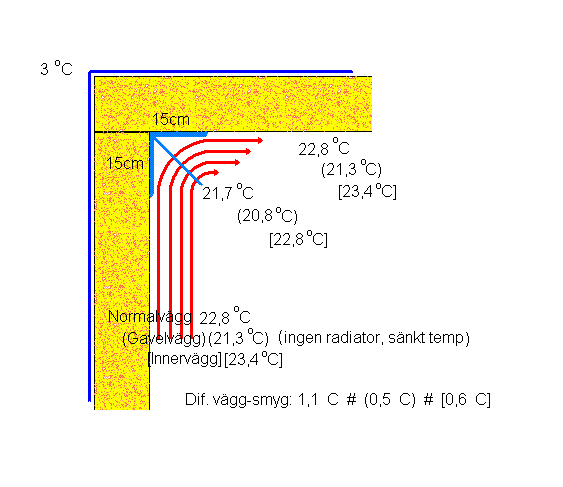
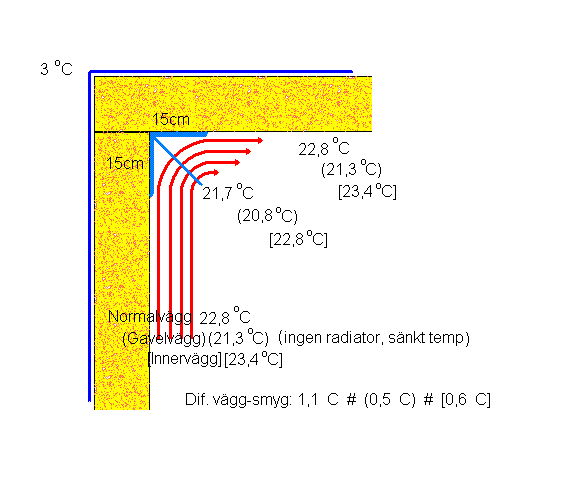
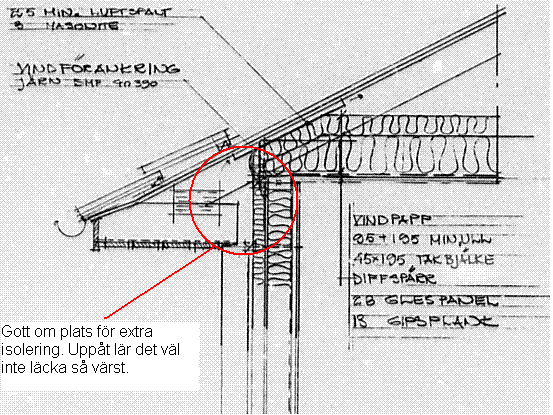
I'm still not 100% sure why the taksmygen is colder. One thought I've had is that the air circulation might not be as good in the corner. Is that reasonable?
What do you get from my measurements?
Even the indoor wall has a diff, illogical.
The gable wall has no radiator, and the one on the other wall is half closed, but the air should circulate from that side, which could explain the lower diff there. The whole wall is a bit colder. Wrong! It's a bit warmer. And even the corners show the same as the taksmygen.
Good to know is that I have a valmat roof.
The surface temperature depends on any thermal bridges
Mold growth can be due to poor air circulation
That's what I'm unsure about, is it a thermal bridge or is it that the heat, so to speak, doesn't reach the corners as well as the wall in general? A thermal bridge can be fixed, but if it's natural airflow, it becomes more difficult, as you'd basically have to round off all the reveals to follow the air, and that probably wouldn't be worthwhile.
The fact that I have a temperature difference even on an internal wall suggests that it's due to circulation.
There's no moisture or mold, so that's not an issue, but if the heat is leaking out, I'll be annoyed.
Don't worry.
The thermometer only shows its own temperature, i.e., the temperature of the sensor tip. It is affected by the surroundings through three things: convection, heat conduction, and infrared radiation (heat radiation).
When you measure over flat surfaces, you get roughly the same result; it's only in the corner that it's different. It can be as simple as the sensor having a different radiation balance with the surroundings when it's in a corner and "sees" two surfaces instead of one.
Additionally, a one-degree difference (if that is the case) is probably within the measurement accuracy (even though the thermometer specs likely boast of less tolerance).
Don't worry.
The thermometer only shows its own temperature, i.e., the temperature of the sensor tip. It is influenced by the surroundings through three things: convection, heat conduction, and infrared radiation (thermal radiation).
When you measure over flat surfaces, you get about the same result, only in the corner is it different. It can be as simple as the sensor having a different radiation balance with the surroundings when it is in a corner and "sees" two surfaces instead of one.
In addition, a degree difference (if it is) is within measurement accuracy (even if the thermometer specs probably boast less tolerance).
Measuring with IR, the wall is evenly warm and starts to lose temperature about 15 cm from the corner where it is also the coldest. I guess I'll have to measure on the outside then, if it becomes windless, it should be warmer there if there's a leak.
What you see is completely normal and, as previously mentioned, is an effect of having heat transfer outward in two directions.
I don't know what you're measuring with, but an IR camera gives a much better picture of how it looks than measuring point by point.
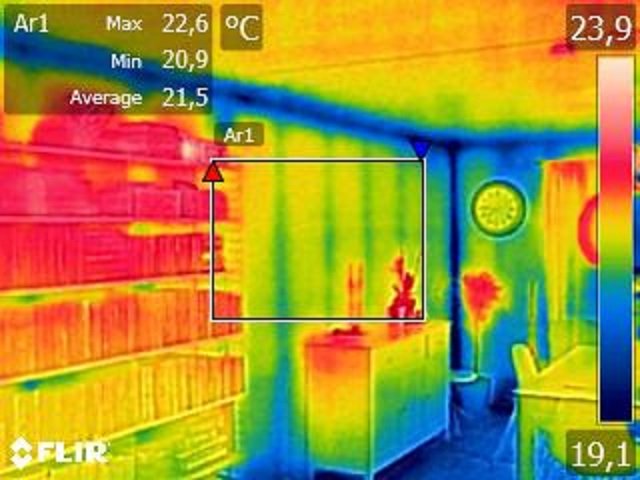
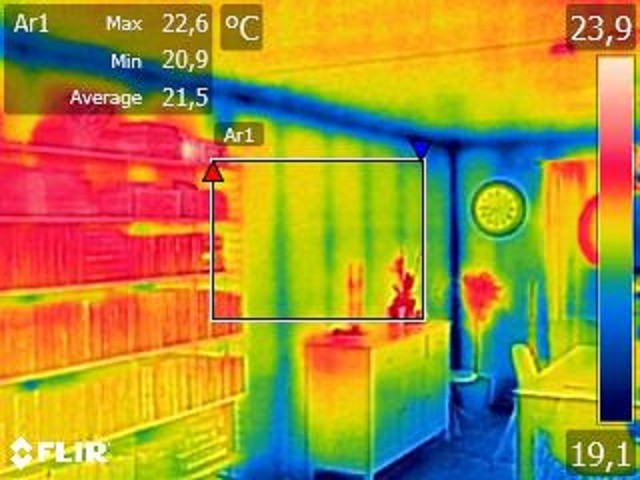
Below is a picture from my home. You can clearly see how much colder the corner is (to the left of the clock). You can also see the thermal bridges from the framework inside the wall.
What you see is completely normal and, as previously mentioned, an effect of having heat transfer outward in two directions.
I don't know what you're measuring with, but an IR camera gives a much better picture of how it looks than measuring point by point.
Below is a picture from my home. You can clearly see how much colder the corner is (to the left of the clock). You can also see the thermal bridges from the framework inside the wall.
[image]
Yes, that's how it looks. But if it's because of thermal bridges, I don't understand why it's not compensated with insulation in these places. 1-2 degrees may seem little, but it adds up to kWh over the year. A possible measure could be to install styrofoam crown moldings; there are several options to choose from.
Yes, that's how it looks. But if it's due to thermal bridges, I don't understand why they haven't compensated with insulation in those areas. 1-2 degrees may seem little, but it adds up to kWh over the year. One measure could be to install polystyrene ceiling moldings, there are some to choose from.
What do you actually mean, how should one compensate with insulation instead of a beam? The beam is there because it's needed for the framework of the house.
Everything that is colder than its surroundings is by definition a thermal bridge, it doesn't necessarily mean it's poorly insulated there, just that it's slightly worse than the rest of the wall.
I don't think polystyrene ceiling moldings will help a bit, very little at least.
What do you actually mean, how should one compensate with insulation instead of a beam? The beam is there because it is needed for the house's structure.
Anything that is colder than the surrounding area is by definition a thermal bridge; it doesn't necessarily mean that it is poorly insulated there, just that it is a little worse than the rest of the wall.
I don't think foam board adhesive will help at all, very little at least.
Sure, you can do that, but you can also make both the walls and ceiling 3 meters thick and fill them with insulation. There would still be a thermal bridge in the corner. It doesn't leak more energy there than anywhere else on the wall. It's just that it leaks in two directions. You don't really save more energy just because the wall is completely homogeneous in U-value terms.
What you see is completely normal and, as previously mentioned, it's an effect of having heat transfer outward in two directions.
I don't know what you're measuring with, but an IR camera gives a much better picture of what it looks like than measuring point by point.
Below is a picture from my home. You can clearly see how much colder the corner is (to the left of the clock). You can also see the thermal bridges from the framework inside the wall.
[image]
A bit OT but what kind of camera did you take the picture with?
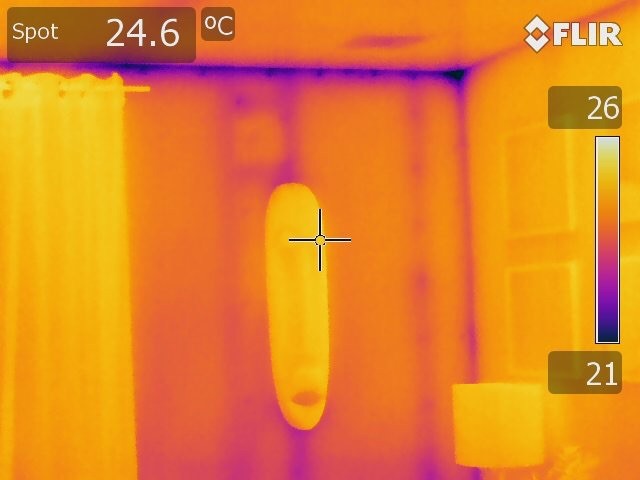
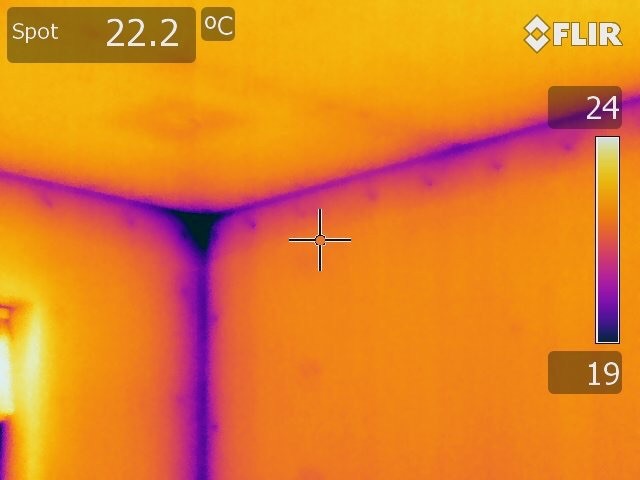
Here is a picture from my home, taken with a flir t660, which also shows the phenomenon of colder corners.
In the upper picture, there is an exterior wall on the left and an interior wall on the right.
Vi vill skicka notiser för ämnen du bevakar och händelser som berör dig.