
14,814 views ·
9 replies
15k views
9 replies
Which I-beam in load-bearing wall
Going to make a roughly 3-meter wide hole in a brick wall. According to the inspector, it could very well be load-bearing; without the calculations from 1956, he didn't dare to give a definite answer... He thought we should treat it as load-bearing anyway. The floor slabs are concrete, and the rest is brick and aerated concrete. The trusses run perpendicular to the wall that is to be demolished, which also indicates it's a load-bearing wall.
Anyway:
What size I-beam would be appropriate?
How much longer than the width of the hole should the beam be?

Anyway:
What size I-beam would be appropriate?
How much longer than the width of the hole should the beam be?
Answering myself...
An inspector I talked to had seen similar cases where IPE160 had been used. Now the hole is only 230 cm and I have an IPE 180 beam on its way, so it should hold.
A carpenter I had there usually makes the hole about 25 cm larger on each side, so I'll go with that.
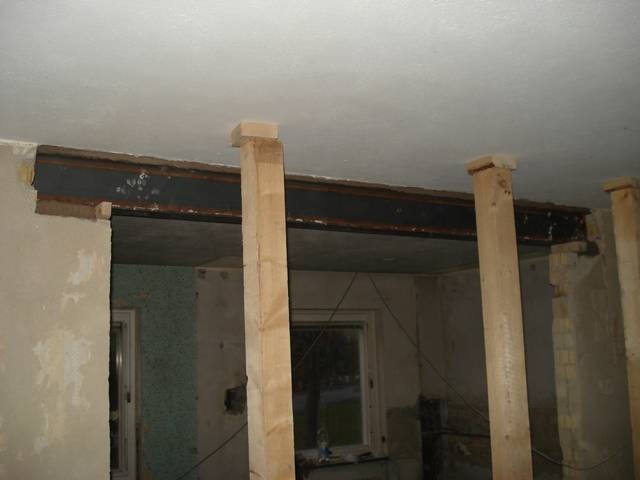
Bonus picture of how it looked when I cut into the wall...

An inspector I talked to had seen similar cases where IPE160 had been used. Now the hole is only 230 cm and I have an IPE 180 beam on its way, so it should hold.
A carpenter I had there usually makes the hole about 25 cm larger on each side, so I'll go with that.
Bonus picture of how it looked when I cut into the wall...
If an IPE-160 is strong enough as a replacement for a load-bearing wall, is a VKR beam 100x100x5 mm sufficient as a replacement?
I have the impression that a hollow profile is stronger but more expensive than an I-beam in the corresponding dimension. The weight per meter is about the same.
I have found datasheets, but I can't interpret them
IPE beam datasheet
VKR hollow profile datasheet
I have the impression that a hollow profile is stronger but more expensive than an I-beam in the corresponding dimension. The weight per meter is about the same.
I have found datasheets, but I can't interpret them
IPE beam datasheet
VKR hollow profile datasheet

Hello! Continuing on your thread... I have a house from the 40s and it looks somewhat like yours. 1 1/2 floors with a basement, however, mine is made of wood and there is a chimney to the left of the door into the kitchen! The wall you have marked is the one I plan to remove! I also assume the wall is load-bearing, but the basement's concrete wall is not exactly under this wall; it's about a meter into the kitchen (it connects with the chimney in the basement) but it's not worth risking here
I'm working on figuring out glulam dimensions for this as the opening will be 370 cm wide! Glulam pillars 90x90 at each end and a glulam I-beam at 90x225 should hold, but I'm far from sure about this! So I welcome any input The glulam beam will rest on the full surface of the pillar 90x90...
I'm working on figuring out glulam dimensions for this as the opening will be 370 cm wide! Glulam pillars 90x90 at each end and a glulam I-beam at 90x225 should hold, but I'm far from sure about this! So I welcome any input
The glulam beam will rest on the full surface of the pillar 90x90...
Sorry Mats_o! My mistake... However, the beam will rest on 90 to 100 mm on one side and 180 mm on the other due to double columns! It won't be more than that! On the other hand, I offset a piece of the outer wall for the door (150 cm) and then placed the beam about 25 cm extra on each side!
Hope this can contribute something!
Thanks from me...
Hope this can contribute something!
Thanks from me...
Click here to reply