I'm going to test this relatively new forum section I'm not sure if the topic really fits here, but I'll give it a try!
If I'm going to set up a shelf that is two meters long with two brackets, how far should I space the brackets for optimal support? That is, for the least flex in the shelf.
Two different options are:
1. Divide the shelf into three equal sections without support.
200cm/3 ~= 67cm. So, you place each bracket 67cm from each
outer edge, and between the brackets it’s also 67cm.
However, it feels like the shelf might get more support in the middle than
at the edges.
2. Let each bracket support half of the shelf.
Half the shelf = 1m. Center the brackets under each half.
So, you place the brackets 50cm from each outer edge, and
between the brackets it would then be 100cm. This feels better than option one,
but I'm not sure if it's optimal. Possibly the shelf will flex more in the middle than at the edges.
Does anyone know how to calculate this? You'd have to assume an even load over the entire shelf, even though in reality, it probably won't be like that...
Option 2 is best. Provided that the load on the shelf is evenly distributed, each 1-meter half of the shelf will be balanced in the middle by its own bracket, and the bending moment in the middle of the shelf will be minimal. But shouldn't you have three brackets on such a long shelf? One in the middle and the outer ones 1/3 meter in from the ends.
Well, spontaneously I also thought option two felt much better than option one. But is it the optimal placement? This is something I think about every time I put up a shelf with two brackets, regardless of shelf length
In this particular case, the shelf is being installed above an opening, so there's no possibility to attach any bracket directly under the shelf. Furthermore, in this case, the load will be concentrated at two points about 60cm in from each edge.
But how do you actually calculate this? (I mean the general case described in my first post)
Actually not difficult as long as you remember the formulas. But they are relatively complicated, so complicated that I forgot them a few weeks after the last exam.
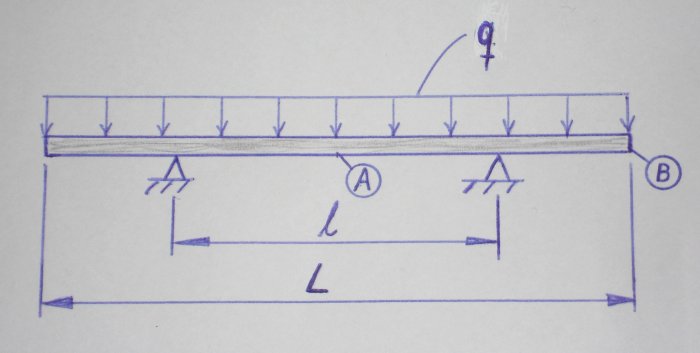
Assume I place 50cm - bracket A - 100cm - bracket B - 50cm
I then place a 10kg weight at the far left (50cm from A). The torque on A is then 10*9.81*0.5 ~= 50Nm. If I place the same weight in the middle between A and B, i.e., 50cm to the right from A, the torque is only 25Nm since half of the force from the load is absorbed by A and half by B. So should I move the brackets closer to the edges?
Let's test what happens if you divide each half of the shelf into three parts and place the bracket one-third of a meter from the edge. Then we have 33cm - A - 67*2cm - B - 33cm. 67*2 = 134. So it's 134cm between A and B.
The same load is placed far left on the shelf. The torque at A is now 10*9.81*0.33 ~= 32Nm. If the load is placed in the middle of the shelf, the torque at A is 10*9.81/2*1.34/2Nm = 5*9.81*0.67Nm ~= 33Nm.
So we got a much more even distribution of the moments. If I had calculated with exact thirds, the moments would probably have been exact.
Have I thought and calculated correctly? Is minimized torque directly equivalent to minimized deflection in the board (minimal sag)?
Assuming you mean the load case below, and want to know which support distance l, (small L), in relation to the shelf's length L gives the same deflection at A and B.
Well, a load case is probably a combination of loads and supports on a structure.
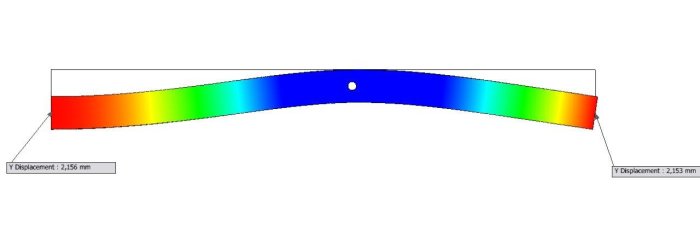
Tried with various support distances in a computer calculation, the result below isn't entirely off, is it? The calculation is done on a half-model of the shelf, the left end of the model is thus the middle of the shelf, a symmetry cut. The hole represents the support.
Tlundberg:
Had difficulty following your second calculation example, but regarding the first, I guess you actually want to double the load in the middle if you have a uniformly distributed load over the entire shelf. This means that the shelf is in equilibrium with a uniformly distributed load. Now the case may occur where you place something very heavy at the edge of the shelf, causing it to tip over, so it’s probably not advisable to set it up this way...
I forgot to mention the support distance I experimented with. With l (lowercase L) equal to 56% of L, I got the same deflection in the middle A and the end B.
If the supports are made so they also bear upward force, the shelf doesn't tip over.
kalubah: I fully understand. I can barely keep up myself now when I read it again two months later...
I'll give it another try, this time with a small illustration.
The triangles are "bracket A" and "bracket B" from my previous example. The slightly thicker black line is, of course, the shelf which I have set the length of to 2m.
Scenario 1:
Divide the shelf in half and place a bracket in the middle of each half.
x becomes 50cm. y becomes 100cm. z becomes 50cm.
Place a 10kg load all the way to the left (50cm from bracket A). The torque on A will then be 10*9.81*0.5 ~= 50Nm. If I place the same load in between A and B, i.e., 50cm to the right from A, the torque at A will be only 25Nm because half the force from the load is absorbed by A and half by B.
Scenario 2:
Divide the shelf in half and place a bracket one-third of the half's length in from the edge.
x becomes approximately 33cm. y becomes approximately 2 * 67cm = 134cm. z becomes approximately 33cm.
The same load as in the previous scenario is placed in the same positions as in the previous scenario.
The torque at A now becomes 10*9.81*0.33 ~= 32Nm when the load is placed all the way to the left on the shelf. If the load is placed in the middle of the shelf, the torque at A becomes 10*9.81*0.67/2Nm ~= 33Nm.
The maximum torque at bracket A thus becomes 50Nm in Scenario 1, but only 33Nm in Scenario 2. Scenario 2 should therefore be better.
But my models and calculations are based on the assumption that it's a point load.
From both of you (Granngubben and kalubah), it sounds like it becomes different if you consider a homogeneous load spread over the entire shelf.
So, one should place the brackets differently depending on whether one wants the least possible sagging if the shelf is filled with books or if one wants the least possible sagging when placing a very heavy toolbox on the shelf, regardless of where it is placed.
I was mostly thinking that if you have twice the distance between the consoles as outside the consoles, you should reasonably expect that you also place twice as many things there...
...and in the same spirit, in the case of a "regular shelf in a home environment," one can disregard a portion at the very edges where items are rarely placed to avoid the risk of them falling off (unless the shelf has an edge support?)
With uniformly distributed load, it is always the quintile points that provide the optimal placement. It can be calculated, but I think it would become unnecessarily technical.
Vi vill skicka notiser för ämnen du bevakar och händelser som berör dig.

 I'm not sure if the topic really fits here, but I'll give it a try!