
4,548 views ·
12 replies
5k views
12 replies
What were they thinking:confused:

Member
· Västernorrland
· 97 posts
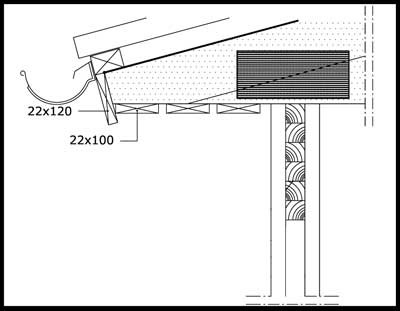
I nailed a drip plate onto the almost vertical 22x120 board (which lies on the mentioned board and the roof trusses). The part of the plate that lies on the roof truss is about 10-15cm wide and supports the vapor barrier quite well. But it might be a little late to mention that now ...
Member
· Västernorrland
· 97 posts
Did you move up (towards the ridge) the lowest batten so that it was nailed above the plate then? Or how did you solve it so that you don't have water standing against the top edge of the lowest batten?JockeR said:
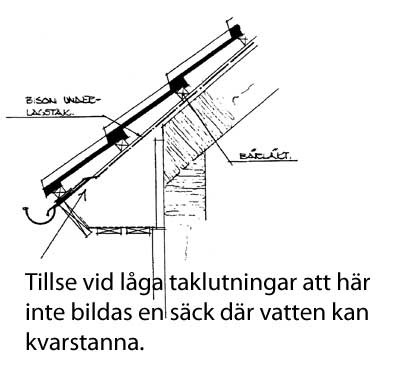
Now I don't know what a kondensduk is, but I have a type of cloth (plastic or fiberglass?) under my metal roof. The accompanying instructions mentioned that a 200 mm wide plywood board should be milled into the rafters at the eaves to avoid what you describe. Is the drawing on the left from Lövångers? What I miss and don't understand is why there isn't a ströläkt? With a ströläkt, you can pull the cloth over the board at the front edge of the roof. Otherwise, the water stays inside, it doesn't come out. Was there no instruction included?
Member
· Västernorrland
· 97 posts
Isn't it strange!? According to Bison's instructions, you can do it in two ways, with or without counter battens, but there was no guidance on how to do it at the eaves and eaves board if you go without counter battens.JanneL said:Now I don't know what a condensation cloth is, but I myself have a type of cloth (plastic or fiberglass?) under my metal roof. The accompanying instructions pointed out that at the eaves, a 200 mm wide plywood board should be milled into the rafters to avoid what you are describing. Is the drawing on the left Lövånger's? What I am missing and don’t understand is why there is no counter battens? With counter battens, you can pull the cloth over the board at the front edge of the roof. Otherwise, the water stays inside, it doesn't come out. Wasn't there any guidance with it?
Stupid as I was, I went with what I thought would be the easy way, so now I'm standing here like a fool with the eaves board
 .
.In your place, I would do the following: Remove the lowest supporting batten and possibly the one above. Purchase raw plank, 22 x 120, enough for two rounds at the eaves. Mill down the boards and restore. I think this will be the cheapest option. It will also be good.
Member
· Västernorrland
· 97 posts
Great idea, Janne! Huge thanks!JanneL said:
Excellent opportunity to inaugurate the new router!
Feels easier with the circular saw/jigsaw?
Member
· Västernorrland
· 97 posts
Haha, well, it actually feels pretty logical to mill out with a milling cutter...
Personally, I don't know if I would have bothered to do anything in this case, the small amount of water that might run out onto the condensation plastic can run on the back of the footboard, it sits airy and dries quickly, but sure, it's not an optimal solution, of course...
Personally, I don't know if I would have bothered to do anything in this case, the small amount of water that might run out onto the condensation plastic can run on the back of the footboard, it sits airy and dries quickly, but sure, it's not an optimal solution, of course...
Member
· Västernorrland
· 97 posts
Oh darn! Maybe I'm excessively worried about moisture? Because the last thing you want is to tear everything up after a few years when everything has rotted.
Well, I'm not saying you should do that or that it's the right thing to do, but if it were my house, I'd do it that way
You can always spray a good amount of primer oil or something similar for rot protection on the inside if you're worried, the simplest way is with one of those sprayers where you pump up the pressure, which costs about 40kr at Biltema..
You can always spray a good amount of primer oil or something similar for rot protection on the inside if you're worried, the simplest way is with one of those sprayers where you pump up the pressure, which costs about 40kr at Biltema..
Member
· Västernorrland
· 97 posts
Thanks Janne and Tossegubben! It feels reassuring to have you experienced gôbbar here on the forum.
Click here to reply