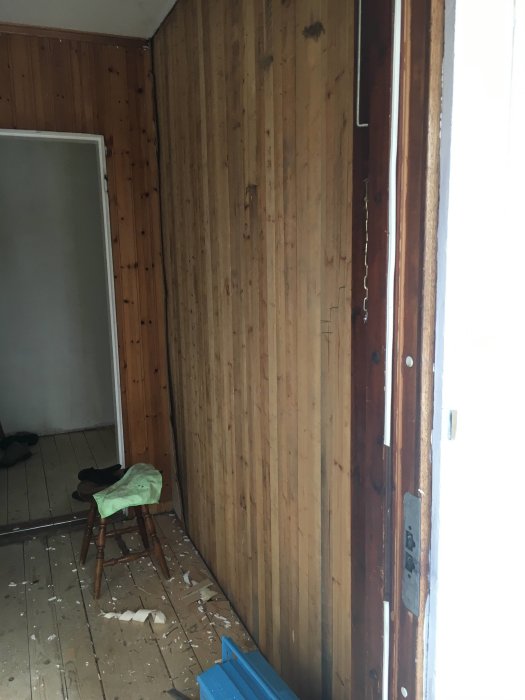
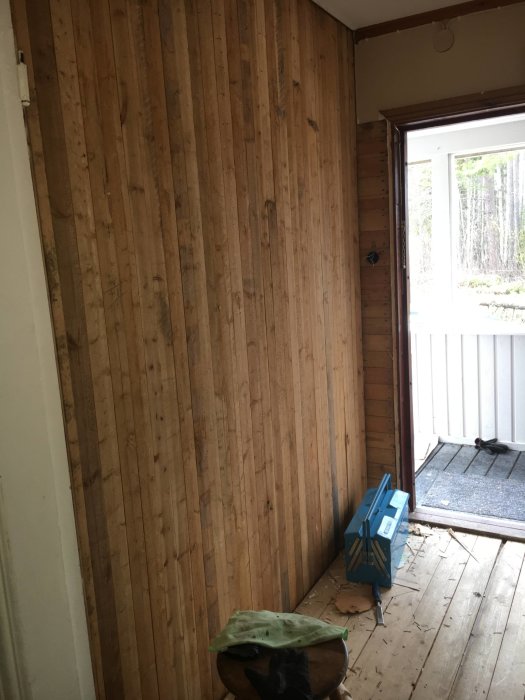
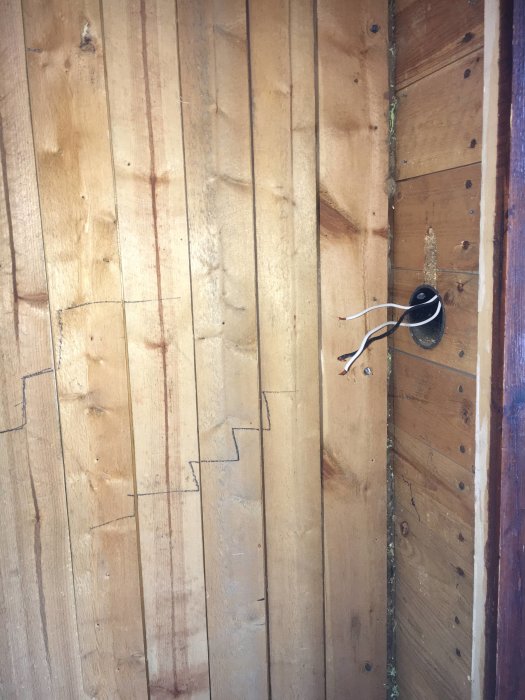
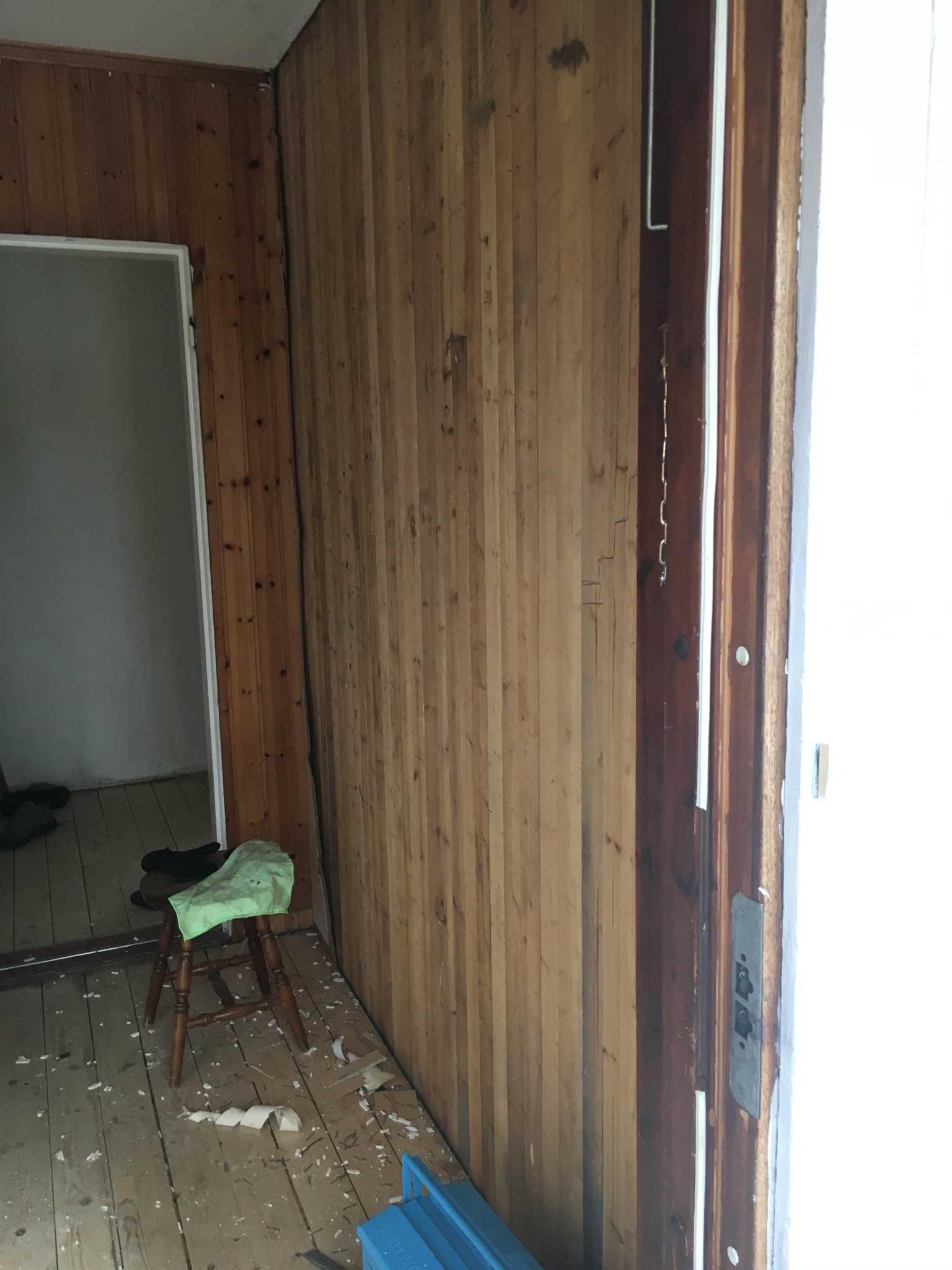
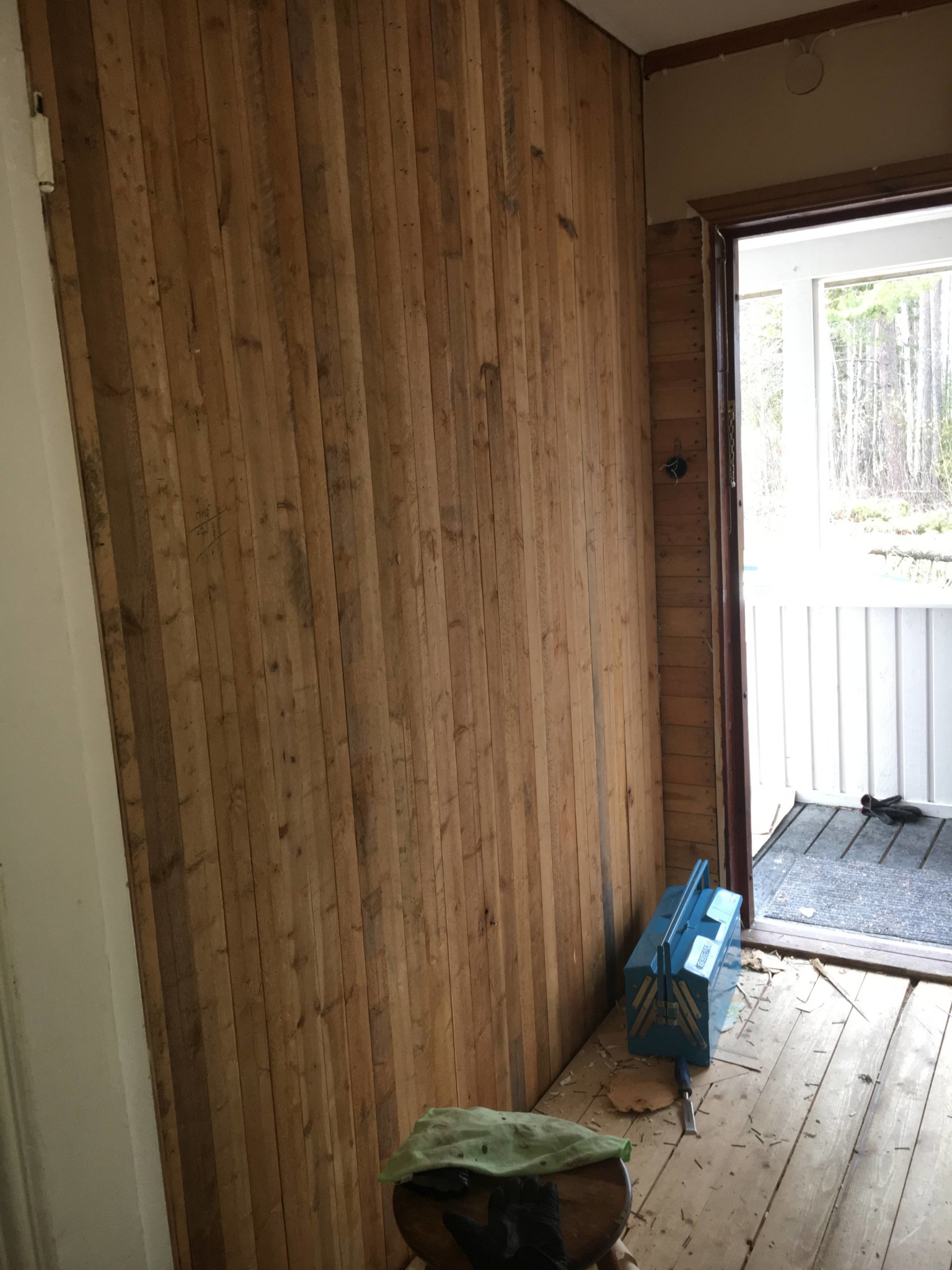
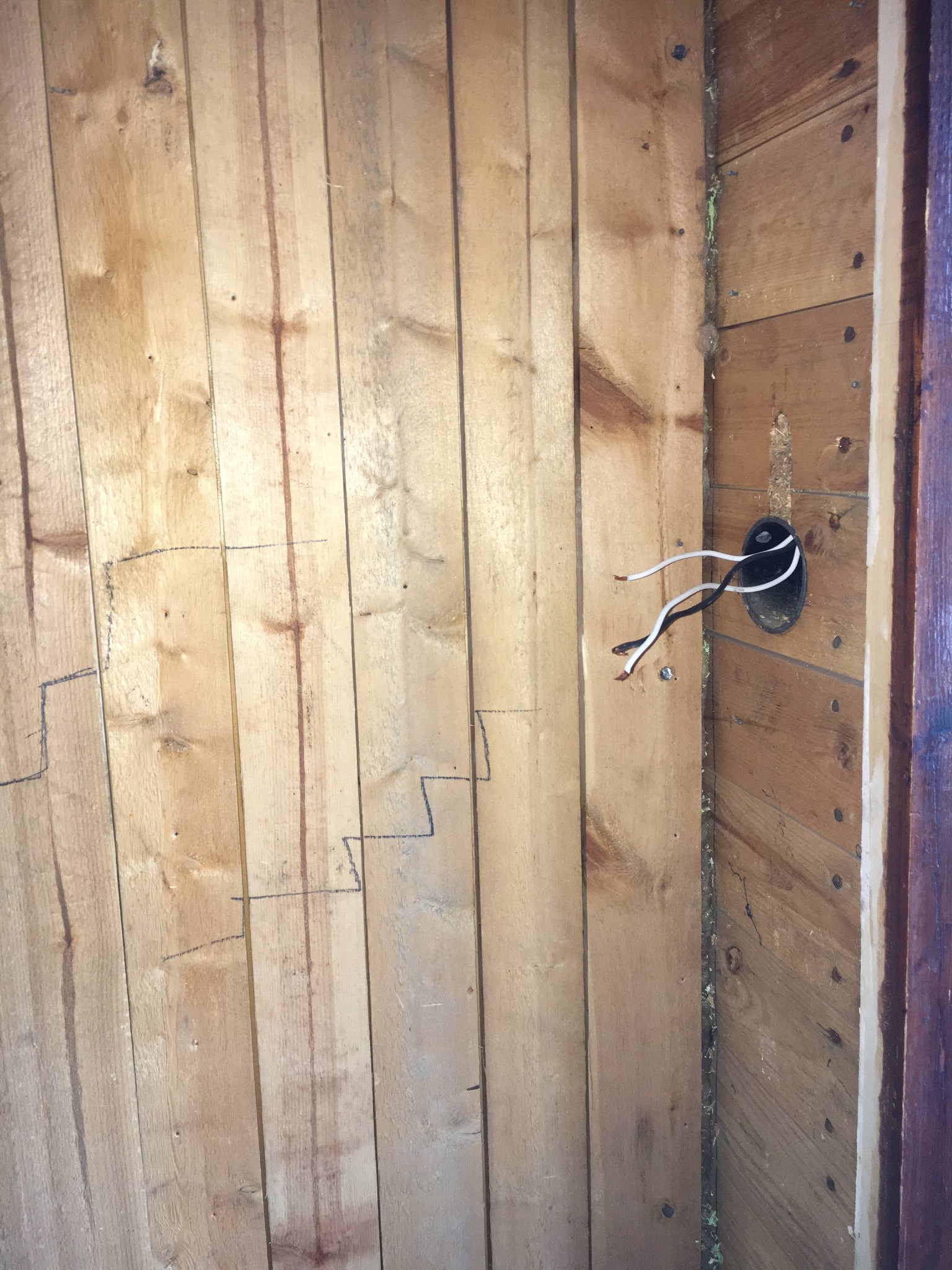
This is the entrance hall in our house from 1945. The wall consists of vertical wood paneling or wooden boards and runs along the house at 90 degrees to the ceiling beams. On the other side is the living room, which also has a board wall. There is an approximately 5 cm thick gap between the walls. So, it's double board walls. Judging by the lack of nails on the wood paneling, there seems to be no stud between the walls. And this is what makes me puzzled.
The hall is cramped, and I'm considering moving the wall in about 1 meter to get a much larger and more pleasant hall. But normally, you would remove the wall filling, expose the studs, and based on what you see, you remove studs and place a beam as relief.
But how do you proceed in this case when the wall filling is what's load-bearing? Can someone explain the technique behind this wall? Above is an upper floor and a wall in about the same place. Below is a basement with a masonry wall roughly in the same place. The lower beams of the trusses are spliced here and there and not continuous.
Looks like standing planks. Sturdy contraptions and even sturdier nails
I can't answer whether you need to alternate or not if you're building a new load-bearing one a meter away.
I think it looks like the panel is nailed obliquely in the tongue and groove. The last board closest to the outer wall seems to have nail heads. Considering the year it was built, the house should have a plank frame, but perhaps not everywhere. If the wall feels hollow when you tap on it, it's probably some form of stud construction. If you have access to floor plans, it's easier to assess.
I think it seems like the panel is toe-nailed into the tongue. The last board closest to the outer wall seems to have nail heads. Considering the year of construction, the house should have a plank frame, but maybe not everywhere. If the wall feels hollow when you knock on it, it is probably some form of stud construction. If you have access to floor plans, it's easier to assess.
Unfortunately, there are no floor plans. The house is probably too old. So it is double walls with a hollow in the middle, likely with studs. But I don't see any nails in the boards indicating a stud behind.
It is very likely that the wall is not load-bearing. Load-bearing walls were not constructed in that way at that time. However, assessing it like this remotely without blueprints is not possible. You will need to create your own floor plan. Measure the house from outer wall to outer wall using a laser meter and draw it to scale. It is important to be able to see the thickness of the walls.
It is very likely that the wall is not load-bearing. They didn't build load-bearing walls in that way at that time. But assessing it like this remotely without drawings is not possible. Then you need to make your own floor plan. Measure the house from outer wall to outer wall using a laser measure and draw it to scale. It's important to be able to see the thickness of the walls.
Ok I will do that.
Click here to reply
Vi vill skicka notiser för ämnen du bevakar och händelser som berör dig.