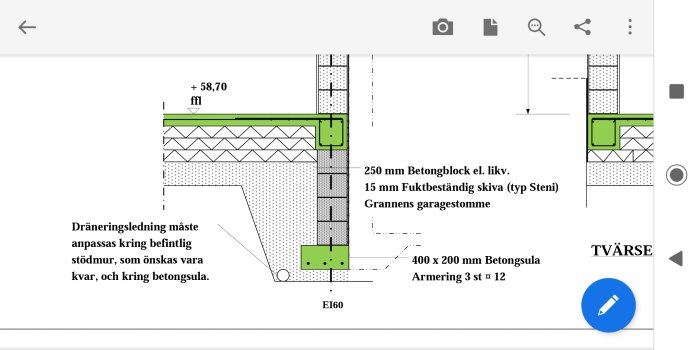
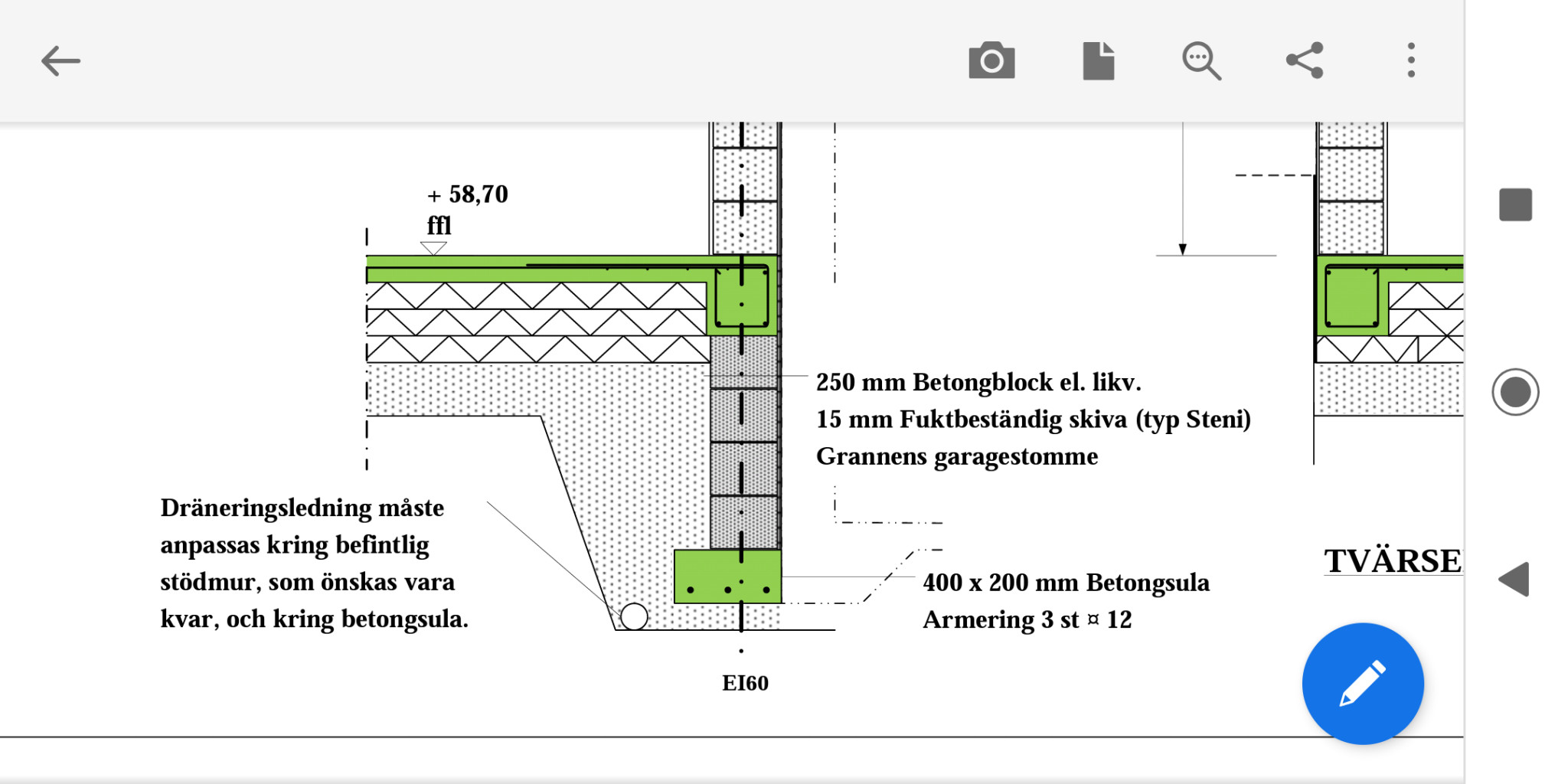
I have a construction drawing and need to pour a footing for a retaining wall. (The green part at the bottom of the image.) The wall is to compensate for the slope of the ground where I am building the garage. The slab's footing will rest on the retaining wall. The footing for the wall is 20 cm high and 40 cm deep (and 12 m long) and is reinforced with 3 parallel reinforcing bars.
However, when I went to pick up gravel for the concrete, there were several types to choose from! So I initially took drainage gravel and hope to get an answer here before Monday.
The local gravel pit in the village had:
8-11
11-16
8-22 (washed)
16-22
16-32
Does the gravel for concrete have to be washed for the cement to adhere, or will unwashed work? If so, can it be washed manually?
Since there is never washed etc., I have used rörgravsgrus (0-8) and macadam 8-16. It has always worked well for simple castings like the one you are going to do now.
The easiest is to take 0-18 or 0-32 and possibly mix in some 0-8 if the mix isn't "rich" enough
Yes, I was planning to mix it myself. It's just over a cubic meter, so too little for a concrete truck and too much (expensive and hard to transport) to buy ready-made concrete bags.
What I've managed to read is that you shouldn't really have in the 0-fragments but have macadam instead because the 0-fragments don't really contribute to strength, and a lot of cement is needed to glue these 0-fragments together. But I'm not really an expert...
I would take 8-22 or 11-16 of the ones you have there.
I'm going to go with both, anyway it'll be two trips with my unbraked trailer so I might as well take two different ones. Then it will be an equal amount of sand and ballast.
On all the places I read, it only mentions how many parts sand/cement and ballast you should have, never anything about the size of the ballast.
Most have 1 part cement and 3 parts aggregate, a little more cement for harder concrete.
Then there are all sorts of variations on the aggregate. Byggmax has 3 parts sand and 1 part ballast (unspecified size).
Cementa's website advocates half "gravel 0-8" and half "stone 8-16."
Tenico has a recipe of 1:3:9 for cement: sand: ballast, that is, more ballast than sand, opposite to byggmax.
Yes, I plan to mix it myself. It's just over a cubic meter, so too little for a concrete truck and too much (expensive and difficult to transport) to buy ready-made concrete bags.
From what I've managed to read, you shouldn't really include the 0-fragments but use macadam because the 0-fragments don't really contribute to the strength and much cement is needed to bind these 0-fragments together. But I'm no expert...
If you're mixing with cement, you'll need 0-fraction. For example, casting gravel, 0-4, 0-8 or whatever is available. Plus some aggregate, for example, 11-16.
If you're mixing with cement, you need 0-fraction. For example, Casting gravel, 0-4, 0-8, or whatever is available. Plus some ballast, like 11-16
Is natural sand considered 0-fraction? Many recipes are just sand and macadam.
If I understood correctly, is macadam crushed stone without 0-fraction? Should I perhaps have used what they call crushed stone here at the gravel pit, 0-something, like 0-22 for example?
Regardless of how you do it, the distribution of the fractions is wrong if you ask a cement guy, but it is "standard" to use rörgravsgrus 0-8 instead of gjutsand which is rarely available, and for this, you usually have 8-16 mak.
I have mixed some concrete myself mostly because I had stone dust 0-8 and crushed stone 8-16 left over at home. Used half a bag of cement and a bag each of the two aggregate fractions. It has worked excellently outdoors for plinths, edging stones, etc. just like @MathiasS says.
I think that rörgravsgrus has a better grading curve than stone dust (which has too much fine material), on the other hand, you can just compensate with more cement.
The biggest problem with regular gravel is that it can contain humus, maybe you avoid that with stone dust.
Yes. Maybe. The concrete guys are probably laughing at us, but I've probably mixed just under half a cubic meter of concrete at the cost of five bags of cement, each costing just over fifty kronor. He who laughs last, laughs best...
We mixed 15 cubic meters of concrete for our house foundation (in batches of course ) this was done with 0-8 gravel (gjutegrus) and 8-16 macadam (washed seems unnecessarily expensive). You need to mix different parts of materials to achieve the right strength for the concrete, so check that.
It has worked excellently outdoors for plinths, curbstones, etc. just like @MathiasS says.
This is for a footing that will support the entire garage and the soil underneath, so that's why I'm trying to find out as much as I can. For plinths and the like, I totally understand using whatever you have on hand!
Vi vill skicka notiser för ämnen du bevakar och händelser som berör dig.



MathiasS said:

Andreas Lundgren said:
Yes, I plan to mix it myself. It's just over a cubic meter, so too little for a concrete truck and too much (expensive and difficult to transport) to buy ready-made concrete bags.useless said:
Fulkemisten said: