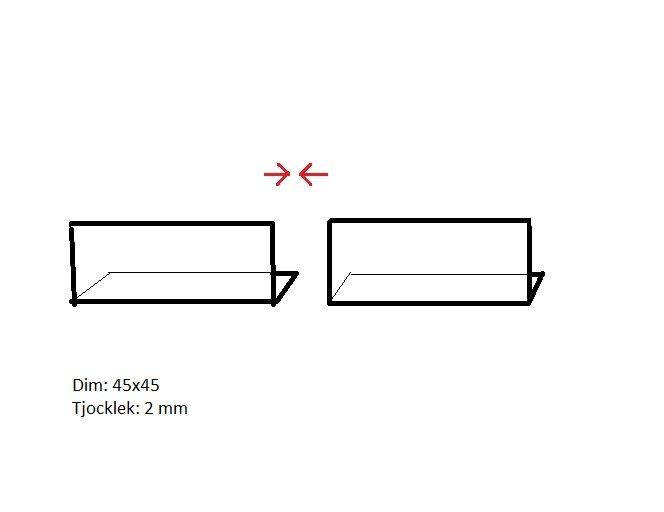
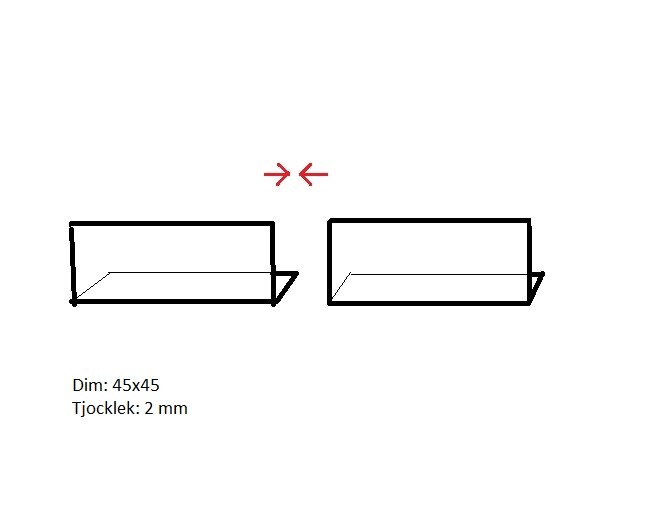
I've made a little freehand drawing, it looks clumsy - but the pieces are supposed to be identical........
It's quite thin material thickness, 2 mm or a bit more. Is this something that can be done with a stick welder? I have a fairly easy-to-weld 130 amps inverter. If this is possible, how do you make it as straight as possible?
Should the two cut angle iron pieces be placed edge-to-edge and then weld over the seam line? Or should the pieces be placed a few millimeters apart at the ends and let the weld filler fill this gap?
Someone said you could weld the angle irons when one is "inside" the other so you have more surface to attach the weld to, but it wouldn't look very nice.
How would you have reasoned in a similar situation? Before the admonitions start pouring in, I know that MIG and TIG are better for this kind of work - but I thought I'd give it a try with the current resources, unless everyone says it's impossible.
The angle iron joint is to become a couple of "specially shortened" legs for a pinball machine weighing about 130 kg. That is, if this can be done, there will be four of them.
I would probably have cut "Halvt i halvt" so that you get a slightly longer contact surface. So let one part keep the back and the other part the bottom. If the material is pure iron, you should manage with the rod if you have the right rods of course.
Proper joint preparation is crucial - it's essential in all stick welding. Use a 1.6 or 2.0mm electrode. Get a piece of aluminum angle iron or bend a piece of aluminum sheet, at least 2mm thick, to use as alignment and root support. Place the aluminum profile inside the steel profile and secure it properly with clamps. This way, the leg stays straight (or at least straighter). Additionally, the aluminum profile acts as root support to prevent holes if you're unsure about welding. Aluminum does not adhere to steel, so there's no risk of it sticking. If done correctly, the weld joint will be as strong as the surrounding material, so there's no need for lap joints or similar.
To avoid misalignment, start by tack welding on each edge and in the corner. Check alignment and reinforce the three tacks a little more. Check alignment again. Then you just weld.
Puncture them with a small gap of 1 mm or similar, weld the inside of the angle, grind out the backside until you meet the weld from the inside, weld the outside completely. That way, you avoid welding slag into the joint.
Talk about a detour!
A pinball machine needs sturdy legs. It shall be bumped, hit, and banged. Girls should be able to sit on the corners! A pinball machine must withstand rough handling. Rock n' roll, plain and simple!
Get real angle irons, fit them in, grind them down, and chrome them. Anything else is doomed to sooner or later result in catastrophe.
I suppose you can't weld. How do you think things like cranes and bridges are built? Well, they make joints on such beams that are subjected to some load and need to hold, and they do hold.
Talk about a detour!
For a pinball machine, you need sturdy legs. It should be bumped, hit, and banged. Girls should be able to sit on the corners! A pinball machine must withstand rough handling. Rock n' roll, simply!
Get real angle irons, fit them, grind them, and chrome them. Anything else is destined sooner or later to result in catastrophe.
Pinball machines usually also have stainless steel legs.
The angle iron joint will become a pair of "special cut" legs for a pinball machine weighing about 130 kg
It may not be an answer to your question, but I am curious why you are welding two pieces together to make a leg. When you write "special cut," I assume the legs are to be shorter than the original legs. I would probably shorten the stainless original legs and ensure that the adjustable foot comes along. If you don't want to cut the original legs, there are plenty of pinball enthusiasts who have scrapped machines for spare parts.
Stainless steel, then? In my naivety, I've thought they were chrome?
It's possible there are variants, but the games I've owned have had stainless steel legs. I think ... or, hmmm. I need to go check!
Edit: My Bally from 1973 has all shiny parts made of stainless steel. But of course, that's no guarantee that all games have it. I retract my statement since I don't actually know. Anyway, I would probably have shortened the original legs instead.