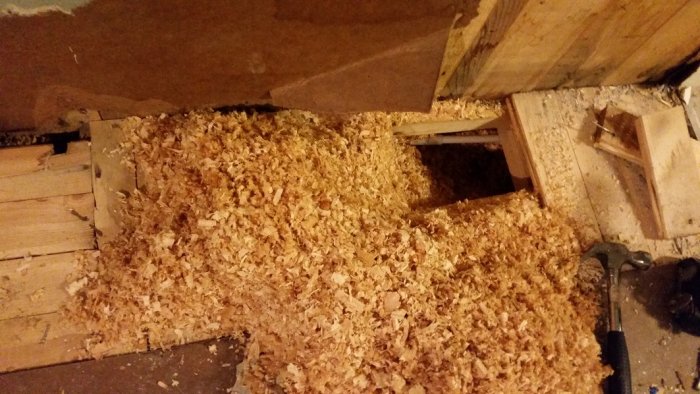
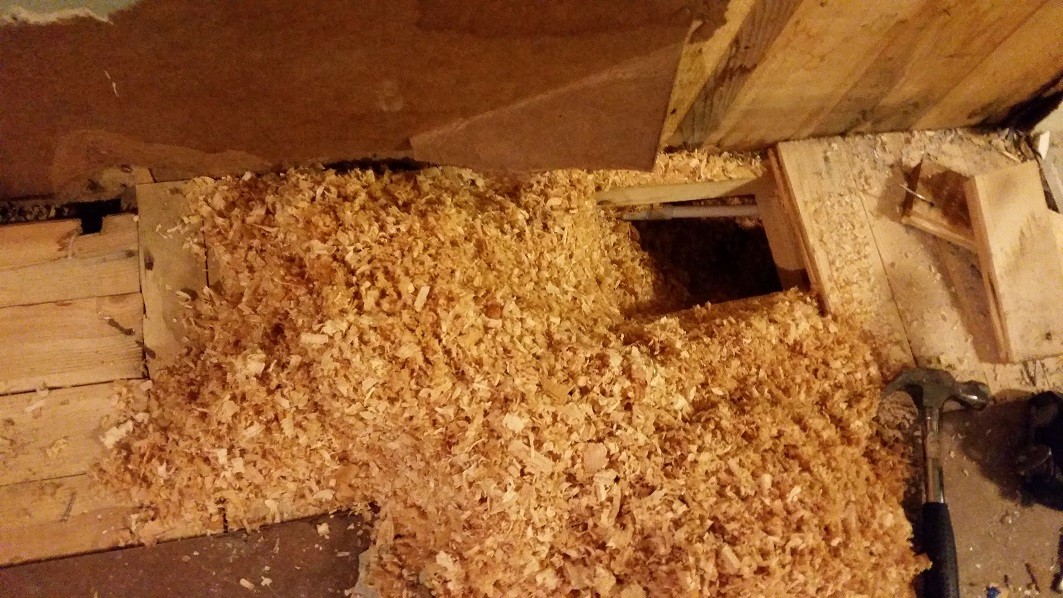
I'm renovating the kitchen and unfortunately, the water pipes have been dripping into the subfloor now (my fault ). The house is from 1965. There is sawdust in the subfloor. The question is how I can best fix this?
It's quite wet at the bottom, but there is no plastic, so it should be able to dry out?
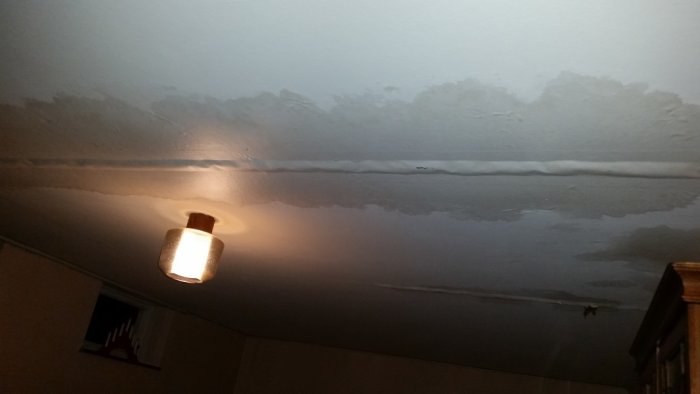
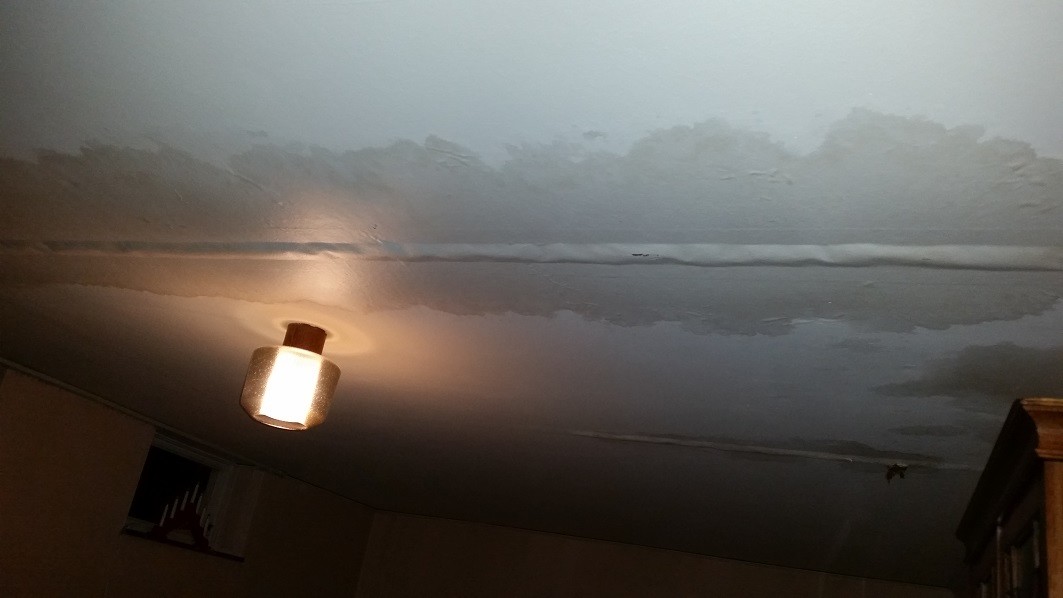
Should I tear down the entire ceiling in the room below? Should I vacuum out all the sawdust? Any tips and thoughts?
open up and out with all the spån and let dry. preferably dehumidifier
Should I open the joists from above or below?
How do you make it look best with the ceiling below, do I have to take it down or is it enough to paint when it has dried?
let it dry, you don't need to do anything other than wait................If you want it to be invisible later, you'll of course have to repaint and possibly replace the subroof if it's fiberboard and buckling and becoming crooked.
As long as the leakage is fixed and it's only wood we're dealing with, you don't need to open more than necessary. It will dry even if you build it in again. It would have been a huge difference if there was mineral wool there or if it was plastered or something. Then you would have to tear everything up.
Glad to hear it's drying! But out of curiosity; doesn't mineral wool and plaster dry?
The leak has been fixed. It was me being careless and leaving open pipes, hoping that the valve on the incoming water was tight. I knew I should have plugged it, but I took a chance because I didn't have any fittings for Ø16mm copper then
we open up everything and tear away anything that is damp.
partly, chipboard and material are damaged, and then there is a risk of mold.
and it is not us as the building company who decides but a moisture technician who says/orders the extent.
Nice to hear that it's drying! But out of curiosity; don't mineral wool and gypsum dry?
The leak has been fixed. It was me being careless and leaving open pipes and hoping the valve on the incoming water was tight. I knew I should have capped it but I took a chance, as I didn't have any fittings for Ø16mm copper then
we open up everything and tear away anything that is damp. part of it is because chipboard and materials get destroyed, and then there is a risk of mold. and it is not us construction companies that decide, but a moisture technician determines/orders the scope
Ok so you really don't know, you just do what your moisture technician says ... that surely creates a lot of work anyway.
Ok so you don't really know, you just do what your moisture technician says ... it certainly creates a lot of work anyway.
Yes, we know that everything that is damp must be removed.
The worst part for us is that we have to do it cheaply too because we have insurance companies that don't want to pay more than they need to. So it's a delicate balancing act.
It looks quite wet and I would probably want to replace as much of the sawdust as possible and also the surface layer in the ceiling underneath. However, it will dry out over time and probably won't pose any major risk, but since the ceiling needs to be redone now, you might as well play it safe.
why should you replace shavings that have gotten damp once? and mold? why would it mold? It's only modern constructions that mold and probably the moisture technician mentioned doesn't know more than modern drywall carpenters either...
It's different if there's a leak that goes on for a very long time with constant moisture exposure. Then you can assume things start to happen. But wood that gets wet once due to a leak dries and isn't affected anymore after that.
but if insurance companies are involved, it should go quickly, there shouldn't be any complaints and nothing, so then it becomes what it becomes.
why should you replace shavings that have been damp once? and mold? why would it mold? It's only modern constructions that mold and probably the moisture technician mentioned doesn't know more than modern drywall carpenters either........
It's different if it's a leak that continues over a very long period with constant moisture exposure. Then you might assume that things start to happen. But wood that gets wet once due to a leak dries and is not affected any further afterward.
When I read the first paragraph, I actually seriously doubt whether you are being ironic or not. Of course, non-modern constructions can also mold. What makes a construction modern or not? For mold growth, 4 things are required:
1. High RH (over 75% for most materials) - Check!
2. Suitable temperature (20*C is perfect) - Check!
3. Nutrients in the form of organic material (it can be assumed old shavings contain other dirt too) - Check!
4. Time - Uncertain
All conditions are therefore present for mold growth except possibly time. This largely depends on how you allow it to dry out. If you leave everything closed, there will be mold growth, guaranteed. You won't see it, perhaps not smell any odor, but it will be there. However, if you open it up and insert fans, you remove the time factor. If you remove the old shavings, you have essentially removed all the factors.
And yes, I know more on the subject than the average drywall carpenter. I can guarantee you that.
That thing about mold can be discussed forever..............some are rabita and some have common sense, and we all reason differently. Mold spores can be found in just about anything if you look long enough.
Vi vill skicka notiser för ämnen du bevakar och händelser som berör dig.

 ). The house is from 1965. There is sawdust in the subfloor. The question is how I can best fix this?