
10,434 views ·
17 replies
10k views
17 replies
Wall types 1942 "Swedish wooden houses"
Hello!
I bought a house last year. It's a 1.5-story from 1942. Most of it is already renovated, but I find the walls thin and plan to add extra insulation in the future.
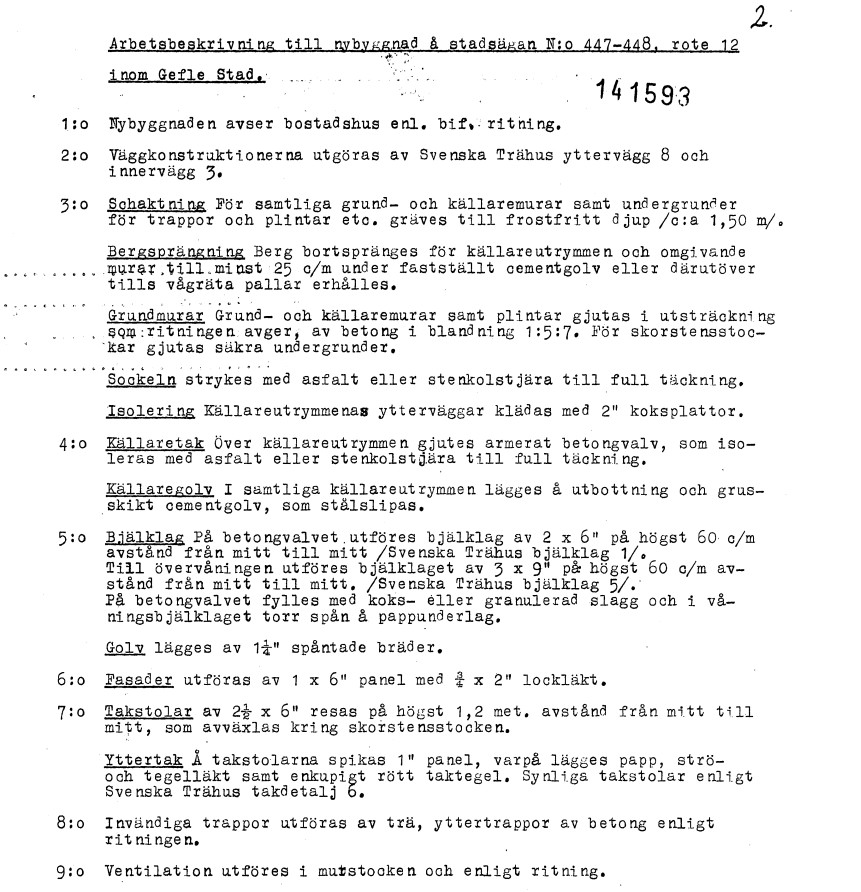
I have obtained old drawings of my house and am trying to decipher the wall construction. There is no detail over the walls, but there is a Work Description attached with the drawings. (attached image).
It states that "The wall constructions consist of Svenska Trähus outer wall 8 and inner wall 3."
I have googled and searched for these wall types but can't find anything.
Does anyone know what this means and can translate it for me?
Thanks in advance!
Best regards,
Filip
I bought a house last year. It's a 1.5-story from 1942. Most of it is already renovated, but I find the walls thin and plan to add extra insulation in the future.
I have obtained old drawings of my house and am trying to decipher the wall construction. There is no detail over the walls, but there is a Work Description attached with the drawings. (attached image).
It states that "The wall constructions consist of Svenska Trähus outer wall 8 and inner wall 3."
I have googled and searched for these wall types but can't find anything.
Does anyone know what this means and can translate it for me?
Thanks in advance!
Best regards,
Filip

Exciting! Your house should be one of the early houses that ten companies under the name Svenska Trähus started manufacturing in modules in the 1940s, in Hudiksvall. http://www.pressen.se/7522655.html
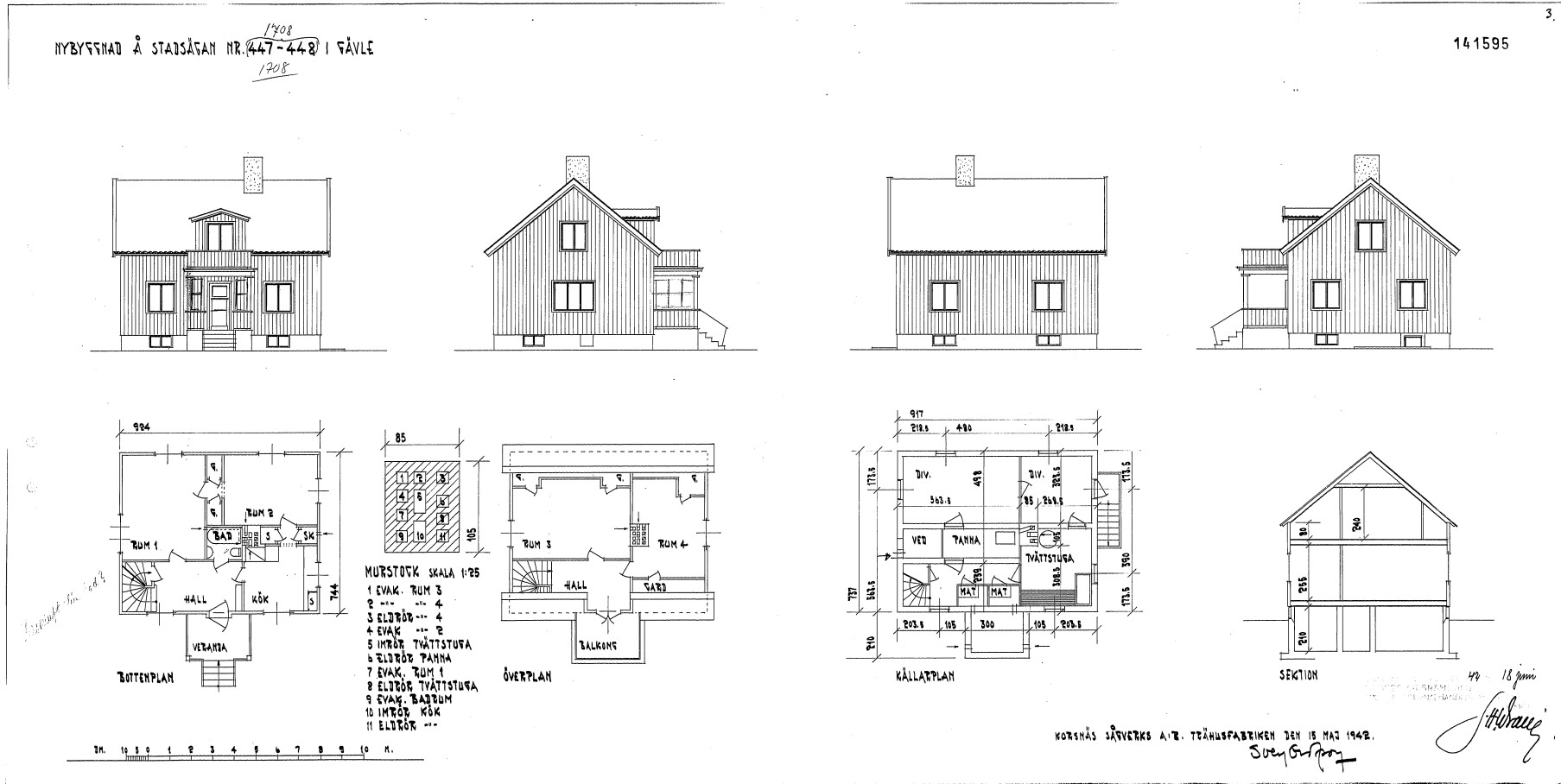
Interesting! The drawings appear to be created by Korsnäs Sågverks A.B Trähusfabriken. Which should reasonably be the one that built it and thus is part of these ten companies.
I can see Korsnäs bruk from my yard and have been informed by neighbors that the person who built the house worked at the workshop there. So it wouldn’t be surprising if the house came from there.
It's fun to understand a bit of the house’s history.
However, it seems that it may be difficult to obtain the wall types as there doesn’t appear to be a common standard for building at that time.
But all answers are gratefully received!
I can see Korsnäs bruk from my yard and have been informed by neighbors that the person who built the house worked at the workshop there. So it wouldn’t be surprising if the house came from there.
It's fun to understand a bit of the house’s history.
However, it seems that it may be difficult to obtain the wall types as there doesn’t appear to be a common standard for building at that time.
But all answers are gratefully received!
Best answer
This is how the walls of an AB Svenska Trähus house from 1946, which I lived in before, were constructed. From the inside view.
1/2" tretex.
Vapor barrier paper.
3" vertical tongue-and-groove planks.
1" horizontal tongue-and-groove timber.
Asphalt paper
1/2" air gap.
1" vertical exterior cladding.
+ narrow battens
It was a house that was modular.
It retained heat well, despite the thin walls.
Sound insulation was poorer.
1/2" tretex.
Vapor barrier paper.
3" vertical tongue-and-groove planks.
1" horizontal tongue-and-groove timber.
Asphalt paper
1/2" air gap.
1" vertical exterior cladding.
+ narrow battens
It was a house that was modular.
It retained heat well, despite the thin walls.
Sound insulation was poorer.
The exact same construction was in my old Svenska trähus from 1947.H HSP said:This is how the walls were constructed in an AB Svenska Trähus from 1946 that I used to live in. From the inside:
1/2" tretex.
Tar paper.
3" vertical tongue and groove planks.
1" horizontal tongue and groove wood.
Asphalt paper.
1/2" air gap.
1" vertical outer panel.
+ narrow battens
It was a house in modules.
It retained heat well despite the thin walls.
The sound insulation was worse.
The house I live in was built in 1946 by Swedish wooden houses, and I also received all the documents from when it was built. The walls are constructed as described:
12mm wood fiberboard, 2” tongue-and-groove plank, vapor barrier paper, 35mm high-porous insulation board, 1.1/2” x 3” horizontal studs, 12mm wood fiberboard, asphalt vapor barrier paper, 1” x 6” exterior panel, 3/4” x 2” batten strips.
12mm wood fiberboard, 2” tongue-and-groove plank, vapor barrier paper, 35mm high-porous insulation board, 1.1/2” x 3” horizontal studs, 12mm wood fiberboard, asphalt vapor barrier paper, 1” x 6” exterior panel, 3/4” x 2” batten strips.

90% of all wooden houses were built with a load-bearing structure of standing plank in the 40s. Toward the end, stud frames began to take over.
In the 20-30s, it was often standing tongue-and-groove 3" plank, while in the 40s it was usually tongue-and-groove 2" plank.
In the 20-30s, it was often standing tongue-and-groove 3" plank, while in the 40s it was usually tongue-and-groove 2" plank.
And often, if you have, for example, geothermal heating, it is not economically profitable to replace windows and add insulation to the facade; the cost takes so long to recoup with reduced heating costs that it's simply better to let the heat go up the chimney... Or rather, it pays off to insulate the attic as older houses often have an unfinished cold attic that is easy to insulate from above as it doesn’t require any changes to the surface layers.
Just as an example. If 25% of the heat leaks through windows and 25% through the facade (it is probably lower than this as much leaks through ventilation, foundation, roof, etc.) and you can make the windows and doors twice as good with insulation, then you have halved the cost for half of the heating. In other words, you have reduced your heating costs by 25%. Now let's imagine your heating costs 10,000 SEK (we're only talking about heating the house, not hot water and certainly not the entire electricity bill), you will lower this by 2,500 SEK/year. If a window replacement costs 100,000 and additional insulation costs 150,000, again just an example, it will take 100 years to pay off with this investment. On top of this comes the interest for the money.
Now, if you have direct-acting electricity, and thus a higher heating cost, normally you shouldn’t start with insulating and replacing windows. You should start by installing a heat pump. This saves you quite directly 60-70% of your heating cost, and you also save on hot water costs. This investment likely costs less than insulation and window replacement.
As a bonus, the house's "cultural value" with interiors, windows, and facades is preserved.
If the interior, windows, and facades are "worn out," then additional insulation might indeed be cheaper, but it should not be forgotten that windows and facades from the 1940s were of a completely different quality than today's windows, so it is probably still better to renovate these, as they will last longer than newly manufactured equivalents.
Just as an example. If 25% of the heat leaks through windows and 25% through the facade (it is probably lower than this as much leaks through ventilation, foundation, roof, etc.) and you can make the windows and doors twice as good with insulation, then you have halved the cost for half of the heating. In other words, you have reduced your heating costs by 25%. Now let's imagine your heating costs 10,000 SEK (we're only talking about heating the house, not hot water and certainly not the entire electricity bill), you will lower this by 2,500 SEK/year. If a window replacement costs 100,000 and additional insulation costs 150,000, again just an example, it will take 100 years to pay off with this investment. On top of this comes the interest for the money.
Now, if you have direct-acting electricity, and thus a higher heating cost, normally you shouldn’t start with insulating and replacing windows. You should start by installing a heat pump. This saves you quite directly 60-70% of your heating cost, and you also save on hot water costs. This investment likely costs less than insulation and window replacement.
As a bonus, the house's "cultural value" with interiors, windows, and facades is preserved.
If the interior, windows, and facades are "worn out," then additional insulation might indeed be cheaper, but it should not be forgotten that windows and facades from the 1940s were of a completely different quality than today's windows, so it is probably still better to renovate these, as they will last longer than newly manufactured equivalents.
Cool!C CM1234 said:The house I live in was built in 1946 by Swedish wooden houses and I also got all the papers from when it was built. The walls are constructed according to the description:
12mm wood fiberboard, 2” tongue and groove plank, building paper, 35mm high porous insulation board, 1.1/2” x 3” horizontal spars, 12mm wood fiberboard, asphalt building paper, 1” x 6” exterior panel, 3/4” x 2” batten
I'm not quite sure if this construction is on your house from 1946 or if it was according to my attached description?
Good, because it was a hell to remove the old ones, they were mounted according to the sliding method, the wall was built from one side, and the frame was slid in from the side and nailed in. A sliding track in the frame, no nails in the sides, so it was just a matter of sawing the frame into small pieces. Hence the questionF fangalid said:
Lucky to avoid dealing with that then, didn't sound too good!L Liteavvarje said:Good, because it was a H-E to remove the old ones, they were mounted using the sliding method,
the wall was built from one side, and the frame was slid from the side and nailed in.
A sliding track in the frame, no nails in the sides, so I just had to saw the frame into small pieces.
Hence the question
 I've also looked around a bit about the different wall types but haven't managed to find anything concrete.