
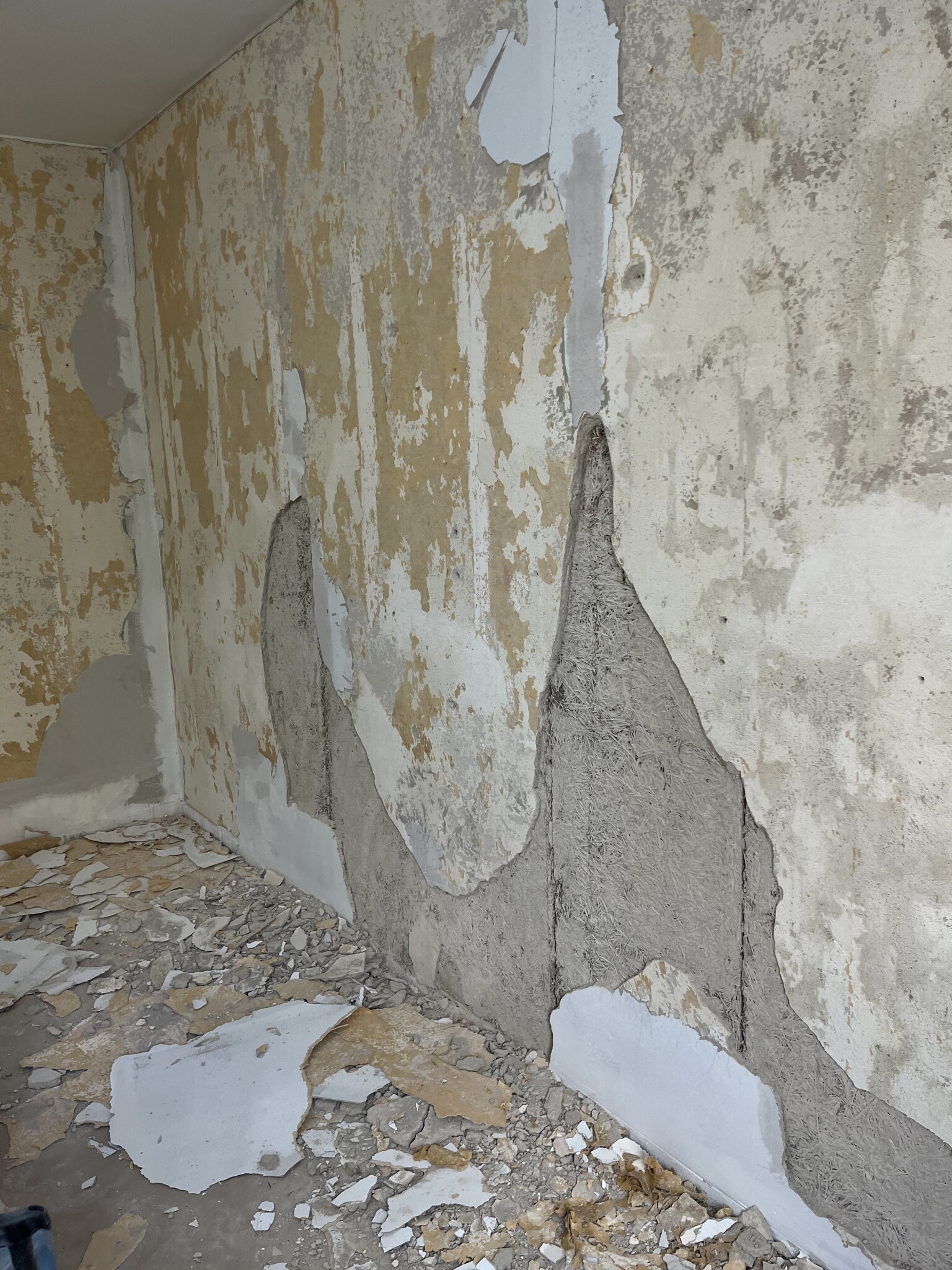

I know that many use plaster mortar for similar plastering. Whether it's optimal, I don't know. Preferably wait for responses from other more knowledgeable members.
Last edited:

There are probably two schools:
1. The plaster group.
2. The cement-based filler group.
Both work. By chance, I happened to land in category 2.
You can also plaster with render. It's cheap. But it shrinks over time, so it rarely works well for renovation repairs of this type when time is limited.
1. The plaster group.
2. The cement-based filler group.
Both work. By chance, I happened to land in category 2.
You can also plaster with render. It's cheap. But it shrinks over time, so it rarely works well for renovation repairs of this type when time is limited.
I had a similar situation, used husfix (casco). It works well and is easy to work with. Mine was a bit deeper, so I had to apply in rounds and let it dry in between. However, it sinks afterward, so you have to wait for all the layers, including the final fillings, to dry properly. I thought it had done so in my case, so I finished with painting cloth and painted it nicely. It looked as good and even as could be when I checked with raking light. But after several weeks, it had sunk a bit anyway, sigh. Had to put on a new layer of putty, sand it, add new painting cloth, and paint. Now it hasn't sunk anymore, and everything is double-reinforced with two layers of painting cloth, but I wasn't too happy having to redo and get it right.
If gypsum plaster is better, I don't know, but once many years ago, I repaired large holes in walls in another apartment with gypsum mixed in coarse putty, and I recall that worked fine as well.
If gypsum plaster is better, I don't know, but once many years ago, I repaired large holes in walls in another apartment with gypsum mixed in coarse putty, and I recall that worked fine as well.
Shrinks (more) during the drying time to be more precise, which is one reason why plaster must be applied in several (centimeter-thick) layers.Claes Sörmland said:
Other factors to consider:
1. Price. Husfix about 60 SEK/kg, gypsum plaster about 10 SEK/kg, lime mortar about 7 SEK/kg.
2. The comparative hardness of the materials, which affects the risk of crack formation where the materials meet - the more similar, the better.
3. Application. Gypsum and cement filler have a more paste-like, spackle-like consistency which can be perceived as easier to work with if you are not familiar with the properties of mortar. It can simultaneously be harder to achieve an even, smooth surface. The open time and adhesion also matter for the application.
5. Moisture properties. Not relevant here, but in exposed positions, one must consider how the materials react to moisture.
Click here to reply