
10,289 views ·
21 replies
10k views
21 replies
Wall material stable
We are in the process of planning a stable construction and we're stuck on the question of choosing material for the walls. My husband wants to build regular insulated wooden walls because he feels he has a handle on it (we've built quite a bit ourselves before), and it would also match the other buildings we have on the property. However, I'm considering whether it might be better to use Leca blocks that are plastered both inside and out. I imagine plastered Leca walls would be easy to maintain in a stable and we wouldn't risk any beaver-like horse gnawing the facade (we'll have a paddock around the stable).
We haven't built masonry walls before, and while I think "how hard can it be," my husband envisions it as a major job to get everything straight and right. My counter is that we could hire professionals to do it.
Of course, the end result is the most important thing, but at the same time, we want the construction to go quickly when we get the go-ahead (we are still waiting for a land regulation to be completed and will apply for a building permit as soon as we've decided what to build, so the process up to the actual construction feels endless). The cost is obviously also a factor. A wooden stable can be bought in the form of prefabricated wall panels, and that's an option we are considering, but how would a masonry stable hold up in terms of time and cost compared to that?
We also considered a stable in prefabricated concrete modules, but that was ruled out since we would need to widen the access road just to receive the delivery...
We haven't built masonry walls before, and while I think "how hard can it be," my husband envisions it as a major job to get everything straight and right. My counter is that we could hire professionals to do it.
Of course, the end result is the most important thing, but at the same time, we want the construction to go quickly when we get the go-ahead (we are still waiting for a land regulation to be completed and will apply for a building permit as soon as we've decided what to build, so the process up to the actual construction feels endless). The cost is obviously also a factor. A wooden stable can be bought in the form of prefabricated wall panels, and that's an option we are considering, but how would a masonry stable hold up in terms of time and cost compared to that?
We also considered a stable in prefabricated concrete modules, but that was ruled out since we would need to widen the access road just to receive the delivery...

There are many parameters to consider. Have you thought through the need for the degree of insulation (i.e., U-value)? Have you read the Swedish Board of Agriculture's recommendations? Personally, I think that walls made of lecasten should have certain advantages. Some animals and species can be very rough. Then there's the issue of hygiene and the ability to keep clean. If you're going to build with masonry, lecasten (if it's wide) is one of the simplest things to work with. Mortar boxes, levels, and mason's string make it easier. But it requires precision and patience, as does all building.
Thanks for the response!
The idea is some insulation to achieve a more pleasant climate inside the stable, but it will not be a heated building, so the level of insulation definitely doesn't need to match a wall in a residential house. Horses are definitely rough animals, and if you have a wooden structure, you'll need to ensure that all parts they can reach are protected in some way, for example, clad with something not so tempting to bite on.
It sounds promising that lecasten is reasonably easy to build with. I'm thinking that about 20 cm in width might be enough, are they considered wide? I'm married to a meticulous builder, a little too meticulous sometimes, I think, but that might be good in this case. Patience is perhaps what's lacking (from my side, that is).
The idea is some insulation to achieve a more pleasant climate inside the stable, but it will not be a heated building, so the level of insulation definitely doesn't need to match a wall in a residential house. Horses are definitely rough animals, and if you have a wooden structure, you'll need to ensure that all parts they can reach are protected in some way, for example, clad with something not so tempting to bite on.
It sounds promising that lecasten is reasonably easy to build with. I'm thinking that about 20 cm in width might be enough, are they considered wide? I'm married to a meticulous builder, a little too meticulous sometimes, I think
, but that might be good in this case. Patience is perhaps what's lacking (from my side, that is).

Wood-framed walls and fiber cement panels on the inside might be an option? Very robust material that withstands moisture.
Type:
https://www.byggmax.se/trossbottenskiva-fibercement-p07043
Type:
https://www.byggmax.se/trossbottenskiva-fibercement-p07043
Yes, I consider 20 cm wide. Just because most animals generate their own heat, many believe that animal barns don't need to be insulated. 20 cm leca stone corresponds to about 7 cm mineral wool, so it might be just right. The stone should be plastered on both sides to become tight and not harbor various unwanted creatures.
Hi
I built a stable myself a few years ago. I constructed the walls with NC-blocks from https://nystromscement.se (sorry if it's too much advertising). You dry-stack the blocks and fill mortar into the channels gradually. I was able to do about 4-5 courses/day myself. The stable was 7x7 m. I hired a neighbor with a tractor to lift beams over the doors and windows.
I applied a red primer on both the outside and inside, added an 80 mm west coast board on the outside and wooden paneling (which suited the style of the farm best). I plastered the inside. Plastering is a messy and tough job. So it's more work than a simple wooden wall. But insulating from the start is crucial. According to one of the modular stable sellers I talked to, the most common question a year after delivery of non-insulated stables was: "How do I insulate afterward?"
I built a stable myself a few years ago. I constructed the walls with NC-blocks from https://nystromscement.se (sorry if it's too much advertising). You dry-stack the blocks and fill mortar into the channels gradually. I was able to do about 4-5 courses/day myself. The stable was 7x7 m. I hired a neighbor with a tractor to lift beams over the doors and windows.
I applied a red primer on both the outside and inside, added an 80 mm west coast board on the outside and wooden paneling (which suited the style of the farm best). I plastered the inside. Plastering is a messy and tough job. So it's more work than a simple wooden wall. But insulating from the start is crucial. According to one of the modular stable sellers I talked to, the most common question a year after delivery of non-insulated stables was: "How do I insulate afterward?"
Thanks for the reply! I'll check out that type of block too. I've heard that it can be a bit tricky with all the mortar you have to mix and get down into the channels, especially since it becomes large amounts. But it should be really stable with that type of wall. Yes, it's plastering that I dread the most if it comes to building...U Urban J A said:Hello
I built a stable myself a few years ago. I built the walls with NC blocks from [link] (sorry if it's too much advertising). You stack the blocks dry and fill mortar in the channels gradually. I could do about 4-5 layers/day myself. The stable was 7x7 m. I hired a neighbor with a tractor to put up beams over the doors and windows.
I applied red primer on the outside and inside, added an 80 mm west coast board on the outside and wood paneling. (fit best with the style of the farm). I plastered the inside. Plastering is a messy dirty job. So there's more work than a pure wood wall. But insulate from the start. According to one of the modular stall sellers I talked to, the most common question 1 year after delivery of uninsulated stalls was: "How do I insulate afterward?"
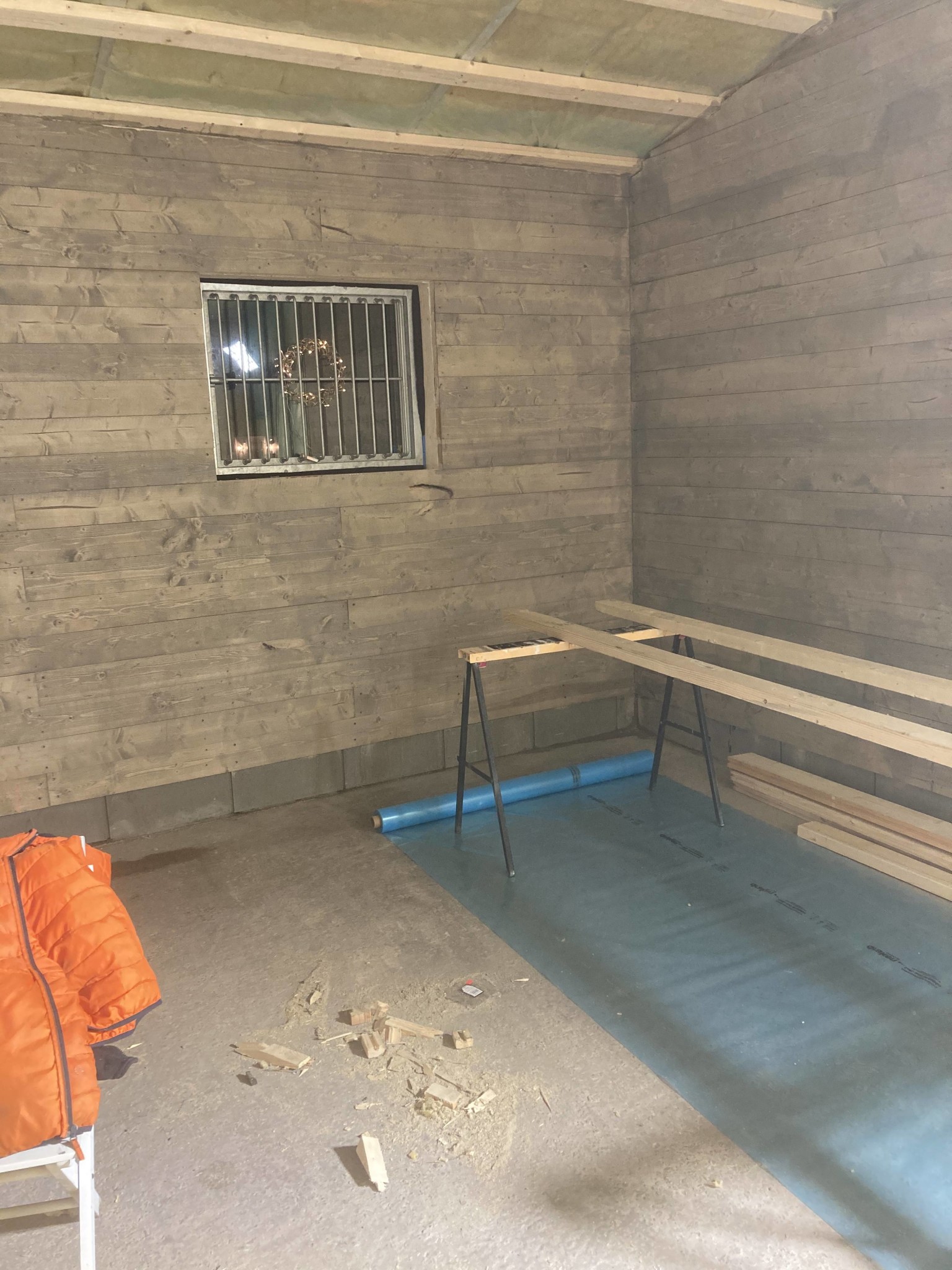
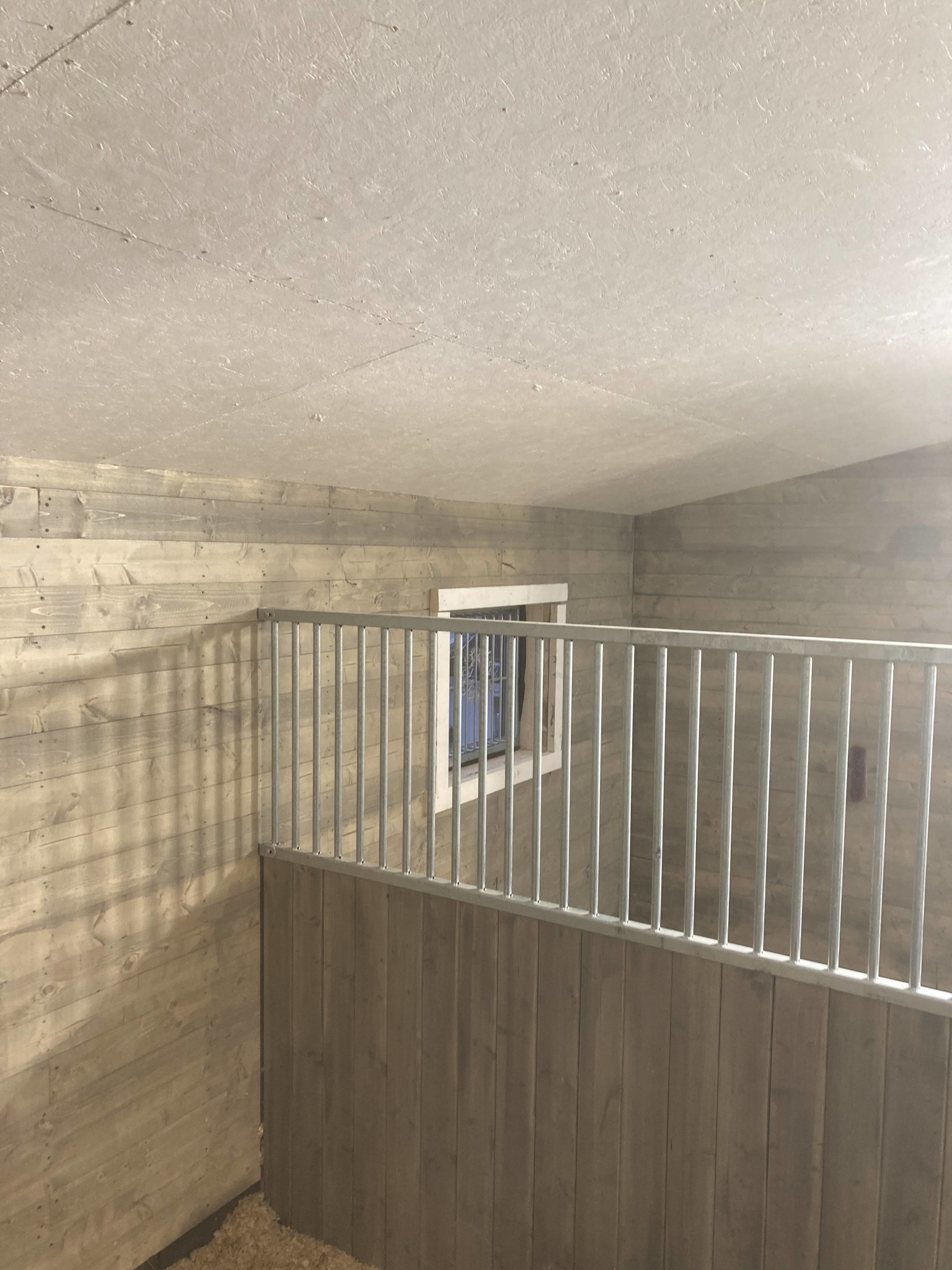
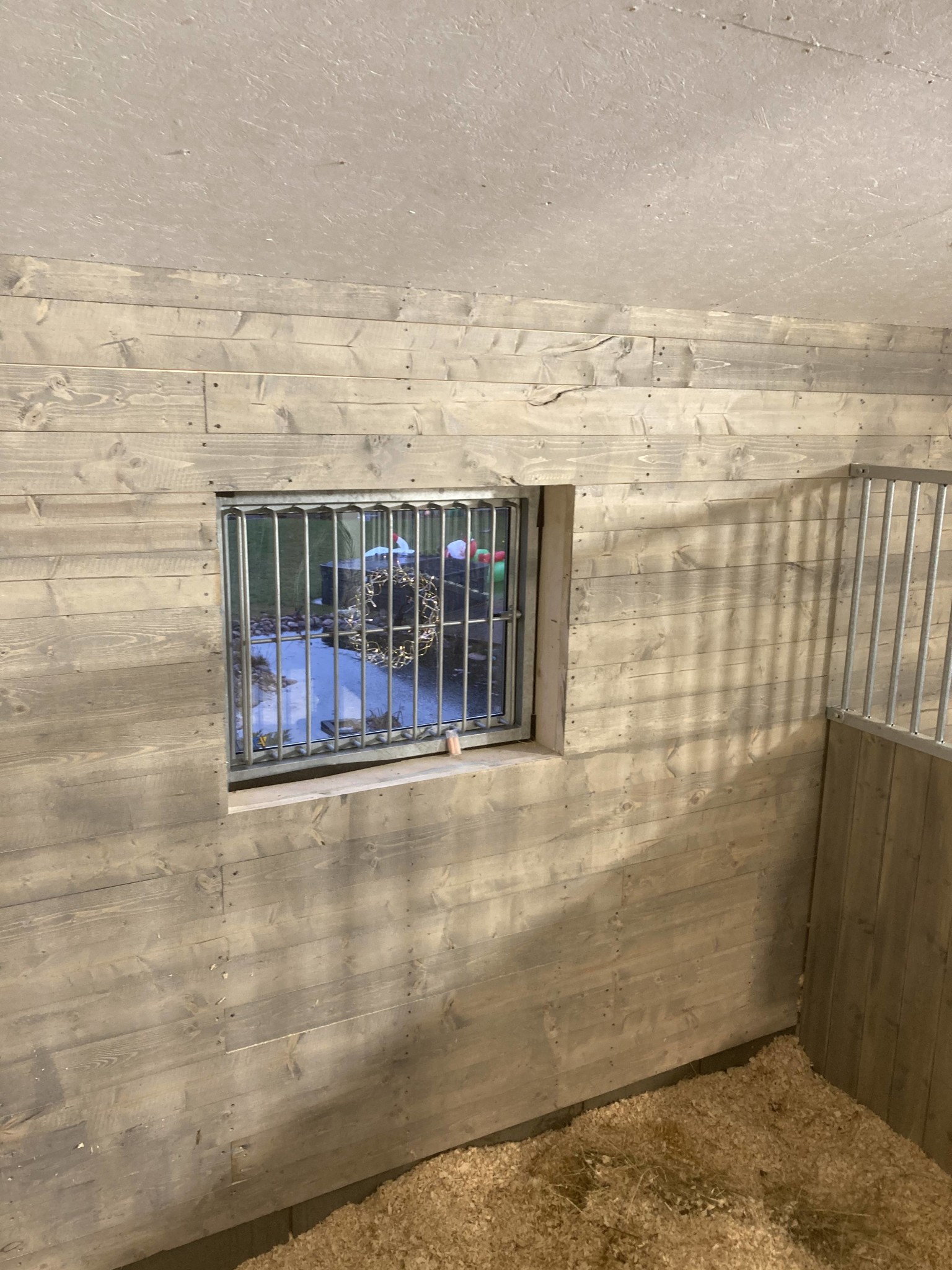
Horses tend to chew on most things, so I wouldn't have anything that could cause trouble for the critters.
A wooden stud wall with form plywood pulled down over the raised sole on the inside is the right type of wall to use. When the plywood is worn out, you simply replace it. The stalls are best constructed with horizontal studs.
If there are no grids between the stalls, it's a good idea to cover the top stud with sheet metal to prevent chewing.
A wooden stud wall with form plywood pulled down over the raised sole on the inside is the right type of wall to use. When the plywood is worn out, you simply replace it. The stalls are best constructed with horizontal studs.
If there are no grids between the stalls, it's a good idea to cover the top stud with sheet metal to prevent chewing.
The problem in our case will probably mainly be the facade since we are planning to have free-range (the horses will be able to go in and out as they please) and therefore the horses will also be directly outside the stable. Other areas should be solvable I think. I know some choose a metal facade for this reason, but that doesn't feel like an option for aesthetic reasons.L Lutte said:Horses will gnaw on most things, so I wouldn't have anything that could cause trouble for the critters. A wooden frame wall with formply lowered over the elevated sole on the inside is the right way to go. When the plywood is worn out, you just replace it. The stalls are suitably made of horizontal beams.
If you don't have bars between the stalls, it might be a good idea to cover the top beam with metal to stop the gnawing.
Lecablock is recommended, especially in a year like this one with a rat invasion in the mineral wool walls we have, despite cleanliness and lots of traps. The difficult part is not the masonry but the plastering.