
28,952 views ·
41 replies
29k views
41 replies
Vinyl flooring asbestos
Hello,
In my house, there are many different vinyl flooring installed during the 70s and 80s. According to what one reads, there is a risk of asbestos until the late 70s in such flooring. All the vinyl flooring has a type of paper backing in various colors. The one with green paper has been tested and is asbestos-free. Does anyone know what type of paper was used after the asbestos ban and how/if one can distinguish them?
In my house, there are many different vinyl flooring installed during the 70s and 80s. According to what one reads, there is a risk of asbestos until the late 70s in such flooring. All the vinyl flooring has a type of paper backing in various colors. The one with green paper has been tested and is asbestos-free. Does anyone know what type of paper was used after the asbestos ban and how/if one can distinguish them?

The asbestos-containing material I have experience with (laid in 1974 in a concrete apartment) was light gray. A slightly newer (presumably) asbestos-free one was gray-yellow and likely had fiberglass instead.
Attaching a link with a very good picture of what the asbestos layer usually looks like. https://natasyajungblog.blogspot.com/2014/01/armstrong-asbestos-sheet-flooring.html
The asbestos-free later variants were somewhat different. Novilon, for example, which was a popular brand, used a layer that most closely resembled stiff, rather hard foam plastic.
The asbestos-free later variants were somewhat different. Novilon, for example, which was a popular brand, used a layer that most closely resembled stiff, rather hard foam plastic.
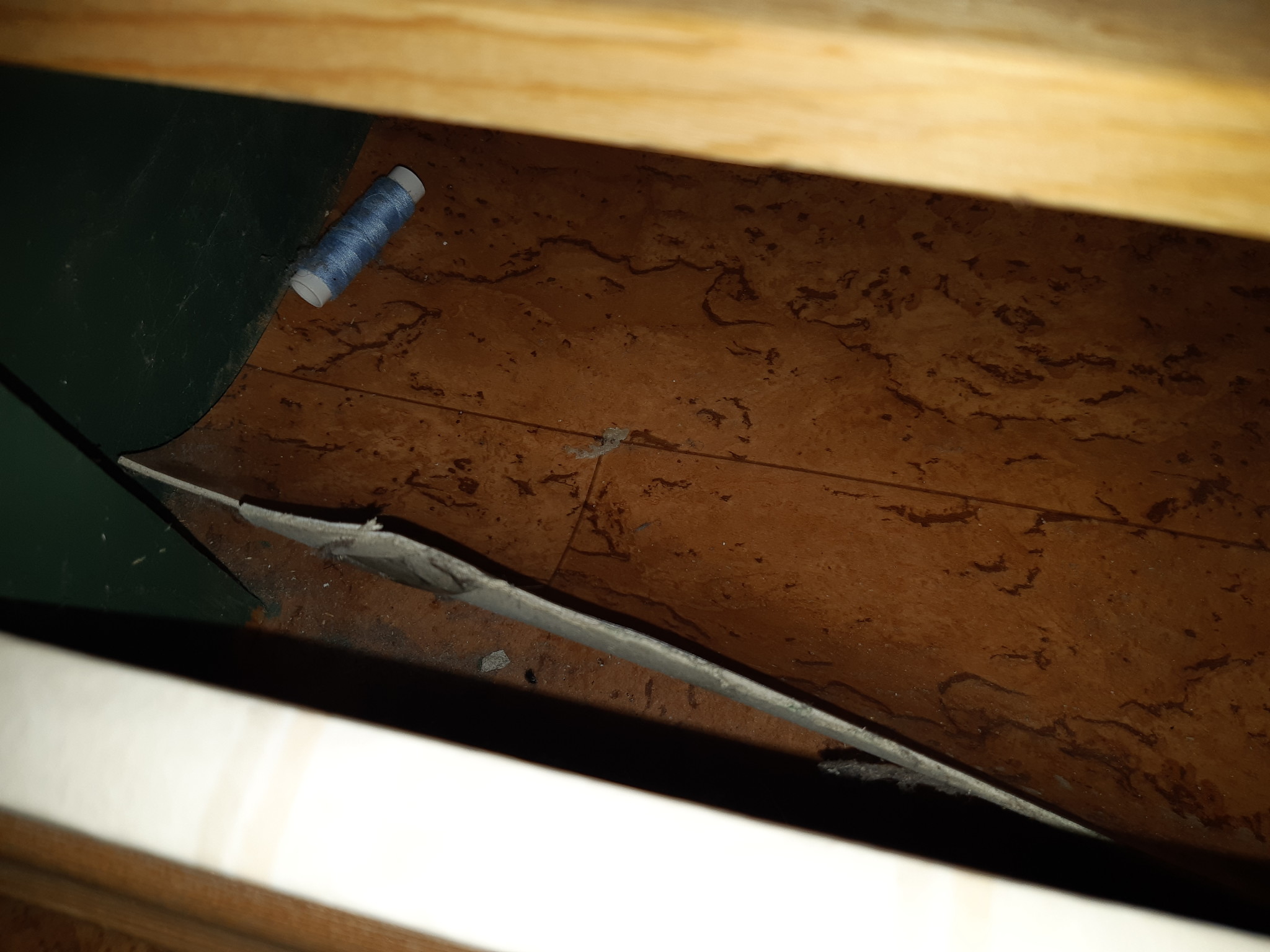
Well, it is possible/probable that there is asbestos paper under my plastic mat in the basement lounge. The only question remaining is what do I do with it? In the lounge itself, the mat is intact and looks so fresh that you wouldn't believe it is 45 years old. However, in the closets in the hallway... There, the mat is coming off the floor. Considering that I have unknowingly stored bedding there for the past 7 years... Additionally, given that I live where I do (Västerbotten inland), it doesn't get any easier. When I talked to OCAB last week about my pipes in the basement, they didn't seem particularly eager to come here...
Yes, my floor looks like the one in the picture, unfortunately. What almost upsets me is that the Asbestos guy from OCAB didn't seem particularly interested in my problem. I mentioned the floor, but he claimed that cork-patterned mats usually don't have asbestos layers, an old floor layer I talked to this week, however, wasn't so sure...hscn said:

Well, the OCAB guy also thought that you could cut the pipes on the straight part and then carry out the pipe hooks whole. My partner and I are considering doing this. However, it feels a bit uncertain to tackle the carpet. The cardboard on the back must be sanded off and then I immediately become doubtful if we can do this in a neat and fairly safe manner. I'm less worried for my own sake, I can probably protect myself somewhat, but I don't want the mess all over the house. Does anyone have experience with asbestos carpets?
What is under the carpet? If it's wood, maybe the easiest is to saw it up and replace the wood as well. If it's concrete, there are special tools to scrape it off (a bark spade or a larger variant on wheels). I would never attempt sanding.
Do the carpets have to be removed at all? Another option could be to encapsulate by laying new material on top. (In that case, it's good to document for future owners what is underneath.)
Do the carpets have to be removed at all? Another option could be to encapsulate by laying new material on top. (In that case, it's good to document for future owners what is underneath.)
Yes, in the basement room we can probably encapsulate it and lay a carpet on top, that carpet is on a kind of foam structure that is on a concrete floor. I'm not particularly keen on tearing everything out. The basement is dry and without mold, because it is furnished, it is indeed heated. What I'm most puzzled about is how do I get 4 remnants of that carpet that is glued to the concrete floor in a built-in wardrobe.
That carpet we have in the kitchen under the current floor.
It definitely doesn't have any asbestos in it, it's a plastic carpet.
Do you perhaps mean that it is glued with glue that contains asbestos?
That glue is black and would be very difficult to tear off.
It definitely doesn't have any asbestos in it, it's a plastic carpet.
Do you perhaps mean that it is glued with glue that contains asbestos?
That glue is black and would be very difficult to tear off.
That sounds good!
No, I don't mean the glue. My carpet has a lower layer of gray papp. It definitely belongs to the carpet, so no lumppapp lying under a plastic carpet....
It will be tested anyway before I proceed with it. As Henrik S says, different manufacturers might have had similar patterns. Still, it's fun to hear that you recognize it as asbestos-free!
No, I don't mean the glue. My carpet has a lower layer of gray papp. It definitely belongs to the carpet, so no lumppapp lying under a plastic carpet....
It will be tested anyway before I proceed with it. As Henrik S says, different manufacturers might have had similar patterns. Still, it's fun to hear that you recognize it as asbestos-free!
The pattern on the top doesn't say much unfortunately, as the exact same one was likely used both before and after the ban on asbestos in building materials (which is reasonable when considering the manufacturing process).
The word "plast" in plastic mat refers only to the top side, the underlayer has consisted of all sorts of materials, of which asbestos paper was unfortunately common for a long period.
The word "plast" in plastic mat refers only to the top side, the underlayer has consisted of all sorts of materials, of which asbestos paper was unfortunately common for a long period.
That's probably true... I just hoped that this carpet was also asbestos-free because the carpets in the adjacent rooms, which, judging by the style, were renovated around the same time, were. But during the decade change of the 70s/80s, a year can be crucial..
But you suggested encapsulation, do you have any tips for that?
But you suggested encapsulation, do you have any tips for that?