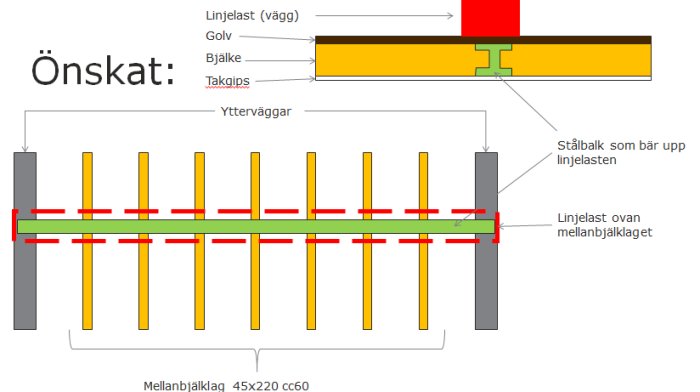
I have a floor structure that has been loaded with a load-bearing wall, which has led to a deflection that seems to have stabilized but is still undesirable. Now I'm considering if it would be possible to relieve the floor structure of the wall's load by installing a steel beam directly under the wall, which would be perpendicular to the floor structure. Is it feasible without having the beam exposed? I'm thinking of bypassing on both sides of the wall, cutting the floor structure from below, and installing a steel beam that the floor structure can rest on while the steel beam is supported by the exterior walls. Is this possible?
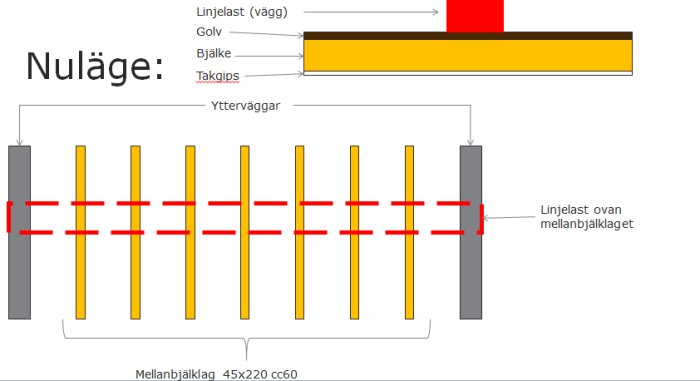
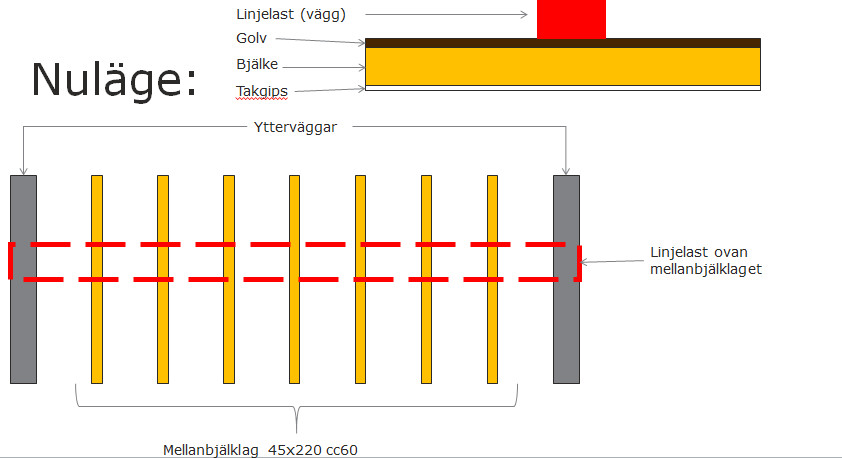
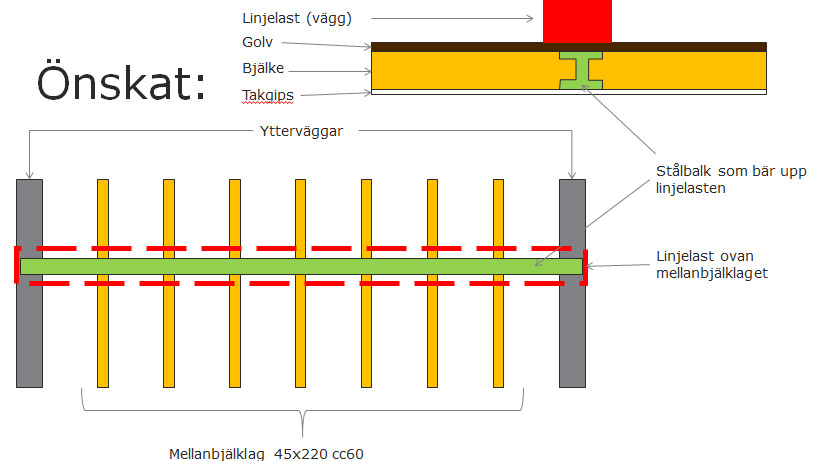
@KnockOnWood Thanks but those weren't applicable items @bossespecial Attached are two sketches, performed in the multifunctional tool Powerpoint. Unfortunately I don't have access to better tools during the long weekends. I hope they are decipherable. I should also add that each image consists of two views: 1) Joists seen from above (lower/left view) and 2) joists seen from the side (upper/right view)
Regardless of loads and dimensions, I don't think this is a good solution. I find it difficult to see how an HEA beam could be introduced in this situation. It would be a better idea to address the need for load distribution above the joist.
@bossespecial Yes, it holds up the roof. It's an old outer gable on a yodeler's balcony to which a new extension has probably been added, but someone likely didn't have their calculator with them when the joists were sized. There is an opening in the wall, but that opening has no joist underneath because a staircase comes up there.
@justusandersson What options are there to handle the reinforcement need above the joists? The wall and floor (including waterborne underfloor heating) have been in place for a long time, so it would be least bad if it could be solved from below. I've played with the idea of notching out the top flange of a HEA so that the beam could be pushed up from underneath if you stamp up on both sides where the beam will lie and cut a groove in the joists. However, that would mean the beam would effectively become an upside-down T-beam, so the question is how the strength would be then.
@KnockOnWood I see it now in the last link. Just skimmed for pictures in the different threads But I assume you could expose the joists then and in that way maneuver the beam in? Here, it's a joist that's attached to the floor chipboard, likely screw-glued.
I see it now in the last link. Just skimmed through the different threads for pictures But I guess you were able to cut out the joists then and get the beam in that way?
We did this when the house was built seven years ago. Probably a bit easier than going into an existing structure.
If you want, I can send a more detailed description in a PM.
If you are going to place a beam, it should be possible to just cut off the bit needed, bring up the beam and screw-glue new fitting pieces in place. Whether or not this is a good idea is another matter.
But what if you add more beams longitudinally at cc30?
We did this when the house was built seven years ago. Probably a bit easier than going into an existing structure.
If you want, I can send a more detailed description in a PM.
Feel free to send it so I can see if there's anything applicable.
Another option might be a glulam beam? However, the height is limited to 220, so it would have to be a rather wide beam to do the job. Thoughts on that?
Independent of loads and dimensions, I don't think this is a good solution. I find it hard to see how one could insert a HEA beam in this situation. It might be a better idea to solve the bridging need above the floor.
I also think it looks really difficult.
Isn't it possible to bridge the wall itself instead above a doorway or something with a glulam beam or something?
This might not be optimal but... take down the ceiling gypsum and place plates on the existing beams.



 But I assume you could expose the joists then and in that way maneuver the beam in? Here, it's a joist that's attached to the floor chipboard, likely screw-glued.
Karl_Pedal said: