
162,096 views ·
317 replies
162k views
317 replies
Warning for Biltema's decking screw

Always use stainless screws for decking. Learned from good advice on the forum here. Decking moves, and hardened screws break.
Inland class A2, coastal class A4.
Piece of cake.
And of course, the right dimension depending on the decking you are screwing.
Inland class A2, coastal class A4.
Piece of cake.
And of course, the right dimension depending on the decking you are screwing.
Not entirely sure it depends on the screws. A common reason is that the decking boards are laid directly against each other. Over time, the decking boards usually swell and cause abnormally large tensions in the screws, which can then snap. The type of screw you used is relatively brittle compared to stainless steel screws, which are somewhat more ductile. According to Svenskt Trä's recommendations, decking should be laid with the required edge-to-edge distance to avoid your exact problem. For example, a 120 mm wide decking of impregnated pine should be laid with a 26 mm edge-to-edge distance. This allows the decking boards to swell when absorbing moisture in connection with precipitation. As it appears in the picture, the decking boards are mounted directly against each other, or at least with too small a gap. Deformations (shape changes) in the boards can be a contributing cause in combination with brittle screws of low quality.J Johan byggare said:I just want to share a warning about Biltema's decking screws, see pictures below. I laid 20 sqm of decking in spring 2018, the first 15 with screws of an unknown brand and about 5 sqm with Biltema screws.
There is no problem with the unknown brand but now I notice that about 90% of Biltema screws have simply snapped off.
You have to search hard for worse crap and I hope many of you haven't bought and used the same junk!
[image] [image]
Then small children can get their hands and feet stuck between the boards! Should it really swell > 21% in width?Holger Gross said:
I have previously laid decking with a knife blade spacing of about 3 mm in between. Later, when the decking dried, the gaps became 6-7 mm. It looks terrible.It's not entirely certain that it's due to the screw. A common reason is that the decking boards are laid flush against each other. Over time, the boards typically swell and cause abnormally high stress on the screws, which can break as a result. The type of screw you've used is relatively brittle compared to stainless steel screws, which are somewhat tougher. According to Svenskt Trä's recommendations, decking should be laid with the required edge-to-edge spacing to avoid exactly this problem. For example, a 120 mm wide decking made of impregnated pine should be laid with a 26 mm edge-to-edge spacing. This allows the decking boards to swell when absorbing moisture during rainfall. As it appears in the picture, the boards are mounted flush against each other, or at least with too small a gap. Deformations (shape changes) in the boards can be a contributing factor combined with brittle screws of low quality.
This year I screwed new decking down without any gaps with normally wet wood. Now I have 3*4 mm gaps when it has dried. When it rains, I have about 2 mm gaps. Perfect.
Svenska Trä's recommendations are to lay 120 mm decking with 6 mm gaps, which looks incredibly ugly just when the decking is new, and then it results in enormous gaps when it dries.
I measured the width of all my boards to sort them to get neat joints, and I had widths of 119-122 mm on these.
Most were 120-121 mm.
Of course, the decking boards swell with rain, but not as much as they were initially when they were wet inside.
126 mm as Svenska Trä recommends, I don't understand how they get to that. Please explain what gaps can be expected according to their recommendation. Assume the decking you're laying is 120 mm new wet wood as it is when you pick it up from the builder's merchant.
This is so simpleJ janusz_w said:
Follow their instructions and you will get huge gaps when the decking has dried
In other words, screw the first board and then measure 126 mm (if it is a 120 mm type) according to the picture below. That's where you place the next row.
Note also that it says minimum edge-to-edge distance, and it can therefore be more.
If the decking is 120 mm and hasn't dried, you'll probably get gaps around 10 mm.
I wonder if anyone does it like that?
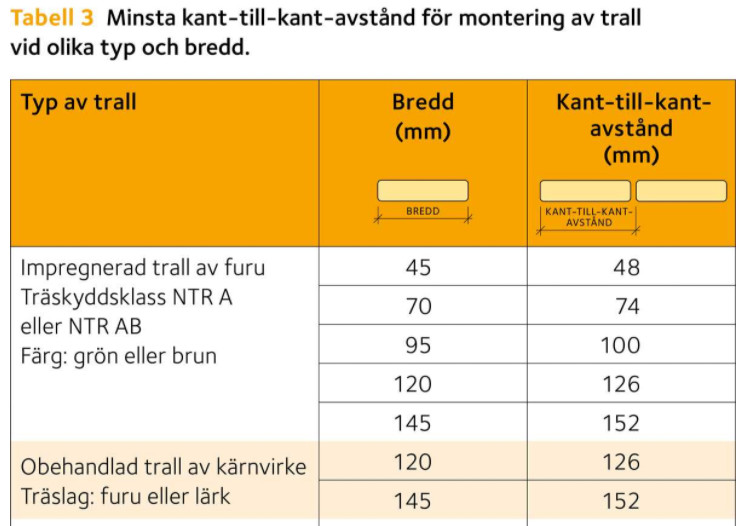
https://www.byggbeskrivningar.se/trall
It depends on how the wood has been stored. Nowadays, wood is usually stored under a roof at building supply stores. What you buy today is quite dry. It also depends on how the wood is stored at the construction site and for how long. In the past, treated wood could be delivered with an abnormally high moisture content, and then you had to account for some shrinkage. Therefore, it was recommended to store the wood on-site, protected under a roof, until it was dry enough to be used. That's not the case nowadays.M Myckling said:

Yes, how should one know if it's soaking wet or half-dry, I assume it shrinks differently then.
I laid decking at home and placed it edge to edge after a friend said that's how you should do it, despite my objections that it probably wasn't that wet.
The result is a still completely tight deck; after a week of sunny weather, I have tendencies of gaps, maybe 2-3mm, which close up as soon as a little rain comes
I had thought about laying it with a knife between, which probably would have been good.
I laid decking at home and placed it edge to edge after a friend said that's how you should do it, despite my objections that it probably wasn't that wet.
The result is a still completely tight deck; after a week of sunny weather, I have tendencies of gaps, maybe 2-3mm, which close up as soon as a little rain comes
I had thought about laying it with a knife between, which probably would have been good.
If you wait until the decking dries, you'll have some warped wood to deal with. Some even bend lengthwise. It's a hassle to screw down such decking.
The instructions state that you should not drive the screw head below the surface because then the decking can be compromised. It has never happened to me, but that's probably because I use the right kind of decking screws, stainless steel.
The instructions state that you should not drive the screw head below the surface because then the decking can be compromised. It has never happened to me, but that's probably because I use the right kind of decking screws, stainless steel.
I don't understand where you get > 21% from? If decking with a width of 120 mm is installed with an edge-to-edge distance of 126 mm, swelling of 5% of the original width is allowed. This is a reasonable measurement. Of course, shrinkage occurs under favorable conditions in the summertime when the surrounding relative humidity is low. This initial gap may be needed to accommodate the swelling/shrinking from seasonal variations in surrounding relative humidity as well as direct moisture impact from temporary rainfall or ground moisture and sudden solar radiation. In summertime, the gaps are largest but rarely so large that small children can get their hands and feet stuck between the boards. Experience shows that screws can break, among other things, because decking is installed tightly against each other. Ask the serious screw manufacturers. Breakage in screws can sometimes be a combination of causes, where even ring orientation, ring density, and inadequate surface treatment can be contributing factors.C civilingenjören said:
One reason hardened decking screws break is due to hydrogen embrittlement.I don't understand where you get > 21% from? If decking with a 120 mm width is installed with an edge-to-edge distance of 126 mm, swelling of 5% of the original width is allowed. That's a reasonable measure. Obviously, shrinkage occurs under favorable conditions in the summer when the surrounding relative humidity is low. This initial gap may be needed to handle the swelling/shrinkage due to seasonal variations in the surrounding relative humidity and also direct moisture impact through temporary precipitation or ground moisture and sudden sunlight. In summer, the gaps are largest but rarely so large that small children can get their hands and feet caught between boards. Experience shows that screws can break, among other things, because decking has been mounted edge to edge. Ask the serious screw manufacturers. Breakage in screws can sometimes be a combination of causes, where annual ring orientation, annual ring density, and inadequate surface treatment can also be contributing factors.
Which has happened with batches from Essve.
You seem knowledgeable about this subject, so you should be aware of this problem and how it occurs.
Not just that the wood swells.
Have you screwed any decking yourself?