
21,670 views ·
104 replies
22k views
104 replies
Why is there such a big difference at the same lumberyard?
Imagine the interesting development this thread took 😅
I’m sitting here chuckling too as the original poster is completely open about their knowledge gaps (to me, this usually indicates strong self-esteem and probably being very good at something else - academically/high-paid or not) and is asking entirely relevant questions. The fact that the original poster mentioned being academically educated suggests to me that they want to learn from facts, not random guessing (maybe this is the wrong place then...), after which the random guesses and opinions on academics start pouring in. Two references have been presented. One from a thesis at a university engineering level where even the conclusion itself points out how uncertain the result is and hints at peer-reviewed research, another reference was to an industry page, which also doesn’t feel like something to rely on as an academic (zero references to a popular science text). A third person has thrown out the name of an institute in the best influencer style without backing it up with any more details, so that doesn’t count.
I am not the original poster. But I have been in school long enough that many in this thread would definitely look down on me 🤓✌️
However, I am pretty sure that the original poster isn’t any wiser since they started asking their questions 😅
Funny to see how highly academia is regarded 😂
I’m sitting here chuckling too as the original poster is completely open about their knowledge gaps (to me, this usually indicates strong self-esteem and probably being very good at something else - academically/high-paid or not) and is asking entirely relevant questions. The fact that the original poster mentioned being academically educated suggests to me that they want to learn from facts, not random guessing (maybe this is the wrong place then...), after which the random guesses and opinions on academics start pouring in. Two references have been presented. One from a thesis at a university engineering level where even the conclusion itself points out how uncertain the result is and hints at peer-reviewed research, another reference was to an industry page, which also doesn’t feel like something to rely on as an academic (zero references to a popular science text). A third person has thrown out the name of an institute in the best influencer style without backing it up with any more details, so that doesn’t count.
I am not the original poster. But I have been in school long enough that many in this thread would definitely look down on me 🤓✌️
However, I am pretty sure that the original poster isn’t any wiser since they started asking their questions 😅
Funny to see how highly academia is regarded 😂
When I buy timber, unfortunately, annual rings and heartwood are the very last things I look at. This is because a lot of it looks like bananas or has defects, damage, or the like, so maybe only 1 out of 10 boards I pick up looks good in the worst case. So if I started sorting out sparse annual rings and heartwood, I'd come home empty-handed.
In my last two projects, I've ended up having to buy larger dimensions of timber and split it myself because the pile of the dimension I want is a disaster, and I get tired of sorting.
I shop at Byggmax or Hornbach, rarely Beijer, but it happens. I think there's little difference in the timber; it feels more like it's luck with the deliveries from time to time.
In my last two projects, I've ended up having to buy larger dimensions of timber and split it myself because the pile of the dimension I want is a disaster, and I get tired of sorting.
I shop at Byggmax or Hornbach, rarely Beijer, but it happens. I think there's little difference in the timber; it feels more like it's luck with the deliveries from time to time.

Tomture61
Self-builder
· Född i Luleå
· 6 578 posts
Tomture61
Self-builder
- Född i Luleå
- 6,578 posts
A test has been conducted on just this, end grain.Mats-S said:
End grain should ALWAYS be painted when repainting the facade. Many new houses with vertical facade panels also lack treatment of the end grain, which should be fixed ASAP to avoid future problems.
To be really meticulous, vertical facade panels should also be cut at an angle at the end ("drip nose") to prevent water from settling at the bottom of the panel.
It was tested at different angles and flat cut.
The moisture content in the end grain was measured, checking which absorbed the most moisture after the panel wood was exposed to "precipitation."
The conclusion was that flat cut worked best.
Regarding paint, the end grain should be protected with primer oil and only primer paint.
For the life of me, I can't remember where I found this test.

There is a research report linked earlier in the thread:A test has been conducted on just this, end grain.
It was tested at different angles and straight-cut.
They measured the moisture content in the end grain, what absorbed the most moisture after the panel wood was exposed to "precipitation"
They concluded that straight-cut worked best.
Regarding paint, end grain should be protected with primer oil and only primer paint.
For the life of me, I can't remember where I found this test.
https://www.diva-portal.org/smash/record.jsf?pid=diva2:1435055&dswid=-2341
The short version is that it doesn't matter:
"The conclusion from the used irrigation model was that the drip nose had no significance for the moisture protection of wooden facade panels."
Ehm.... How was it tested?useless said:
"To mimic the water film that can occur during driving rain and increase the ecological validity, the facade panels were irrigated via a wooden gutter."
If you submerge the piece of wood in a gutter full of water, the entire piece will naturally become moist.
However, that's not how reality looks.
A Alexn72 said:Ehm.... How was it tested?
"To mimic the water film that can occur during driving rain and increase ecological validity, the facade panels were irrigated via a wooden gutter."
If you submerge the piece of wood in a gutter full of water, of course, the whole piece will become damp.
However, reality does not look like that.
So you haven't read the report you're criticizing?
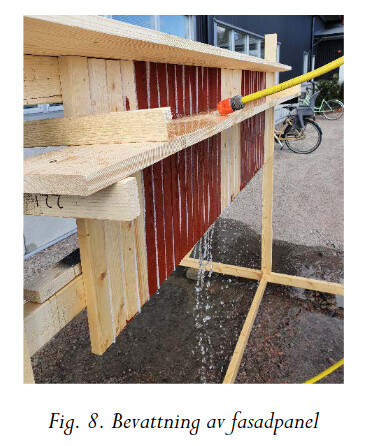
Tomture61
Self-builder
· Född i Luleå
· 6 578 posts
Tomture61
Self-builder
- Född i Luleå
- 6,578 posts
Read an article about a researcher studying wood surface treatment.A Alexn72 said:Ehm.... How was it tested?
"To simulate the water film that can occur during driving rain and increase ecological validity, the facade panels were watered via a wooden gutter."
If you submerge the piece of wood in a gutter full of water, then of course the whole piece will become damp.
However, reality doesn't look like this.
There was a comment that paint lasts about 15-20 years nowadays.
You can't wait that long to determine which is best.
Therefore, the tests are sped up with more UV and moisture.
Tomture61
Self-builder
· Född i Luleå
· 6 578 posts
Tomture61
Self-builder
- Född i Luleå
- 6,578 posts
Thanks, if you want a drip edge, go for it.
The most important thing, however, was the surface treatment.
That was the decisive factor.
Yes, and imagine if we could invite a carpenter/joiner who was active 200 years ago. Undoubtedly, he would outperform most without Google in his back pocket.D din granne said:
For those of us fortunate enough to renovate just 200-year-old houses, you become humbled by how carefully the timber was chosen for each part. Function and exposure entirely dictated which tree was felled and how it was then processed.
Rather called survivorship bias, only well-built houses have survived; the rest have decayed and been demolished.TorpAnders said:
Yes, and imagine if you could invite a carpenter who was active 200 years ago. Without a doubt, he would outdo most without Google in the back pocket.
Because certainly for those of us who have the privilege of renovating precisely 200-year-old houses, you become humbled by how carefully the timber was chosen for the different parts. Function and exposure have completely dictated which tree was felled and how it was then processed.
Many older houses I've seen have had a real shoddy construction, noisy, shaky, improperly sized, etc.

How is your reading comprehension?A Alexn72 said:Ehm.... How was it tested?
"To simulate the water film that can occur during driving rain and increase ecological validity, the facade panels were irrigated via a wooden gutter."
If you immerse the piece of wood in gutters full of water, of course the entire piece will become damp.
However, reality does not look like that.

Even when tearing down old houses built with more artisanally sawn timber, there are often extreme variations in timber quality. It's the need/demand that ultimately dictates, so even if more or less care is taken to use the right timber for the right product, quite a lot of fine timber still ends up as rough planks.K kurlakarl said:
I think that in the past, they dragged timber forward with horses and sleds and selected the trees to be felled, compared to today when large areas are clear-cut. With today's methods, there should be significantly greater differences in the wood.C cpalm said:Even when tearing down old houses built with more artisanally sawn timber, there are often extreme variations in timber quality. It's the need/demand that ultimately drives, so even if one pays more or less attention to using the right timber for the right product, quite a lot of fine timber becomes rough plank.
It also looks different at the sawmills today where they have optimized to get as much plank out as possible and as quickly as possible. For example, star-sawing is not normally used. You also can't buy wedge-sawn planks at the larger building chains, as everything must be according to standard dimensions.
A thesis report for a bachelor's degree is a total of 10 weeks of work…. It is dubious to classify as research (and is not reviewed at the level a real research article usually is) and like the authors themselves do in the sentence you quote, I would also be cautious about drawing too many conclusions based on this… (they disclaim with "based on the irrigation model used," meaning they indicate that this is not a universal result).