
Hello, all handy people.
And yes, I know there are similar threads discussing the same subject... but what I'm wondering about differs slightly... or maybe I just want straight answers to my own questions. I hope you can understand that.
Anyway.
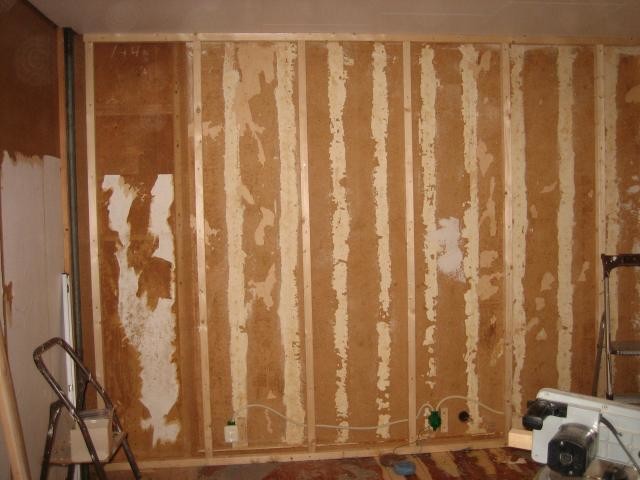
Now, here's the situation: I've got myself a house built in '51 with "plank walls," which are grooved planks in three layers roughly 90-100mm thick. I have then started to add insulation to the exterior walls (on the inside) with 45x45 studs. I screw these onto the Tretex-covered interior walls. That's where I install the new electrical wiring and insulate with Byggmax Insulation Lambda 37 Board.
Now comes the part that's almost keeping me up at night.
I started to think a bit about the future with this additional insulation. I also have plans to add insulation on the exterior. I'm going to carefully and gently dismantle the asbestos cement tiles to then add 95-120 mm of insulation. In other threads discussing vapor barriers, it's mentioned that in old houses it might even damage the house to install a vapor barrier since such old houses rarely have one. Does this apply even if I add insulation on the inside and in a few years also on the outside? So... can I skip using age-resistant construction foil? I thought (if it turns out that the heat retention is better) I might skip the external additional insulation. But if I do go ahead with it, can I skip the vapor barrier on the inside and use tar paper (wind barrier) on the outside, inside the exterior cladding?
I hope you can help me with this.
Best regards,
Andreas
And yes, I know there are similar threads discussing the same subject... but what I'm wondering about differs slightly... or maybe I just want straight answers to my own questions. I hope you can understand that.
Anyway.
Now, here's the situation: I've got myself a house built in '51 with "plank walls," which are grooved planks in three layers roughly 90-100mm thick. I have then started to add insulation to the exterior walls (on the inside) with 45x45 studs. I screw these onto the Tretex-covered interior walls. That's where I install the new electrical wiring and insulate with Byggmax Insulation Lambda 37 Board.
Now comes the part that's almost keeping me up at night.
I started to think a bit about the future with this additional insulation. I also have plans to add insulation on the exterior. I'm going to carefully and gently dismantle the asbestos cement tiles to then add 95-120 mm of insulation. In other threads discussing vapor barriers, it's mentioned that in old houses it might even damage the house to install a vapor barrier since such old houses rarely have one. Does this apply even if I add insulation on the inside and in a few years also on the outside? So... can I skip using age-resistant construction foil? I thought (if it turns out that the heat retention is better) I might skip the external additional insulation. But if I do go ahead with it, can I skip the vapor barrier on the inside and use tar paper (wind barrier) on the outside, inside the exterior cladding?
I hope you can help me with this.
Best regards,
Andreas
If you do not use a vapor barrier when insulating both inside and out, you risk having problems. The insulation makes the wall warmer, which can mean that the dew point is moved outward in the wall, allowing moist air to reach further into the wall without a moisture barrier. Without calculating it, I would guess that you get the new dew point just outside the current plank frame or a little bit into the 120 layer.
If you only insulate on the inside, the opposite happens. The dew point moves inward in the wall.
It's best to insulate on the outside. Then you can bypass any floor edge.
Unfortunately, the vapor barrier will not be effective because you can't draw it past the floor edge if you have an upper floor.
The moisture barrier is most effective if you place it snugly against the inside of the current plank frame and then add additional insulation. Then you can run electrical wiring in the insulation layer without piercing the plastic film.
Don't confuse the internal vapor barrier with the external weather protection. They have two completely different functions.
The vapor barrier stops moisture from the inside. If moisture enters the wall, it cools down and freezes into ice where the dew point is on cold days, causing the dew point to move inward toward the warm side and new freezing occurs, and so on. That is, the cold comes closer to the inside.
The wind barrier protects the insulation from being 'blown through' from the outside. If the insulation is 'blown through'—or rather: the air in the insulation material is stirred or disturbed by the wind—the insulation does not insulate.
It is not the glass/mineral wool or foam that is the insulation. It is the enclosed and still air between the fibers/in the beads that is the 'insulation' because air is a poor conductor of heat.
____________________
Byggaren
If you only insulate on the inside, the opposite happens. The dew point moves inward in the wall.
It's best to insulate on the outside. Then you can bypass any floor edge.
Unfortunately, the vapor barrier will not be effective because you can't draw it past the floor edge if you have an upper floor.
The moisture barrier is most effective if you place it snugly against the inside of the current plank frame and then add additional insulation. Then you can run electrical wiring in the insulation layer without piercing the plastic film.
Don't confuse the internal vapor barrier with the external weather protection. They have two completely different functions.
The vapor barrier stops moisture from the inside. If moisture enters the wall, it cools down and freezes into ice where the dew point is on cold days, causing the dew point to move inward toward the warm side and new freezing occurs, and so on. That is, the cold comes closer to the inside.
The wind barrier protects the insulation from being 'blown through' from the outside. If the insulation is 'blown through'—or rather: the air in the insulation material is stirred or disturbed by the wind—the insulation does not insulate.
It is not the glass/mineral wool or foam that is the insulation. It is the enclosed and still air between the fibers/in the beads that is the 'insulation' because air is a poor conductor of heat.
____________________
Byggaren
Last edited by a moderator:
Bror said:
If by 'vapor retarder' you mean a dehumidifier, it is somewhat useful. But not in this context.
You need to explain further what you mean by 'vapor retarder'?
___________________
Byggaren

I think he means this one:
http://www.thermofloc.se/produkter_angbroms.asp
Or equivalent from another manufacturer.
http://www.thermofloc.se/produkter_angbroms.asp
Or equivalent from another manufacturer.
I can't make this fit with a vapor barrier at all:Immobil said:
THERMOFLOC vapor brake is a diffusion-open and airtight membrane...
The point of a vapor barrier is to be diffusion-tight. Not open. That is, the moisture that comes against the surface should not be able to diffuse through the barrier. The mentioned vapor brake seems to be in the style of what was used before plastic film as a vapor barrier. That is, basically a diffusion-tight paper that wasn't very diffusion-tight and therefore causes problems in exterior walls.
_______________
Byggaren
I mean something like this: http://www.trelleborg.com/sv/Waterp...gar-och-bjalklag/Mataki-Halotex-D50-Angbroms/
The point of this is that it is quite dense, but not as dense as a vapor barrier. It allows moisture to pass through so slowly that it has time to dry outwards.
When you install a vapor barrier in an old house during internal additional insulation, you can rarely get it completely tight, at partition walls and floor beams, for example.
The moisture migration is then concentrated on these surfaces. With a vapor brake, the moisture migration is distributed in a more advantageous way.
The point of this is that it is quite dense, but not as dense as a vapor barrier. It allows moisture to pass through so slowly that it has time to dry outwards.
When you install a vapor barrier in an old house during internal additional insulation, you can rarely get it completely tight, at partition walls and floor beams, for example.
The moisture migration is then concentrated on these surfaces. With a vapor brake, the moisture migration is distributed in a more advantageous way.
BROTHER:
Then we are on the same reasoning that applies to a non-moisture barrier wall of lättbtg. that is glued on the inside before wallpapering. It works because lättbtg. is not a material that can mold. Wood can.
As I myself write in my first post, a moisture barrier is not effective in an existing house because it cannot be made continuous past, for example, the edge of the joists. Therefore, moisture seeks out these weak points. But if the space is ventilated properly, most moisture is prevented from entering the wall according to the law of least resistance. It is ventilated out. So it's better with a moisture barrier that makes it difficult for moisture to get into most of the wall because it forces the air/moisture to stay in the space and be drawn out with the exhaust air. The small amount that remains (assuming the ventilation works as it should) is then negligible. It only causes problems if the ventilation does not work as it should.
Thus, I do not completely condemn the idea of the vapor barrier, but as long as there is no longer experience of it, I do not recommend it either.
_____________________
The Builder
Then we are on the same reasoning that applies to a non-moisture barrier wall of lättbtg. that is glued on the inside before wallpapering. It works because lättbtg. is not a material that can mold. Wood can.
As I myself write in my first post, a moisture barrier is not effective in an existing house because it cannot be made continuous past, for example, the edge of the joists. Therefore, moisture seeks out these weak points. But if the space is ventilated properly, most moisture is prevented from entering the wall according to the law of least resistance. It is ventilated out. So it's better with a moisture barrier that makes it difficult for moisture to get into most of the wall because it forces the air/moisture to stay in the space and be drawn out with the exhaust air. The small amount that remains (assuming the ventilation works as it should) is then negligible. It only causes problems if the ventilation does not work as it should.
Thus, I do not completely condemn the idea of the vapor barrier, but as long as there is no longer experience of it, I do not recommend it either.
_____________________
The Builder
I have used the system in my outer roof. Halotex D50 as a vapor barrier, 380 mm mineral wool, and a diffusion-open underlayer roof Halotex RS10. So, no air gap under the underlayer roof. An outer wall will be constructed in essentially the same way.
Now the roof is only just over two years old, so you'll have to wait 5-10 years for a final review, but so far it has worked well. I will follow up on the matter in about 10 years.
Read more http://www.trelleborg.com/sv/Waterp...nderlagsmaterial-for-tak/Mataki-Halotex-RS10/
Now the roof is only just over two years old, so you'll have to wait 5-10 years for a final review, but so far it has worked well. I will follow up on the matter in about 10 years.
Read more http://www.trelleborg.com/sv/Waterp...nderlagsmaterial-for-tak/Mataki-Halotex-RS10/
Bro, I was thinking of using either Tyvek Supro Grid or Halotex RS10, or possibly Icopal Monopherm 900 in your direction. Along with the related vapor barrier for the above.
Do you know which one is the most cost-effective of the three? Where did you buy the Halotex and at what price?
Do you know which one is the most cost-effective of the three? Where did you buy the Halotex and at what price?
I bought from Beijer and paid 2935 kr/roll 1.5x50 m. That was in May 2006. The vapor barrier Halotex D50 cost 1730 kr/roll 2.7x25 m.
I haven't used the others, so I don't know if one is better than the other, but all three are well-known brands, so the difference is probably small.
I haven't used the others, so I don't know if one is better than the other, but all three are well-known brands, so the difference is probably small.
Click here to reply