
14,198 views ·
15 replies
14k views
15 replies
Folding table, MDF or Plywood???
Hello. I'm going to build a table/surface that can be folded up against the wall when not in use. My son will have a car track on it, but to save some space, I want to solve it this way. A 45x70 batten is attached to the wall and one to the surface. These will then be linked with hinges. Legs are missing from the picture but will be used.
The question is MDF or plywood, and what dimensions are needed. The surface will be full size, i.e., 2440x1220, and the entire inner side will be reinforced by being screwed into the batten, then a frame will be added around it according to the drawing.
Plywood seems a bit lighter and "better" to screw into, I've been told, but many recommend MDF. But it shouldn't weigh so much that it's hard to handle.
The wall is double drywall with probable metal studs. I will probably have some smaller block and rope to help with hoisting, and of course, there will also be a locking mechanism for the folded-up position.
But the main question is plywood or MDF, 16 or 19mm. It shouldn't weigh too much but also shouldn't bend.
/Henrik
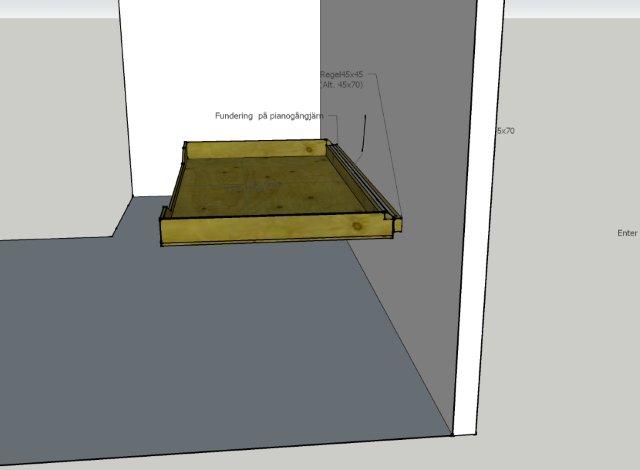
The question is MDF or plywood, and what dimensions are needed. The surface will be full size, i.e., 2440x1220, and the entire inner side will be reinforced by being screwed into the batten, then a frame will be added around it according to the drawing.
Plywood seems a bit lighter and "better" to screw into, I've been told, but many recommend MDF. But it shouldn't weigh so much that it's hard to handle.
The wall is double drywall with probable metal studs. I will probably have some smaller block and rope to help with hoisting, and of course, there will also be a locking mechanism for the folded-up position.
But the main question is plywood or MDF, 16 or 19mm. It shouldn't weigh too much but also shouldn't bend.
/Henrik

Personally, I definitely vote for MDF. Completely smooth, doesn't warp, hard, easy to work with. However, a bit fragile on the edges, but you'll have a frame around it, so that solves the problem.
It's quite a large board, so unfortunately, it might need to be 19mm if the board is to support itself without sagging, but of course, that makes it heavy too.
It's quite a large board, so unfortunately, it might need to be 19mm if the board is to support itself without sagging, but of course, that makes it heavy too.
Fragile around the edges??, my frame is "on top" of the sheet if that makes any difference.
I guess you have to be quite careful with pre-drilling in MDF.
I guess you have to be quite careful with pre-drilling in MDF.
Avoid MDF. Expensive, poor, heavy material that is useless for most purposes except for soundproofing in partitions. If you want furniture quality, you'll need to upgrade to HDF boards which cost more and weigh even more.
With such a large board (2440x1220), you can't avoid sagging even if it is 16 or 19 mm thick (which weighs like lead) if you want it freestanding.
I suggest you take a thinner quality plywood and reinforce it with a rabbeted batten along the edges and two across the middle from long side to long side. This way, you get a lighter construction that is easy to work with and at the same time cheaper.
Here's how I would do it: planed pine batten in dimension 45x34 for a frame that you mill a rabbet groove into along one edge with a handheld router, 7* mm deep (on the 45 side) and 20 mm wide (on the 34 side), along all four sides around the 'table'. You can plug the corners, half-lap them, or dovetail them. Two 28x70 spruce on the flat under the board (not visible when the 'table' is folded down) that you fit with 8 mm dowels into the aforementioned 44x34 (two dowels at each end, total of 8 pieces).
With the rabbet inwards, you can then place a 7 mm plywood board with one or two good sides (depending on whether you can tolerate seeing a slightly knotty side with the board folded up and can afford it). Glued and screwed to the 45x34 in the rabbet.
This way, you get a torsion-resistant table that doesn't sag and doesn't weigh too much. Maybe a bit more work than just clamping up an MDF board, but you couldn't have had that unedged for long either, and then it would have been even more expensive and heavier.
There may be problems finding 7 mm plywood in the format 2440x1220. They tend to be 2000x1000 in standard size. Check with the lumberyard. Finns make larger boards in birch.
*The depth should match the thickness of the plywood.
_____________________
Byggaren
With such a large board (2440x1220), you can't avoid sagging even if it is 16 or 19 mm thick (which weighs like lead) if you want it freestanding.
I suggest you take a thinner quality plywood and reinforce it with a rabbeted batten along the edges and two across the middle from long side to long side. This way, you get a lighter construction that is easy to work with and at the same time cheaper.
Here's how I would do it: planed pine batten in dimension 45x34 for a frame that you mill a rabbet groove into along one edge with a handheld router, 7* mm deep (on the 45 side) and 20 mm wide (on the 34 side), along all four sides around the 'table'. You can plug the corners, half-lap them, or dovetail them. Two 28x70 spruce on the flat under the board (not visible when the 'table' is folded down) that you fit with 8 mm dowels into the aforementioned 44x34 (two dowels at each end, total of 8 pieces).
With the rabbet inwards, you can then place a 7 mm plywood board with one or two good sides (depending on whether you can tolerate seeing a slightly knotty side with the board folded up and can afford it). Glued and screwed to the 45x34 in the rabbet.
This way, you get a torsion-resistant table that doesn't sag and doesn't weigh too much. Maybe a bit more work than just clamping up an MDF board, but you couldn't have had that unedged for long either, and then it would have been even more expensive and heavier.
There may be problems finding 7 mm plywood in the format 2440x1220. They tend to be 2000x1000 in standard size. Check with the lumberyard. Finns make larger boards in birch.
*The depth should match the thickness of the plywood.
_____________________
Byggaren
I probably relied a bit more on the drawing than the builder did, but if one is free to speculate, there are many good variations. The builder's is absolutely good...
MDF requires some form of edge protection, especially if kids are going to play around it.
MDF requires some form of edge protection, especially if kids are going to play around it.
Hmm thanks for a detailed description. It sounds interesting but maybe a bit more difficult than I thought since I lack a router, etc. and I'm not quite sure how you mean. A router could be borrowed though. I've looked around at places like Byggmax, etc., and it's hard to find something that resembles 45*38. Personally, I'm terrible with carpentry terms, so I'm not really sure what a batten is, but I understand planed. Should I be looking for "råplan" "byggregel" or what could it be called?
I've also been advised to make a sandwich construction with thin plywood on each side of some foam/plastic foam. But this would require gluing.
The construction I showed in the drawing should also have legs if that wasn't clear.
I'm leaning towards an 18mm plywood, as it felt lighter/as heavy as a 12mm MDF, and if screwed entirely with a frame on the inside and with an edge all around, it should be fairly stable. I've seen a similar but "worse" construction built with 16mm plywood.
I've had difficulty finding any studs in the wall, so it will probably have to be molly in double gypsum with about 400mm spacing.
I've also been advised to make a sandwich construction with thin plywood on each side of some foam/plastic foam. But this would require gluing.
The construction I showed in the drawing should also have legs if that wasn't clear.
I'm leaning towards an 18mm plywood, as it felt lighter/as heavy as a 12mm MDF, and if screwed entirely with a frame on the inside and with an edge all around, it should be fairly stable. I've seen a similar but "worse" construction built with 16mm plywood.
I've had difficulty finding any studs in the wall, so it will probably have to be molly in double gypsum with about 400mm spacing.
Last edited:
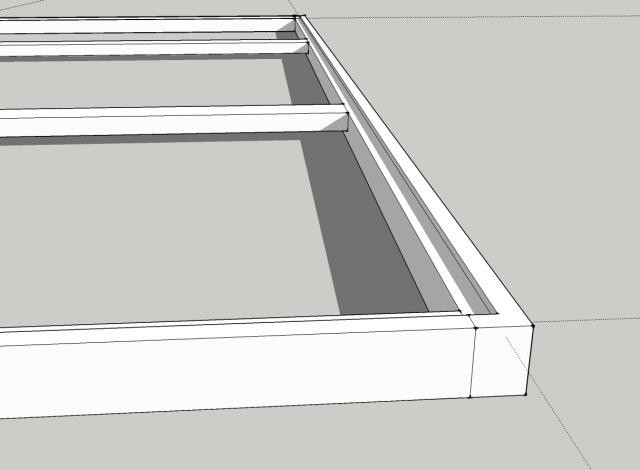
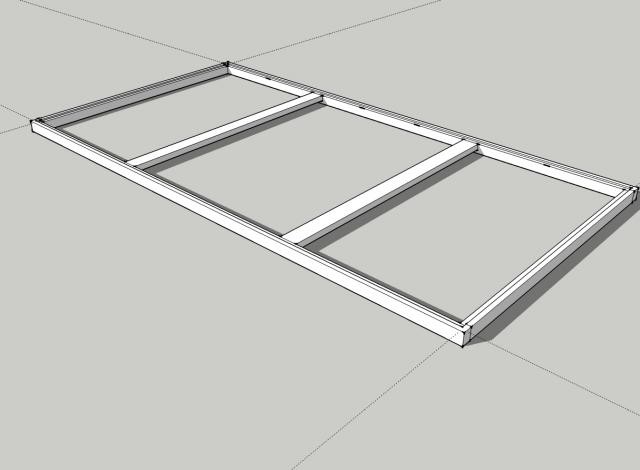
Exactly so. If you can't find 45x38 dimensions, you can take the one closest in width. It's the height (45) needed to make the plywood sheet stiff. If you then want a nice backside, I suggest using a 3 mm plywood with a good side there. It won't have any other function than to cover the cross ribs when the table is folded up.MrWalker35 said:
________________
Byggaren
Would there be any difference if you assemble a frame with 45x45 and have 2 pcs of 45x45 in the middle (instead of 28x70) to then screw a 7mm plywood directly on top. That is, "avoid" the step of milling.
Would it significantly affect the construction? Screw and glue all joints?
Would it significantly affect the construction? Screw and glue all joints?
Every millimeter lower in height results in a more unstable construction. With a recessed plywood sheet, the edges are protected by the frame. They aren’t if you nail the plywood directly on top. But you can 'save' some of the edge and avoid milling if you finish with a beveled corner strip of planed pine around the edge.MrWalker35 said:
____________________________
Byggaren

Thomas59
Construction veteran
· Stockholms län
· 3 424 posts
Thomas59
Construction veteran
- Stockholms län
- 3,424 posts
I wasn't planning to get involved in the basic construction itself but more on how it looks when the board is folded up.
It's a bit dull and perhaps not very nice to have a large board folded up against the wall, and you might want to cover the frame with another board on the underside that you'll see when the table is folded up.
An idea:
Instead, skip the board on the underside, build the "frame" in oak or another type of wood that matches your other furnishings, and voila, you have a nice photo frame with space for stylish photos that you can have a photo shop fix in the right size. You mentioned a car track, so why not like this:
It's a bit dull and perhaps not very nice to have a large board folded up against the wall, and you might want to cover the frame with another board on the underside that you'll see when the table is folded up.
An idea:
Instead, skip the board on the underside, build the "frame" in oak or another type of wood that matches your other furnishings, and voila, you have a nice photo frame with space for stylish photos that you can have a photo shop fix in the right size. You mentioned a car track, so why not like this:

thanks for opinions
"the backside will be "tidied up" in some way.
will try to aim for a milling at least. probably looks best. The problem is finding planed timber. the only thing I can find that is close to 45X38 is a regular stud 45x45. or battens 25*38 or planed 21X43.
what I have access to is like cheapy, byggmax.
"the backside will be "tidied up" in some way.
will try to aim for a milling at least. probably looks best. The problem is finding planed timber. the only thing I can find that is close to 45X38 is a regular stud 45x45. or battens 25*38 or planed 21X43.
what I have access to is like cheapy, byggmax.
We have a similar construction (though a bit smaller) at work, made of oak, with piano hinges against a wall-mounted strip, and support with two legs that form braces against the wall when it's folded up. These "legs" are temporarily attached to oak blocks (2x2 pieces) which are fixed to the wall and on the underside of the table. When folded down, the pieces meet and serve as a protection – allowing the table to lay neatly downward at 90 degrees.
Let's see if I can attach a picture later.
/A
Let's see if I can attach a picture later.
/A
Would have been very interesting to see some pictures of that solution. I'm going to have legs on this build myself and haven't quite decided how yet.
Then choose plane planed 21x43 and mill out 10-12 mm in width on the 21 dimension and as much as you need regarding the chosen board thickness in depth on the 43 dimension. Even if there is not much left of the width dimension, it is enough for the height (43 mm) to be intact on the outside.MrWalker35 said:thanks for opinions
"the back will be "tidied up" in some way.
I will try to aim for milling anyway. It will probably look the best. The problem is finding planed timber. The only thing I can find that is close to 45X38 is regular timber 45x45. or batten 25*38 or plane planed 21X43.
What I have access to is type cheapy, byggmax.
If you then miter the corners together or take the time to dovetail them (a bit more work but much nicer) is up to you. If you miter them together, you must biscuit or plug the corners which requires other work, alternatively an unsightly angle bracket. Joined with the board with screws and glue, the frame then maintains its shape.
On the underside, you can then take a slightly thicker plywood to make it stable and torsionally rigid. Say 5-7 mm.
But you can also take 15 ply (a type of thicker plywood) on top and skip the central battens underneath and also the thinner plywood that is supposed to cover the central batten/s. It is also better to screw the model railway into. (Still, it won't be as violently heavy as 16 mm MDF, which you were initially considering. The soundproofing will, however, be considerably worse with a lighter board. Also something to think about. And it will sound most on a thin plywood sheet if you don't lay rubber matting under the tracks. Then it won't be heard at all.)
The idea with the picture underneath is not so crazy, but it fails because a central batten is needed for the plywood if it is to be thin=light. Then you need two fields or why not 3, 4, or 6 for appearance's sake? (Unless you finish with a 3 mm plywood and get a completely smooth underside. Then there will be no fields at all.)
As legs, I suggest you take two 45x45 (one in each free corner) and attach with a hinge under the board so they hang on when you fold up the board (and parallel to it) and automatically drop down when you fold it down. Then have a wood strip on the wall (attached to it) and screw piano hinges to that and the board's frame timber, and it should hold well. When the board is down, the hinge should be folded like an upside-down V, and with the board folded up, it becomes a 90-degree angle on the hinge. Same with the legs but the other way around.
Therefore, first screw the piano hinges (you'll probably have to take a couple since they are rarely sold (except in specialist stores, read: Teofils etc.) in lengths longer than 50-60 cm at Jula, Clas Ohlson, or Biltema) into the board's frame timber and support the board in the upright position where it should be and then screw the piano hinges to the strip on the wall.
_____________________________
Builder