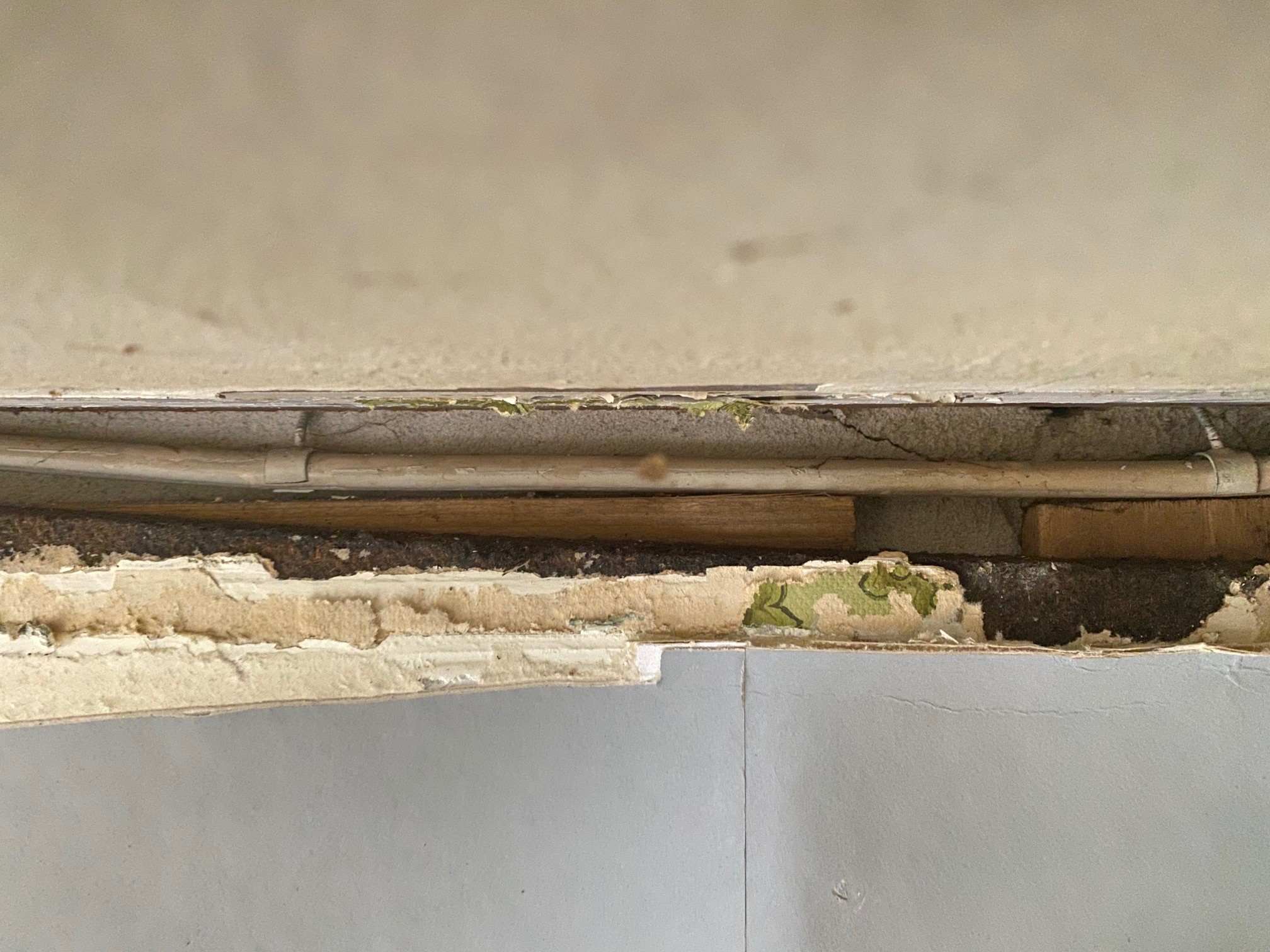
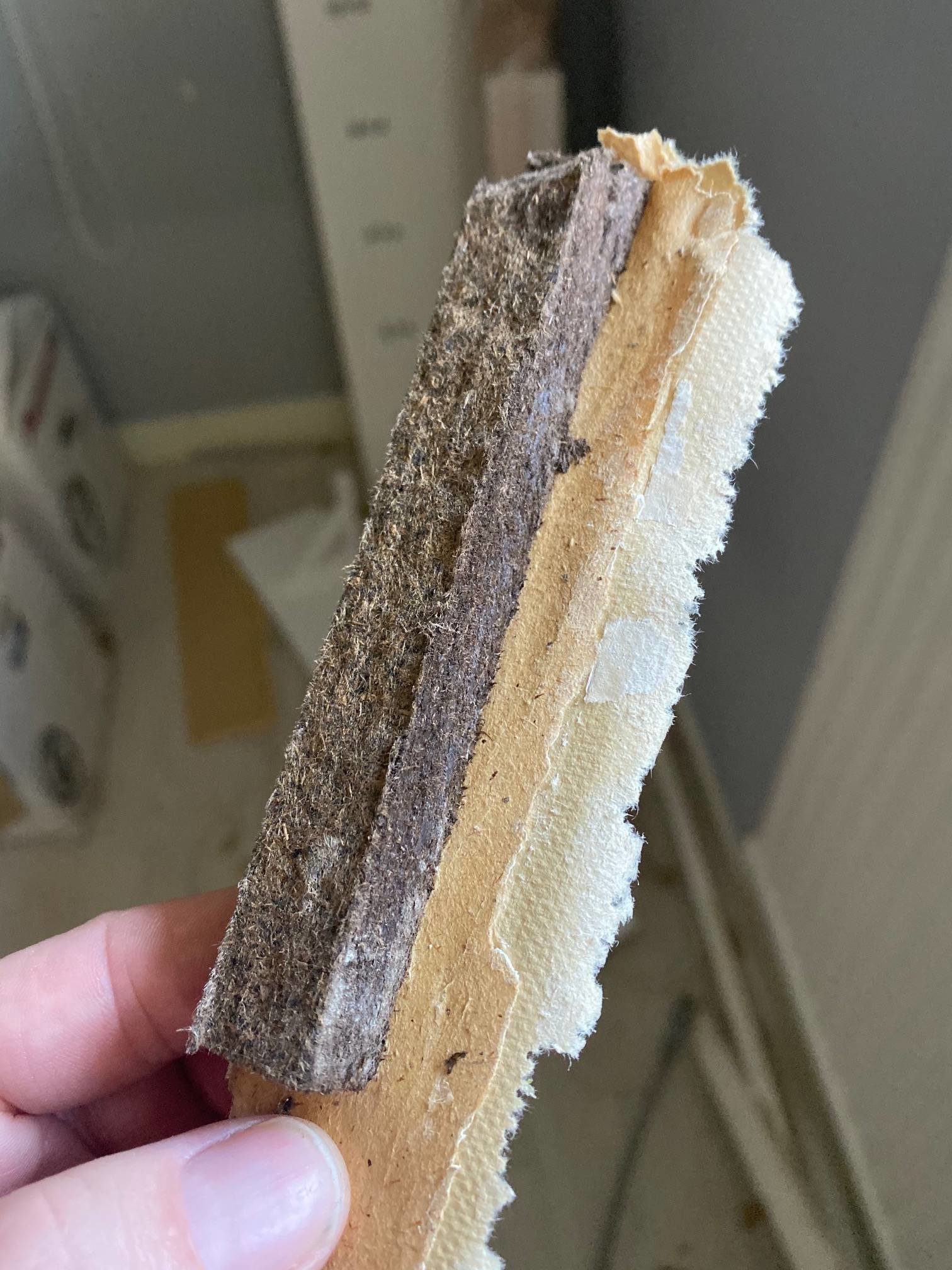
Since I bought the house a few years ago, I have wondered about the construction of the interior wall in our basement rooms. There's some type of board material on the outside of the concrete wall. I understand that it is not plasterboard and have also noted that it “gives a little when you press the wall in different places, as if it's spaced too sparsely behind, like. We don't have any moisture problems in the basement, the house is from '63, but it was drained not too long ago, so I haven't bothered to investigate the matter further. Let sleeping bears lie, etc. But now that I took down the existing ceiling because I was going to put up a new one, I see how the exterior walls are made, raising some questions. First of all, there seem to be wooden studs (or rather some kind of slats) directly against the concrete wall. And on these studs is this board material which is brownish (looks like a brownie cake, approximately) and a bit soft. On top of that, it's wallpapered in several layers, so the indoor surface is smooth and can be wallpapered further. I'm wondering if the board could be what is called tretex?
Beyond this board, there is no insulation and also no moisture barrier. And maybe that's why we've also had no moisture problems in the basement, and that there hasn't been any issue (that we've noticed) with the wooden studs directly against the concrete wall, as no moisture stays in the wood structure but dries up all the time?
I do understand that the construction isn't optimal. At the same time, it might have been wise of the previous homeowner (likely sometime in the early 70s) not to build with insulation inward. Even if it had been done more correctly (no organic materials), the room space would have decreased quite a bit.
If you can see what material the board is, do you see any particular risks with it or the construction as such? I'm not too keen to start a major renovation project, and it seems to be working as it is now? It's likely the same construction in the other rooms of the house as well.
Removing everything and exposing and plastering the concrete walls is not really an option.
PS - the electrical wire visible in the picture isn't live; it seems to just have been left there.
It is correct that it is Tretex.
There are always risks with wood against concrete - But many factors play a role. I have dismantled wooden structures in my basement that have been against concrete for (Judging by the wallpaper) 30 years without any discolorations or damage.
People are a bit paranoid today, and it is justified since moisture can cause problems quite quickly if you trap it with the wrong paint or similar.
Tretex absorbs moisture and can indeed smell if it becomes damp - I still have all my woodwork on the upper floor of the house behind new layers of plasterboard - But I wouldn't want it in the basement...
It looks more like asfaboard, i.e., a type of asphalt-impregnated treetex, in my opinion. Raised basement walls on the inside of concrete/concrete hollow block/leca block should not have a vapor barrier. That will definitely cause problems.
Correct, that is Tretex.
There are always risks with wood against concrete - But many factors come into play. I have dismantled wooden structures in my basement that have been against concrete since (judging by the wallpaper) 30 years ago without any discoloration or damage.
People are a bit paranoid today, and it's justified since moisture can cause problems quite quickly if trapped with the wrong paint or similar.
Tretex absorbs moisture and can smell if it becomes damp - I still have all my wooden materials on the upstairs of the house behind new layers of drywall - But I wouldn't want it in the basement....
The question is whether I can take the opportunity to replace the panels with another type of panel, but without trying to insulate in any way so as not to create moisture problems anywhere in the structure? As mentioned, I don't want to expose the concrete wall; I want something to wallpaper on. But what kind of panel would that be, then? I cannot place drywall directly, can I? And naturally, in that case, I would also want to use something other than wood for framing behind. But are there metal studs that don't protrude so much? Or should I just leave everything as it is, even if it nags a little, in case there might be a better and reasonably simple solution?
It looks more like asfaboard, i.e., a type of asphalt-impregnated treetex, I think. Framed basement walls on the inside of concrete/concrete block/leca block should not have a vapor barrier. That will definitely cause problems.
No, I'm not planning to put a vapor barrier there...
if there are no moisture problems and no mold, I think it seems unnecessary to replace the asfaboard just for the sake of it. if you are worried about the future, get a simple sensor that measures humidity so you can notice if/when conditions change and if you should make a bigger intervention.
if there are no moisture issues and no mold, I think it seems unnecessary to replace the asphalt board just for the sake of it. if you are worried about the future, get a simple sensor that measures humidity so you notice if/when the conditions change and if you need to take major action.
Yes, that's certainly an idea. But perhaps it's really the wooden studs behind that worry me more than the tretex, now that I think about it. In another room in the basement, we might have a faint smell (not mold) that could be coming from the board in the wall. If there was a somewhat simple solution to replace the tretex and wooden studs with something else, I might still consider it.
Click here to reply
Vi vill skicka notiser för ämnen du bevakar och händelser som berör dig.



slacker said:
Correct, that is Tretex.major_tom said: