
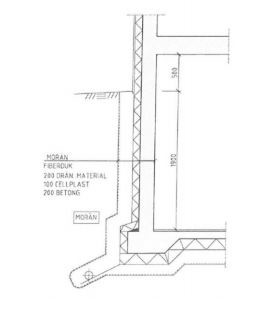
I have encountered a problem with calculating the U-value for different parts of a basement wall above ground as well as below ground. Here's how it looks:
ground) and specify an appropriate average value.
The following construction from the outside:
Till
Geotextile
200 mm drainage material
100 mm cell plastic, λ = 0.033 W/mK
200 mm concrete, λ = 1.7 W/mK
Above ground, the cell plastic is plastered with
20 mm plaster; λ = 1.0 W/mK
ground) and specify an appropriate average value.
The following construction from the outside:
Till
Geotextile
200 mm drainage material
100 mm cell plastic, λ = 0.033 W/mK
200 mm concrete, λ = 1.7 W/mK
Above ground, the cell plastic is plastered with
20 mm plaster; λ = 1.0 W/mK
Last edited:
Hmm, there might be some text missing there, right?
"Here's what it looks like:
ground) and indicate a suitable average."
Is this a practical example from real life or a school assignment? In practice, you can ignore concrete and rendering and just calculate on the foam insulation. If you want to calculate for the entire wall, take the parts separately and add them together considering their share of the total area. That is actually also quite uninteresting because they are insulating against completely different external temperatures (air versus ground).
For the part with concrete+foam insulation, the U-value is calculated as U=1/(sum of all R), R=d/λ, U=1/((0.1/0.033)+(0.2/1.7))=0.318 (note how little the concrete affects it, from 0.33 for only the foam insulation to 0.318 for both).
The other part then has (in the same way) U=1/((0.1/0.033)+(0.2/1.7)+(0.02/1))=0.316
If the draining material is to be included, you simply extend the formula with its R=d/λ.
The average for the entire wall also becomes 0.318 (0.3176) and if you round to reasonable two decimals it is 0.32 anyway. (Utot=(U1*l1+U2*l2)/(l1+l2) where l indicates length, a regular average)
Have I helped you cheat now?
"Here's what it looks like:
ground) and indicate a suitable average."
Is this a practical example from real life or a school assignment? In practice, you can ignore concrete and rendering and just calculate on the foam insulation. If you want to calculate for the entire wall, take the parts separately and add them together considering their share of the total area. That is actually also quite uninteresting because they are insulating against completely different external temperatures (air versus ground).
For the part with concrete+foam insulation, the U-value is calculated as U=1/(sum of all R), R=d/λ, U=1/((0.1/0.033)+(0.2/1.7))=0.318 (note how little the concrete affects it, from 0.33 for only the foam insulation to 0.318 for both).
The other part then has (in the same way) U=1/((0.1/0.033)+(0.2/1.7)+(0.02/1))=0.316
If the draining material is to be included, you simply extend the formula with its R=d/λ.
The average for the entire wall also becomes 0.318 (0.3176) and if you round to reasonable two decimals it is 0.32 anyway. (Utot=(U1*l1+U2*l2)/(l1+l2) where l indicates length, a regular average)
Have I helped you cheat now?
It's a school assignment. Can you send me the entire arithmetic method so I know where my mistake is?F fb35523 said:Hmm, some text might be missing there, right? "This is how it looks: ground) and enter an appropriate average value." Is this a practical example from real life or a school assignment? In practice, you can ignore concrete and plaster and only calculate on the cellular plastic. If you want to calculate for the entire wall, do the parts separately and add them up, considering their share of the total area. It's actually not that interesting since they are insulating against completely different external temperatures (air versus ground). For the part with concrete+cellular plastic, U=1/(sum of all R), R=d/λ, U=1/((0.1/0.033)+(0.2/1.7))=0.318 (note how little the concrete affects it, from 0.33 for only the cellular plastic to 0.318 for both). The other part then has (in the same way) U=1/((0.1/0.033)+(0.2/1.7)+(0.02/1))=0.316 If the draining material should be included, just extend the formula with its R=d/λ. The average for the entire wall also becomes 0.318 (0.3176) and if you round to a reasonable two decimals, it's 0.32 anyway. (Utot=(U1*l1+U2*l2)/(l1+l2) where l indicates the length, a common average) Have I helped you cheat now?
When calculating the U-value for the backfilled part, you also take into account the thermal resistance of the ground. This varies with depth and the type of material. But this should be included in the textbooks, right?
I actually have no knowledge in U-value calculation, but I have used my math skills from college and a bit of basic skill in using formula collections. The U-value for a complete construction, e.g., a wall, can be calculated like this:
U=1/(sum of all R), R=d/λ, U=1/(d1/λ1+d2/λ2+...+dn/λn)
Please verify the above with your own formulas. You should be able to derive this quite easily. I assume you understand what I mean by indices 1, 2, and n.
In this case (lower part without considering it's underground), the calculation becomes: U=1/((0.1/0.033)+(0.2/1.7))=0.318
For the part above ground, only the very limited insulation from the plaster is added, and the denominator is completed with +(0.02/1), that is 0.02 m with λ=1.
Others may be able to help you with how to adjust the part below ground to account for the ground's insulation, I cannot.
U=1/(sum of all R), R=d/λ, U=1/(d1/λ1+d2/λ2+...+dn/λn)
Please verify the above with your own formulas. You should be able to derive this quite easily. I assume you understand what I mean by indices 1, 2, and n.
In this case (lower part without considering it's underground), the calculation becomes: U=1/((0.1/0.033)+(0.2/1.7))=0.318
For the part above ground, only the very limited insulation from the plaster is added, and the denominator is completed with +(0.02/1), that is 0.02 m with λ=1.
Others may be able to help you with how to adjust the part below ground to account for the ground's insulation, I cannot.
Click here to reply