
18,721 views ·
79 replies
19k views
79 replies
Total renovation - Install vapor barrier or not??

Now I'm picking this up quite a long time after.ricebridge said:
My hobbyhorses neigh in unison: No.
An old house is built to "breathe". It is meant to let in and ventilate out air through intentional gaps. If you start installing a vapor barrier somewhere, you get increased moisture load somewhere else. In the worst case, damage.
Instead, you should use natural materials that can handle a certain amount of moisture. Linen insulation or cellulose are examples of such.
But I think this is worth discussing, especially this part you wrote:
"If you start installing a vapor barrier somewhere, you get increased moisture load somewhere else."
A few years ago I thought the same, but I'm not at all sure if that reasoning holds.
Here in post #8 in this thread came the moment when I started pondering over this:
https://www.byggahus.se/forum/threads/plast-eller-inte.60379/#post-407508
You are welcome to read it, and what I and jon_h wrote then.
A bit theoretically, we can say that in a sample house we have 100m2 of interior ceiling area against the attic. No plastic.
And then there is a vapor pressure difference between inside and attic that drives y grams of water vapor per square meter and hour, i.e. the attic is moisture-loaded with 100y grams of water/hour.
If we then apply plastic to half of the ceiling area, the attic will instead be loaded with 50y grams of water/hour.
If you manage to apply plastic to 95% of the surface, the moisture load on the attic will be only 5y grams of water/hour, compared to 100y completely without plastic.
The only thing that could make this (purely theoretical) not hold true is if the moisture in the house rises and thus the vapor pressure, just because it has been plastic-coated.
And sure, if the house is designed with the idea that precisely all moisture in the house should exit through the attic, then it becomes the same moisture load on the attic regardless of how much you manage to plasticize, only everything has to pass through a smaller area.
And if you manage to plasticize 100%, the house will eventually become water-filled.

Now I'm not saying you're wrong and I'm right, but mostly that I think it's worth pondering over and discussing how it works if you apply plastic but don't succeed over the entire surface.
As someone who works with building physics, I want to highlight that a discussion like this can give the impression that the state of knowledge in the field is still uncertain. I would argue that this is not the case at all, and those whose job it is to prescribe and take responsibility for things like wall constructions are not as divided as it sounds here.
It is rarely advisable to skip a vapor barrier; in unclear cases, it's possible to calculate vapor transport and dew point to see if condensation will occur in the wall (this is what we're talking about—moisture in vapor form isn't the problem; it's when it condenses into water). But condensation calculations need only be done in certain cases, such as in constructions without a vapor barrier or where the vapor barrier is far inside the wall.
Hygroscopic insulation materials are a term you almost only encounter in sales material, seldom in technical literature. I wouldn't use it as a solution to a problem, but it may possibly increase the margins in a risky construction.
The statement that the house should breathe is also not found in technical literature. However, there should be an air gap on the outermost part. The principle is that vapor is stopped from the inside, and the moisture that does get through is ventilated away in the air gap. Then the idea that a vapor barrier in one place would increase risks in another place sounds far-fetched.
Finally, the age of the house does not override the laws of physics. An old construction may have survived because it was poorly insulated and drafty, but if it is additionally insulated, the dew point is moved further into the wall, and problems can arise if vapor is allowed to travel from the inside. If there are historical preservation interests, one may/may not be allowed to insulate/rebuild anyway. An old construction that is problem-free will remain problem-free under unchanged conditions. It costs more to heat, but that cost might be subordinate to other interests.
Different building techniques then and now, one must decide on a new or old standard and follow that path.
It is rarely advisable to skip a vapor barrier; in unclear cases, it's possible to calculate vapor transport and dew point to see if condensation will occur in the wall (this is what we're talking about—moisture in vapor form isn't the problem; it's when it condenses into water). But condensation calculations need only be done in certain cases, such as in constructions without a vapor barrier or where the vapor barrier is far inside the wall.
Hygroscopic insulation materials are a term you almost only encounter in sales material, seldom in technical literature. I wouldn't use it as a solution to a problem, but it may possibly increase the margins in a risky construction.
The statement that the house should breathe is also not found in technical literature. However, there should be an air gap on the outermost part. The principle is that vapor is stopped from the inside, and the moisture that does get through is ventilated away in the air gap. Then the idea that a vapor barrier in one place would increase risks in another place sounds far-fetched.
Finally, the age of the house does not override the laws of physics. An old construction may have survived because it was poorly insulated and drafty, but if it is additionally insulated, the dew point is moved further into the wall, and problems can arise if vapor is allowed to travel from the inside. If there are historical preservation interests, one may/may not be allowed to insulate/rebuild anyway. An old construction that is problem-free will remain problem-free under unchanged conditions. It costs more to heat, but that cost might be subordinate to other interests.
Different building techniques then and now, one must decide on a new or old standard and follow that path.

Renovator
· Skåne/Blekinge
· 2 880 posts
THANK YOU! You wrote what I tried to convey with my posts in the thread, but you did it far more professionally. Thanks.W witten said:As someone who works with building physics, I want to emphasize that a discussion like this can give the impression that the state of knowledge in the field is still uncertain. I would argue that this is not the case at all, and those who prescribe and take responsibility for things like wall constructions are not at odds as it might seem here.
It's rare to skip a vapor barrier; in unclear cases, you can calculate vapor transport and dew point to see if there will be condensation in the wall (that's what we're talking about; in vapor form, moisture isn't the problem. It's when it condenses into water). However, condensation calculations are only necessary in certain cases, such as constructions without a vapor barrier or where the vapor barrier is located far inside the wall.
Hygroscopic insulation materials are a term you almost only encounter in sales materials and rarely in technical literature. I wouldn't use it as a solution to a problem, but it might potentially increase the margins in a risk construction.
The phrase "the house should breathe" is not found in technical literature either. However, there should be an air gap on the outside. The principle is that vapor is stopped from the inside and the moisture that still gets through is ventilated away in the air gap. The idea that a vapor barrier in one place would increase risks elsewhere seems far-fetched.
Finally, the age of the house does not affect the laws of physics. An old construction might have survived because it was poorly insulated and drafty, but if you add insulation, the dew point moves further into the wall and problems can arise if vapor is allowed to travel from the inside. If there are antiquarian interests, you might not be allowed to insulate or rebuild. An old construction that is problem-free will continue to be so under unchanged conditions. It costs more to heat, but the cost might be secondary to other interests.
Different building techniques from the past and now; you have to decide on a new or old standard and stick to that path.

Thank you! Finally someone who doesn't believe in goblins, trolls, "living materials," and houses that should "breathe."W witten said:As someone who works with building physics, I want to point out that such a discussion can give the impression that the level of knowledge in the field is still uncertain. I would argue that it is not at all like that, and those whose job it is to prescribe and take responsibility for, for example, wall constructions are not as disagreeable as it sounds here.
A vapor barrier is rarely skipped, in unclear cases it is possible to calculate vapor transport and dew point to see if there will be condensation in the wall (that is what we are talking about, in vapor form the moisture is not the problem. It is when it condenses into water). But condensation calculations only need to be done in certain cases, such as in constructions without a vapor barrier or where the vapor barrier is located far inside the wall.
Hygroscopic insulation materials are a concept you almost only encounter in sales material, rarely in professional literature. I would not use it as a solution to a problem, but it may possibly increase margins in a risk construction.
That the house should breathe, you won't find that sentence in professional literature either. However, there should be an air gap on the outermost part. The principle is that the vapor is stopped from inside and the moisture that still gets through is ventilated away in the air gap. Then the idea that a vapor barrier in one place would increase risks in another place sounds far-fetched.
Finally, the age of the house does not defy the laws of physics. An old construction may have survived because it was poorly insulated and non-tight, but if it is additionally insulated the dew point is moved further into the wall and problems can arise if vapor is allowed to migrate from the inside. If there are antiquarian interests, one may/may not anyway insulate/renovate. An old construction that is problem-free will continue to be problem-free under unchanged conditions. It costs more to heat but the cost may be subordinate to other interests.
Different building techniques then and now, you have to decide on new or old standards and follow that path.
Borrowing the thread a bit.
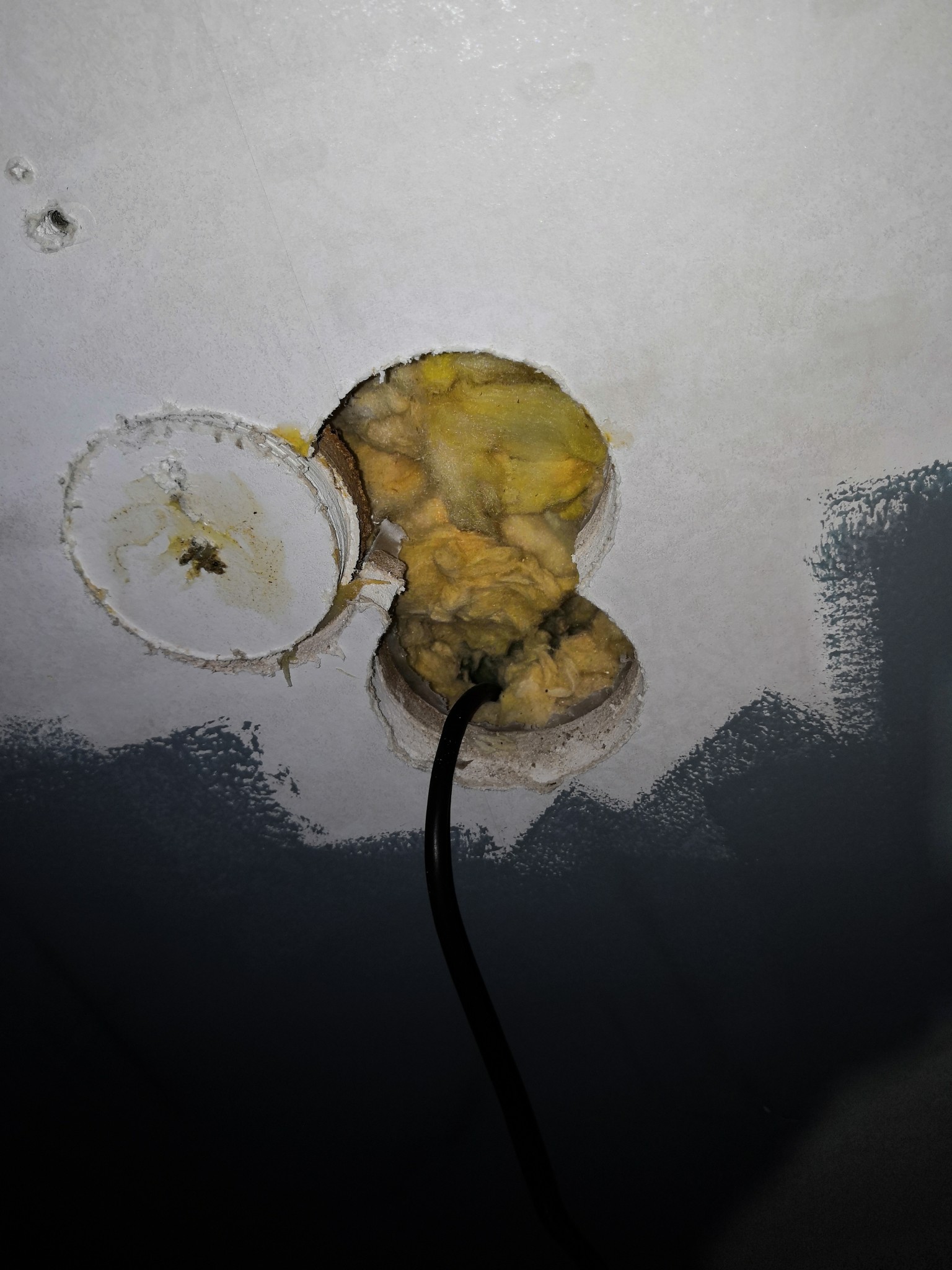
The thing is that I'm going to cover some holes in an exterior wall. The previous owner did not want visible cables to the TV, so they sawed holes in the wall, through the plaster and the vapor barrier. What I want to know is how you would have done it. Seal the vapor barrier and then put filler pieces of plaster? Or ignore the vapor barrier and just put filler pieces of plaster? See image (looks terrible)
The thing is that I'm going to cover some holes in an exterior wall. The previous owner did not want visible cables to the TV, so they sawed holes in the wall, through the plaster and the vapor barrier. What I want to know is how you would have done it. Seal the vapor barrier and then put filler pieces of plaster? Or ignore the vapor barrier and just put filler pieces of plaster? See image (looks terrible)
Renovator
· Skåne/Blekinge
· 2 880 posts
I would wrangle in ÅBP with plenty of overlap on the back of the plasterboard and then repair the plasterboard/hole.Raka said:
Borrowing the thread a bit.
I need to cover some holes in an outer wall. The previous owner didn't want visible cables for the TV and cut holes in the wall, through the plasterboard and vapor barrier. I'd like to know how you would handle this. Seal the vapor barrier and then fit pieces of plasterboard? Or ignore the vapor barrier and fit pieces of plasterboard? See picture (looks terrible)
I have considered doing that. But it feels tricky since the holes are so "small." If I choose not to use plastic, what is the worst that could happen? In the best case, nothing happens at all?
Well, if you cut a piece that's a bit larger than the holes, I think you can quite easily get it in place through the holes.
It won't be taped, but surely quite tight anyway.
Renovator
· Skåne/Blekinge
· 2 880 posts
It will be dense enough, yes. Absolutely correct.
The worst that can happen is that some humid indoor air reaches the structure and condenses in the wall, causing moisture damage to nearby studs and other organic material. By using plastic, you naturally reduce the airflow into the structure, and consequently, also the amount of moisture. No "ordinary" house is hermetically sealed, so a certain amount of humid air always reaches the structure. My approach is to do the best I can with reasonable means to reduce the moisture reaching the structure.
The worst that can happen is that some humid indoor air reaches the structure and condenses in the wall, causing moisture damage to nearby studs and other organic material. By using plastic, you naturally reduce the airflow into the structure, and consequently, also the amount of moisture. No "ordinary" house is hermetically sealed, so a certain amount of humid air always reaches the structure. My approach is to do the best I can with reasonable means to reduce the moisture reaching the structure.
Well written, but wasn't the problem that there was no air gap on the outside, but in this case sealed, as is often the case in older constructions where there was previously no insulation? In a normal case with an air gap or where it is not sealed on the outside, the barrier is obvious (in these cases I agree about goblins and trolls). But do you mean that it should be completely sealed on both sides?W witten said:As someone who works with building physics, I want to point out that such a discussion can give the impression that the state of knowledge in the field is still uncertain. I want to argue that this is not true at all and those whose job it is to prescribe and take responsibility for things like wall constructions are not as divided as it sounds here.
You rarely dare to skip a vapor barrier; in unclear cases, it is possible to calculate vapor transport and dew point to see if there will be condensation in the wall (that's what we're talking about, in vapor form the moisture is not the problem. It's when it condenses into water). But condensation calculations only need to be done in certain cases, such as in constructions without a vapor barrier or where the vapor barrier is located deep within the wall.
Hygroscopic insulation materials are a term you almost only encounter in marketing material, rarely in technical literature. I would not use it as a solution to a problem, but it may possibly increase margins in a risk construction.
That the house should breathe, you do not find that phrase in technical literature either. However, there should be an air gap on the outermost side. The principle is that the vapor is stopped from the inside and the moisture that still gets through is ventilated away in the air gap. Then the idea that a vapor barrier in one place would increase risks in another place seems far-fetched.
Finally, the age of the house does not alter the laws of physics. An old structure might have survived because it was poorly insulated and leaky, but if it's additionally insulated, the dew point moves further into the wall and problems can arise if vapor is allowed to travel from the inside. If there are conservation interests, you might/must not insulate/rebuild. An old construction that is problem-free will continue to be problem-free under unchanged conditions in the same way. It costs more to heat up, but the cost may be subordinate to other interests.
Different building techniques then and now, you have to decide on new or old standards and stay on that path.
Managed to glue the spacers before I read your response (haven't plastered yet). In hindsight, it feels dumb. The question is whether I should tear down what I've glued and use plastic. The openings are in the part of the house furthest away from both the kitchen and bathroom, so it feels like no moisture will come there.It will be sufficiently tight, yes. Absolutely correct.
The worst that can happen is that some damp indoor air reaches the construction and condenses in the wall, causing moisture damage to nearby studs and other organic materials. If you use plastic, you'll obviously reduce the airflow into the construction, and consequently the amount of moisture. No "ordinary" house is hermetically sealed, so a certain amount of damp air always reaches the construction. My approach is to do the best I can with reasonable means to reduce the moisture that reaches the construction.
Renovator
· Skåne/Blekinge
· 2 880 posts
I would have done it, but it's not my houseHad time to glue the spacer pieces before I read your answer (haven't puttyed yet). In hindsight, it feels silly. The question is whether I should tear down what I've glued and put plastic. The holes are in the part of the house that is furthest from both the kitchen and bathroom, so it feels like no moisture will get there.
Renovator
· Skåne/Blekinge
· 2 880 posts
What you can also do is cut out a larger piece of drywall from the wall, conveniently place the plastic that then well covers the holes in the plastic and put the drywall back.Managed to glue the support pieces before I read your response (haven't plastered yet). Which now in hindsight feels stupid. The question is whether I should tear down what I've glued and put plastic. The openings are in the part of the house that is farthest away from both the kitchen and bathroom, so it feels like no moisture will get there.
To be honest, I don't think that hole in the vapor barrier will actually cause any damage, unless it's a sauna room.Managed to glue the spacers before I read your response (haven't plastered yet). In hindsight, that feels dumb. The question is whether I should tear down what I glued and put plastic. The hole is in the part of the house that is the farthest from both the kitchen and bathroom, so it feels like no moisture will get there.
If the house works correctly overall, meaning it has ventilation that removes old and humid air to a normal extent and maintains a slight negative pressure, then there's no chance of disaster. Actually, the biggest risk might be that it causes drafts with outdoor air coming in, cold air in winter.
Just because I don't think there will be any problems doesn't mean I would completely ignore trying to fix it if it were my problem. But I would weigh the effort against how important I think it is. And not lose sleep over it.