
1,286 views ·
5 replies
1k views
5 replies
Torsional rigidity in bridge section
Hello..
I have built an approximately 20 m long floating dock with sections made of two longitudinal beams 45x145 with a length of 5.2 m. The sections are 1.2 m wide and have a walking surface of decking 22x95. There is also a middle beam 45x90. The problem is that they want to twist (warp) when you walk over them. How can I counteract this and increase the structure's torsional stiffness in the longitudinal direction?
Best regards, Krister
I have built an approximately 20 m long floating dock with sections made of two longitudinal beams 45x145 with a length of 5.2 m. The sections are 1.2 m wide and have a walking surface of decking 22x95. There is also a middle beam 45x90. The problem is that they want to twist (warp) when you walk over them. How can I counteract this and increase the structure's torsional stiffness in the longitudinal direction?
Best regards, Krister
When I studied engineering, we were taught that the most effective way to increase the torsional stiffness of a rectangle/square was to mount a cross brace, i.e., braces from corner to corner. However, I have no personal experience in practicing this.
Renovator
· Västernorrland
· 2 posts
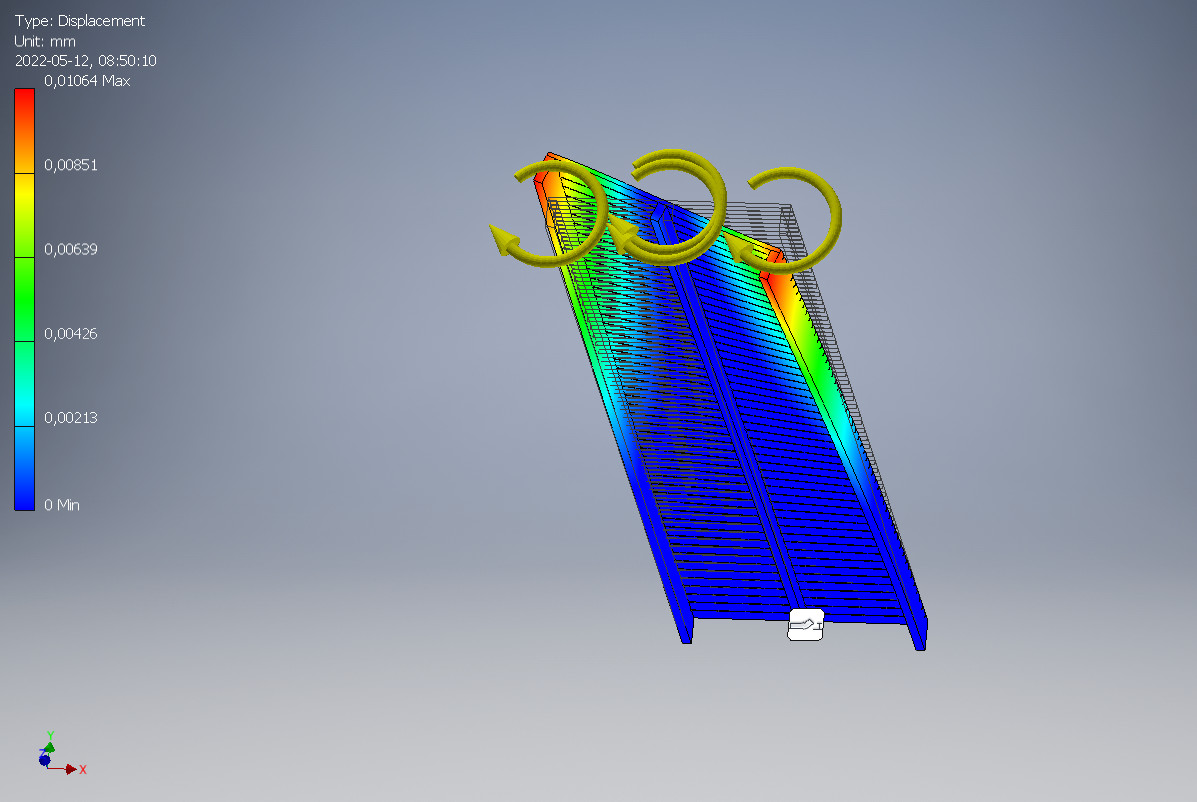
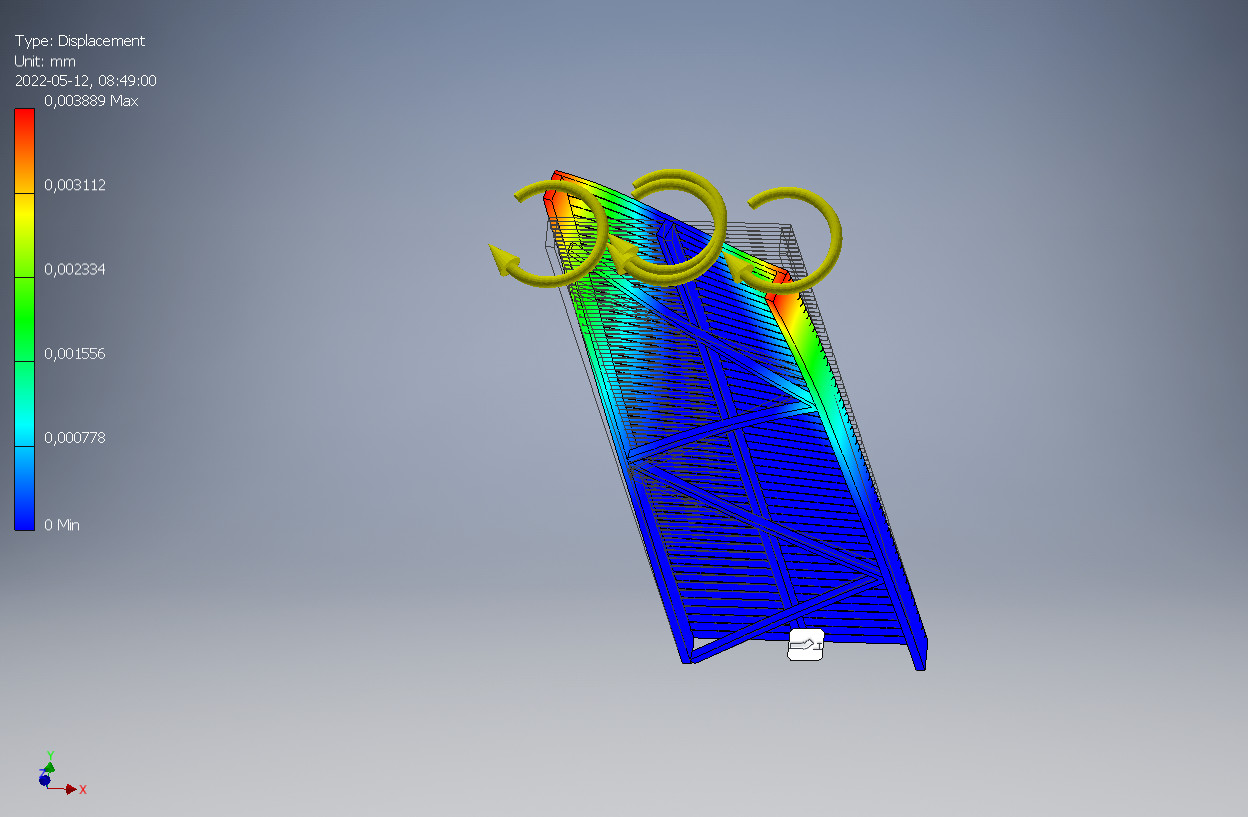
Okay..interesting..you write that you used FEM on it...what does it mean?
So, it gives better results to run several diagonals compared to from corner to corner?
45x45 provides a 60% increase in stiffness...do you gain further by increasing to, for example, 45x70?
So, it gives better results to run several diagonals compared to from corner to corner?
45x45 provides a 60% increase in stiffness...do you gain further by increasing to, for example, 45x70?


Renovator
· Västernorrland
· 2 posts
One could say that FEM is a computerized strength assessment.
It should become stiffer the coarser the wood you "strive" to use.
I would think it becomes stiffest if you were to set double diagonals or crosses once per width. At 45 degrees.
So a cross on every 1.2m.
If you set a long >5.2m diagonal, it is, on the whole, straight, or nearly parallel with the other studs.
So the optimal solution lies somewhere between these two options. Maybe something similar to the image I uploaded earlier?
It should become stiffer the coarser the wood you "strive" to use.
I would think it becomes stiffest if you were to set double diagonals or crosses once per width. At 45 degrees.
So a cross on every 1.2m.
If you set a long >5.2m diagonal, it is, on the whole, straight, or nearly parallel with the other studs.
So the optimal solution lies somewhere between these two options. Maybe something similar to the image I uploaded earlier?
Click here to reply