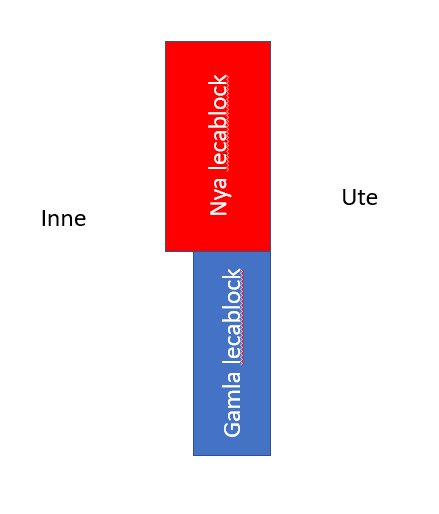
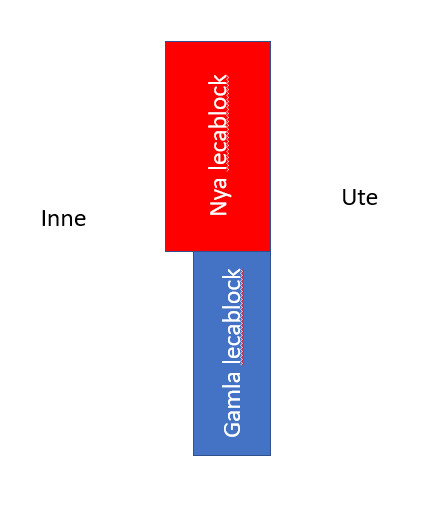
My house is being rebuilt on the site where the previous house was demolished. The first floor consists of leca walls. However, since the new first floor will have a higher ceiling than before, new leca blocks have been built on top of the old ones. Both the old and new wall sections are about 1.5 m each (i.e., 3 m ceiling height in total).
The old leca blocks were 19-20 cm wide. The new ones that have been added are 25 cm wide. They are flush on the outside, creating an overhang on the inside.
The end result we want is a smooth painted surface, and the interior dimensions are tight, so centimeters are valuable.
What do you think we should do?
Ideally, we would like to remove the extra 5 cm that encroach from the new leca blocks since they can hardly help with support when they have nothing underneath them, they take up a lot of space, and they add extra work to align the inside.
If there is no smart way to remove the overhang on the inside, how do you think we should "fill out" the old leca blocks for the overhang from the new ones?
I ask myself the same questions. Saw this today when I passed by the construction site. Will get back with answers once I receive them from the builders.
But I thought I'd already start exploring possible solutions since redoing the wall is probably not an option.
That the extrusion is only on the inside is because they seem to have wanted to align the outside since insulation and then wood facade will be installed.
That they have built on the old wall is because the new house has the same dimensions as the old one, and it was therefore just as good to start from what was already there instead of demolishing and building the same.
There are four walls. Two of them are approximately 8 meters and the other two are about 10 meters, and the height of the new part of the wall is about 1.5 meters. I was also thinking about option 3. I am not knowledgeable at all in this subject, so I apologize in advance. I have seen milling machines for milling out tracing. I'm wondering if there are wider ones that could be used to systematically mill down the old blocks to align with the old wall. I'm not really sure what machines exist for this. Is it completely foolish/complicated given the alternatives?
With such milling of 4-5 cm, would it affect the load-bearing capacity of the block? I'm thinking if there is some structure in the block that creates strength.
Exciting situation. I, like everyone else, am obviously wondering why you chose wider blocks on top when you clearly didn't want them?
The fastest option is obviously to build up with narrower blocks on the inside. But if that's not an option and you want to go down to 190mm, the quickest way is probably to remove the new masonry and use the right blocks - but it certainly won't be the cheapest...
Cutting you can probably forget; it will never be good. The only thing is to build on the wall at the bottom with thin blocks or thick plaster. But that's a lot of work too. You might be able to build on with a thin insulation board at the bottom and then plaster it together with the new blocks to make it smooth. But it's a bit fiddly and requires plaster mesh, etc.