I need to remove about 8 mm along the entire length of an already mounted door casing that has been painted with several layers of paint. This is to make room for a Kulokabel, also past a large mirror, which is flush against the casing and thus prevents me from simply clamping it as usual on the outside of the casing.
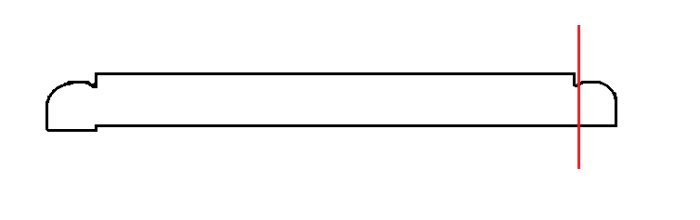
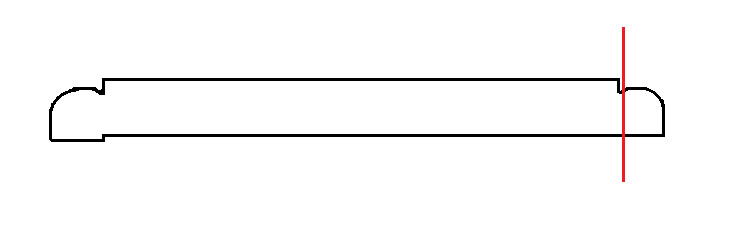
The casing has roughly this profile, and it is at the red line that needs to be removed:
The mirror that is in the way can be taken down, but it must be put back in the same place afterwards.
Tips on how I can do it. I have a plunge saw with rail, router, multi-tool (pmf180), Japanese saw, etc. in my tool arsenal. And something new might also be acquired if that's the only, or absolutely best way to solve it. Everything will be painted afterwards, so the surface layers don't need to be preserved.
I only have a really crappy picture, it's this casing's right side that needs to be milled down about 8 mm.
I think it's tricky to make it look good with a multimaster - in my book, it's best when cutting against the grain, not along the fibers. I would probably try to attach a guide on the molding and then use a hand router. Just a thought - if you're redoing the surface, why not simply remove the molding carefully and cut with a table saw or plunge saw?
Given that we're talking about a casing and not an entire apartment complex:
If the installation surface of the casing is as flat as your sketch suggests, I would place a straightedge or equivalent on top of the casing, clamp it through the doorway, and then let the multi-tool run along it. Of course, you have to keep an eye on the angle, but it still feels manageable (and easier than, for example, whipping up the entire bed saw with a track on the wall...)
It might be easier if you set the blade at ~90 degrees so the machine can run along the track rather than sticking straight out, though it could become trickier at the end of the strip.
I wonder if I should try with the multi-tool anyway. Keeping it simple is certainly a nice thought. Setting up tracks can take time. Using the crescent-shaped blade must be good, it probably guides straight better?
I don't understand why so many are against the multi-tool. If you take it easy and use the half-moon blade, it shouldn't be that difficult to get it straight. It doesn't create much dust either.
One should also install the cable before painting, so a bit of wobble might disappear because of that.
But at the same time, it would be unfortunate if it didn't become invisible at all after caulking and painting, so a bit of "better be safe than sorry," I think too.
The multi-cutter works quite well when you can run it down in the profile groove.
It might be too full of paint, and/or perhaps uneven for that reason.
I don't know, and it's not at home so I can't check now.
But I'm considering if I should attach a strip/batten type, with a few brads, and then saw with the crescent-shaped blade guided along the strip.
If I take it easy and stay focused, it should go reasonably well.
Isn't it perfect with a half-moon and a multicutter there, angled so the machine runs largely parallel with the wall and a guide rail for the blade. Easy to handle and as nice as one can request if you are careful, all other heavier machines in that position and aligned with rails, etc., should be considerably more difficult to handle.
2 clamps, plunge saw. Finish towards the floor with the multi-cutter.
I've been considering that too.
But the walls are almost 40 cm thick :eek:
But there are long clamps too. My longest one-handed clamps might just barely be enough.
But there are advantages as well, there tends to be significantly less dust with the plunge saw if I use the vacuum cleaner attachment. Not to be underestimated.
Vi vill skicka notiser för ämnen du bevakar och händelser som berör dig.