
4,693 views ·
34 replies
5k views
34 replies
Temporary 12m long beam
Hello
I need to put together a temporary beam of 12m, which will only be supported at the ends. It will only support a tarp.
I'm thinking of screwing together three 4.8m long 120x21mm boards to 12m and then also placing 120x21mm "on top" to create a T-beam.
Do you think this could be stable enough to lift and support a tarp as protection against night frost and possibly rain? It will not be used in case of snowfall.
I need to put together a temporary beam of 12m, which will only be supported at the ends. It will only support a tarp.
I'm thinking of screwing together three 4.8m long 120x21mm boards to 12m and then also placing 120x21mm "on top" to create a T-beam.
Do you think this could be stable enough to lift and support a tarp as protection against night frost and possibly rain? It will not be used in case of snowfall.

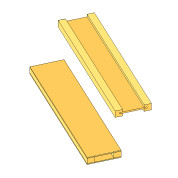

If you do as planned, the "tvär" part should be downward to be able to take up the load. That's the whole idea with a T-beam.

It is probably difficult to manufacture a temporary beam that can withstand loads from both the side and above without becoming very large and heavy. If the beam is only meant to support a tarp, then the tarp probably stiffens the side loads somewhat, and of course, it is possible to set up lines from the beam to further brace it laterally.

Seems odd. I myself have a tarpaulin on the caravan that stays in place precisely because the snow is dirty. Possible rain actually sounds really screwy. Where do you live?ToRy said:

I don't think it's stiff enough to support itself even, but will buckle sideways and then collapse completely.Snickerick said:
It requires something like a suspension bridge or supports underneath.

Yes, the whole idea is that it must support itself without problems, it must become stable both in height and sideways; if it's only stable in height, it will buckle sideways and twist, cave in like you write mycke_nu.
Carl_Elvis, which parts do you mean should be down when you say the cross part? My thought is that it should be mounted like a T, with the flat side up and the shaft of the T standing, that should be the most stable, right?
I might have to try and see if it works. The thing is, I have that particular material. The idea of using masonite might be good, such beams do exist in reality, but how about the length and lateral stability? It feels doubtful.
To those of you who find it odd, etc., what happened to your imagination and detective skills? What might someone hanging out on byggahus possibly want to temporarily cover with a tarp for rain and frost protection, in this size? And for those who don't figure it out directly, there's a very good tip just two to three clicks away And those who get there can discuss it there instead, so we don't spoil the fun for others here Some Christmas crafting we shall have
What load should it take and whether it should withstand snow? I hope that was clear from my first post!?
Should it withstand wind? Well, what should I say to that, how long is a piece of string
Carl_Elvis, which parts do you mean should be down when you say the cross part? My thought is that it should be mounted like a T, with the flat side up and the shaft of the T standing, that should be the most stable, right?
I might have to try and see if it works. The thing is, I have that particular material. The idea of using masonite might be good, such beams do exist in reality, but how about the length and lateral stability? It feels doubtful.
To those of you who find it odd, etc., what happened to your imagination and detective skills?
What might someone hanging out on byggahus possibly want to temporarily cover with a tarp for rain and frost protection, in this size? And for those who don't figure it out directly, there's a very good tip just two to three clicks away And those who get there can discuss it there instead, so we don't spoil the fun for others here Some Christmas crafting we shall have What load should it take and whether it should withstand snow? I hope that was clear from my first post!?
Should it withstand wind? Well, what should I say to that, how long is a piece of string
To take load from above, your T should be upside down, otherwise it gives nothing.
Oh, why is a T-construction better at taking load from the "shaft side" than from the "top side"? I didn't think it made any difference. I thought that the thing with forces and counterforces would make it the same if you turn it 180 degrees!?

Member
· Västerbottens län
· 18 060 posts
If it should just be a T, then it should lie like a T, it's the top side that wants to wrinkle. The bottom edge only has tensile forces, so it probably stays straight.
As Carl Elvis reasons, it's wrong, it's the same forces on both the top and bottom, just in different directions.
Protte
As Carl Elvis reasons, it's wrong, it's the same forces on both the top and bottom, just in different directions.
Protte
It depends on the material. Some can withstand almost any amount of pressure (e.g., concrete) but cannot be stretched at all (hence the need for reinforcement).
For wood, the tensile strength in the fiber direction is twice as high as the compressive strength, i.e., the T should be upside down.
[TABLE="class: tabgul tab100, width: 743"]
[TR]
[TD][/TD]
[TD]In the fiber direction
(MPa)[/TD]
[TD]Across the fiber direction
(MPa)[/TD]
[/TR]
[TR]
[TD]Tensile strength[/TD]
[TD]100[/TD]
[TD]3[/TD]
[/TR]
[TR]
[TD]Compressive strength[/TD]
[TD]50[/TD]
[TD]7[/TD]
[/TR]
[TR]
[TD]Shear strength[/TD]
[TD]10[/TD]
[TD]5[/TD]
[/TR]
[/TABLE]
Table 1. Approximate strength values for defect-free spruce and pine timber.
For wood, the tensile strength in the fiber direction is twice as high as the compressive strength, i.e., the T should be upside down.
[TABLE="class: tabgul tab100, width: 743"]
[TR]
[TD][/TD]
[TD]In the fiber direction
(MPa)[/TD]
[TD]Across the fiber direction
(MPa)[/TD]
[/TR]
[TR]
[TD]Tensile strength[/TD]
[TD]100[/TD]
[TD]3[/TD]
[/TR]
[TR]
[TD]Compressive strength[/TD]
[TD]50[/TD]
[TD]7[/TD]
[/TR]
[TR]
[TD]Shear strength[/TD]
[TD]10[/TD]
[TD]5[/TD]
[/TR]
[/TABLE]
Table 1. Approximate strength values for defect-free spruce and pine timber.