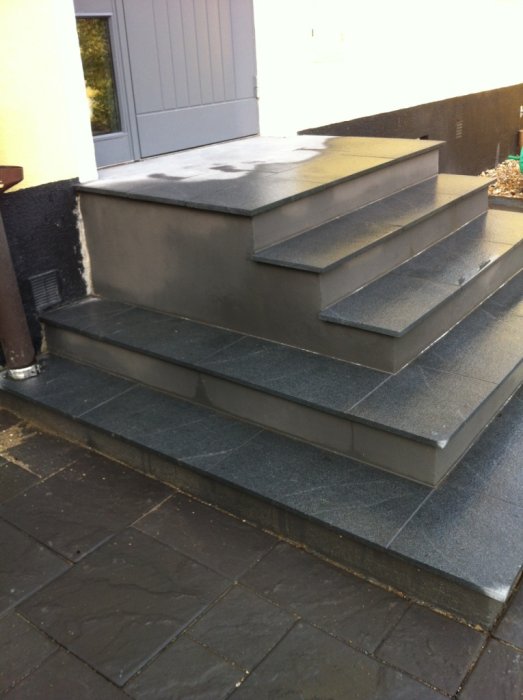
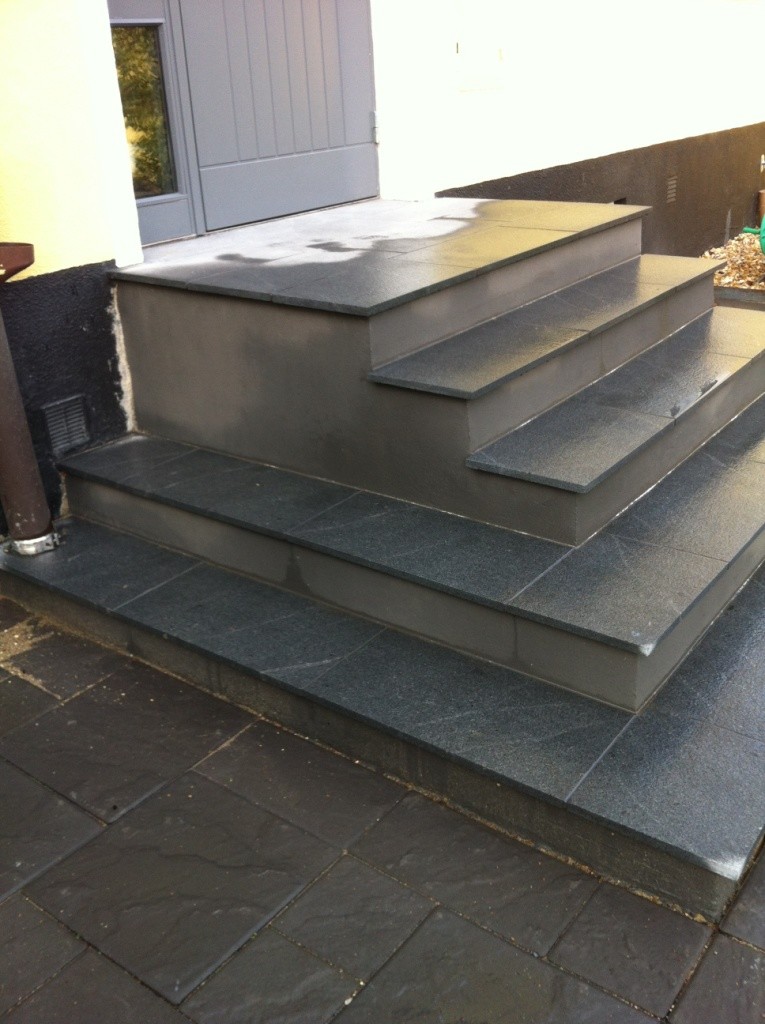
In the spring of 2012, our outdoor environment was renovated. At the same time, a new staircase to the entrance was built. It turned out very nice, but is probably totally misconstructed.
Previously, we had a staircase that was a pre-cast concrete staircase with riverstone. Installed in the late 70s and surely the most modern available at that time, but not so fun nowadays.
In conjunction with the entire outdoor renovation, we got new drainage, making it necessary to demolish the old staircase. We also got the opportunity to have a nicer, more modern staircase. The person who designed the entire renovation of the outdoor environment also designed the staircase and suggested how it should look. And yes, it turned out cool, at least design-wise. But, as we see it in hindsight, a disaster construction-wise.
The staircase is built from masonry lecablocks placed on a cast footing. If I remember correctly, I didn't see any reinforcement in the footing. But maybe there shouldn't be reinforcement in such a footing? Then the staircase is plastered. And one might ask what they plastered with? Afterwards, stone slabs were laid on top grouted with some type of tile grout. Then we painted the plaster ourselves with silicate paint.
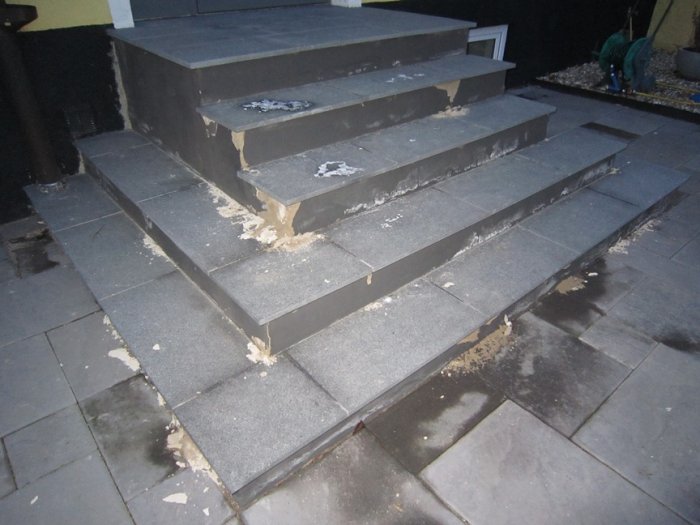
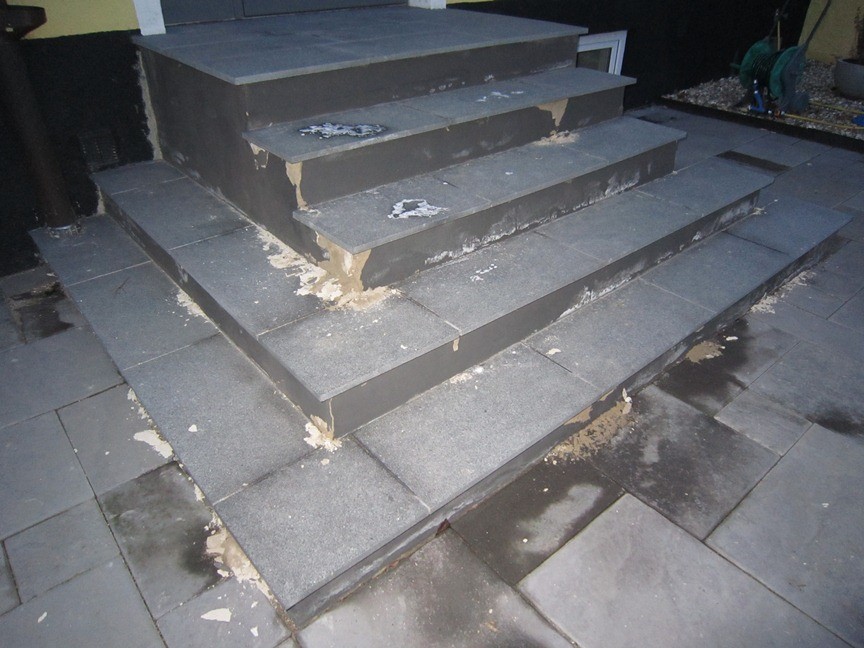
As you can see in the pictures, the staircase has frozen and shattered this winter. It also looks like it acts like a sponge and absorbs a lot of water. Naturally, we've had to salt, this is in southern Skåne. It has snowed, thawed, and frozen alternately, with slick ice on the stairs some days.
Another odd thing is that we never talked about or were suggested a handrail. During this time, we've realized the staircase feels a bit dangerous, it's a long way down from the top plateau. If you’re standing at the top of the staircase with a few shopping bags, it’s very easy to misstep and fall. What little I've read about regulations from Boverket says there should be a handrail on both sides if the staircase is higher than 50 cm. Shouldn't the designer of the staircase know that?
Yes, we are going to file a complaint about this job. Things have to be redone. It can't be done right now; it needs to be warmer first.
But what do you experts think we should demand the company do about this? It would be good to have more knowledge before we contact the company for resolution.
It didn't look good, but salting concrete is, as far as I know, not a good thing... But it shouldn't look like that...
Yes, I agree with that. But it's included in the concept of "poorly constructed". We need to be able to salt steps here in southern Skåne, considering snow/thaw/freeze degrees/plus degrees/black ice. You shouldn't mess with black ice on such steps!
Yes, this staircase was quite poorly constructed, one might say!
Form hardly follows function in this case.
I probably wouldn't file a complaint about this staircase, because if you salt this construction, it turns out this way, unfortunate that you weren't informed that it's not salt-resistant.
However, I hope you can file a complaint about this staircase, that would be really good.
When ordering a new staircase, you probably need to consider a requirements specification first, such as:
Salt-resistant.
Correct step height.
Handrail.
Sufficiently large tread landings.
Durable material, a stone staircase should last 100 years.
No sharp corners.......
No, I absolutely do not agree with you that it has to be a construction defect, regardless of whether it is Skåne or Norrland. Frost shattering in concrete and masonry constructions occurs if water penetrates into these structures. BUT the problem becomes much worse due to the salt that makes the expansion volume 10-15% larger and thus the damage will only increase and become like in the picture. If you have to use salt, you must choose other materials. I myself have lived/am partly living in Skåne with a cast staircase from the 1920s for many years, and have managed with a broom, shovel, and gravel because I have tried to avoid this kind of problem.
If the stairs break due to salting, they are either poorly constructed or improperly treated. We can certainly argue about this, as we have different opinions.
But... how should the original poster proceed when ordering a new staircase to make it salt-resistant and durable?
I personally salted a staircase 20 years ago... incredibly foolish of me as the stairs practically dissolved during the winter... but the new stairs I built, on the other hand, were completely shovel-free since I made them out of steel grating. They weren't very beautiful, but oooh, it was incredibly nice not having to shovel the stairs!
I have salted the stairs for a couple of years. The only concern is salt stains on the hallway floor...
Have they placed the steps with the correct incline?
The only way for the salt to penetrate those stairs is if the steps are sloping inward.
In other words, I DON'T think it's the salt. Wrong concrete or poorly mixed concrete rather.
If you look at the pictures, I don't think water has seeped in from above, but rather from the steps and in the sides where it has been absorbed. One reason for such extensive damage could be salt, but it could also be an unsuitable choice of plaster. Lime plaster absorbs water like a sponge.
The question is whether such an exposed construction should be plastered at all, maybe it would have been better to cast in frost-resistant concrete.
It certainly looks like there should have been a railing. The question is whether the responsibility for that oversight lies with the company or with you; what type of agreement did you have?
If you want to prevent slipping, it should be done with sand or other safe means to melt the ice.
As far as I can see, it's "just" the plaster that has frozen and cracked. It's hardly a construction error but rather an execution flaw. This can, for example, be due to not watering properly in the first few days after plastering, causing the plaster to dry out too quickly. Then the plaster becomes weak and can't withstand frost damage from water absorbed by the plaster. If the plaster reaches full strength, it can withstand frost damage without breaking when water is absorbed into the plaster's pores.
You should be able to complain about the plastering, but I think the biggest concern is the design of the entire staircase.
In addition to the lack of a railing, I think the platform in front of the door is way too small.
I don't really buy the explanation that it's just salt. A lot of the damage is on the upper part of the steps and on parts of the stairs that aren't salted. We've only salted the walkway, not everywhere. But there's damage everywhere, even where it hasn't been salted.
We ordered "all inclusive," meaning the company both designed and executed the job. We've had opinions on what kind of stone should be on top of the stairs, a bit on how the lawn should be designed, and those purely design-related things. But nothing about the construction. If this company offers a total package, I think they should have the knowledge of what's required and what building regulations exist. For instance, they should know that stairs this high require a handrail.
We haven't talked to the company or complained about the job yet. But how do you think we should complain? What should we say to them? I don't think there will be any real problems getting them to address the issues. But what and how should we require them to fix the problems?
I find it hard to imagine that the plaster release is due to anything other than frost burst. The water has seeped behind the plaster, and the most likely scenario is that meltwater has come through the joints and over the fix and down behind the plaster. By that time, the salt concentration has dropped enough to form ice and POP, it shoots off the plaster. I think you should still file a complaint and at the same time strongly consider redesigning parts of the staircase to make it practical and safe. For the latter, you'll probably have to pay a few bucks.
If you look at the picture from last fall, you can see that the stairs are wet in various places. So before winter and before the salt possibly made things even worse.
Vi vill skicka notiser för ämnen du bevakar och händelser som berör dig.