
10,342 views ·
34 replies
10k views
34 replies
The aerated concrete cracked. What do I do now?
Hello.
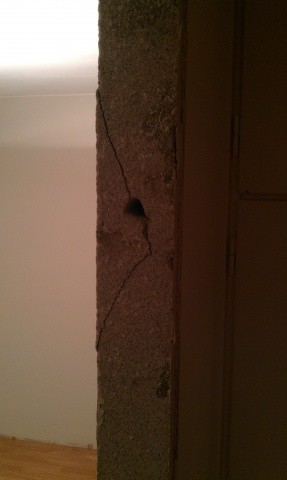
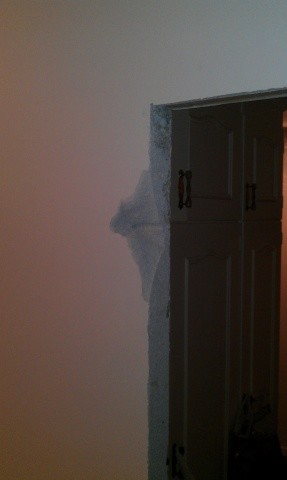
I was installing a new door frame in a thin (~70 mm) interior wall made of aerated concrete (or something similar, did they have aerated concrete in the 60s?). I bought frame screws and matching aerated concrete plugs. Measured and drilled and hammered in the plugs. Then when I started screwing the frame in place, what I was a bit concerned about happened. The wall cracked and large pieces came off around a couple of the screws. I probably shouldn't have used frame screws+plugs in that thin wall. The old frame was nailed with large square nails.
Now to the big question. How on earth do I fix this? Can I somehow glue and clamp the loose piece? Is there any glue that can hold this kind of porous stuff? Can something be cast into it? Primarily, I just want the wall to look intact again from the front side. As for the door frame, I can probably forget about using the current holes in the frame, and will have to plug them and drill new ones, securing the frame to the wall with long nail plugs or similar. Attaching pictures of the mess.
I was installing a new door frame in a thin (~70 mm) interior wall made of aerated concrete (or something similar, did they have aerated concrete in the 60s?). I bought frame screws and matching aerated concrete plugs. Measured and drilled and hammered in the plugs. Then when I started screwing the frame in place, what I was a bit concerned about happened. The wall cracked and large pieces came off around a couple of the screws. I probably shouldn't have used frame screws+plugs in that thin wall. The old frame was nailed with large square nails.
Now to the big question. How on earth do I fix this? Can I somehow glue and clamp the loose piece? Is there any glue that can hold this kind of porous stuff? Can something be cast into it? Primarily, I just want the wall to look intact again from the front side. As for the door frame, I can probably forget about using the current holes in the frame, and will have to plug them and drill new ones, securing the frame to the wall with long nail plugs or similar. Attaching pictures of the mess.

You should have used cut nails. http://www.beijerbygg.se/templates/BB_ProduktListingFlera.aspx?id=9882
I've just been working with a door frame in a lightweight concrete wall. (Had to remove the frame to install the parquet floor.) Unfortunately, the cut nails that Beijer sells are a bit too short. The ones that were in the frame were about 160 mm long. I pulled the nails out of the wall and knocked them out of the frame and then welded them together. I had no problem attaching the frame afterward. To be safe, I also used a little foam sealant. Do you have any nails left in the wall/frame?
I've just been working with a door frame in a lightweight concrete wall. (Had to remove the frame to install the parquet floor.) Unfortunately, the cut nails that Beijer sells are a bit too short. The ones that were in the frame were about 160 mm long. I pulled the nails out of the wall and knocked them out of the frame and then welded them together. I had no problem attaching the frame afterward. To be safe, I also used a little foam sealant. Do you have any nails left in the wall/frame?
Regarding the piece that has come loose, I'm not sure if it can be glued, but I have repaired some with Finja's Puts and Murbruk. In your case, I would have nailed a few 3-inch nails, watered, and repaired with plaster and the murbruk. The nails help keep the piece in place while the mixture sets.
Yep, that's how the old frame was attached. Both the frame and the nail are at the dump. The lightweight concrete package with frame screws was probably for slightly thicker wallsJanneL said:You should have used klippspik. [link]
I recently worked on a door frame in a lightweight concrete wall. (I had to remove the frame to lay the parquet floor.) The klippspik sold by Beijer is unfortunately a bit too short. The one that was in the frame was about 160 mm long. I pulled the nail out of the wall and knocked it out of the frame, then welded them together. Had no problems securing the frame afterward. To be safe, I also used a bit of foam sealant. Do you have nothing left of the nail in the wall/frame?

Four, I think. Possibly three if one was missing in one of the holes. On the other side of the frame, there's a wooden stud, so there's no problem there. It's only one side that needs to be fixed into the lightweight concrete.
Shouldn't one be able to drill for the longest available nail plug and insert the "plugs", put spacers, and nail the frame in place? But maybe cut nails are better? It seems like Gunnebo makes them 175 mm long, the question is where to find them.
Shouldn't one be able to drill for the longest available nail plug and insert the "plugs", put spacers, and nail the frame in place? But maybe cut nails are better? It seems like Gunnebo makes them 175 mm long, the question is where to find them.
