
16,321 views ·
19 replies
16k views
19 replies
The brick facade collapsed =(
Now it feels heavy being a homeowner. Yesterday, just as I had settled on the couch, I heard scratching noises in the wall by the window. I went there and heard it escalate; I barely made it in time to see the brick fall from the window towards the front. I went outside and was met with a minor war zone. The collapse on the gable had pulled all the bricks on the front up to the front door :S
Very bad timing, right in the middle of window replacement. Both windows around the collapse were replaced and survived without any damage as far as I've seen. I've been stacking bricks and chipping mortar since I got home from work until now, so all the bricks are on pallets, but I'll take down the rest that didn't collapse on the gable, tomorrow.
So to the question. Now that the whole mess is down, it feels like it’s just as well to make improvements. The house is from '65, so a lot has happened since then. My exterior walls seem to be constructed as follows from the inside (which I will verify by taking down the asfaboard and inspecting it over the weekend).
- Wallpaper
- Porous fiberboard 13mm
- Standing grooved wood 35mm
- Insulation and horizontal studs about 100mm
- Asfaboard-like panels about 15mm
- Polystyrene 30mm
- Air gap
- Brick
So what is best to do with the wall?
I'm considering tearing down everything up to the thick insulation, putting up standing studs 45-70mm with insulation in between, adding wind-paper, and then brick.
Here are some pictures of the mess.
Very bad timing, right in the middle of window replacement. Both windows around the collapse were replaced and survived without any damage as far as I've seen. I've been stacking bricks and chipping mortar since I got home from work until now, so all the bricks are on pallets, but I'll take down the rest that didn't collapse on the gable, tomorrow.
So to the question. Now that the whole mess is down, it feels like it’s just as well to make improvements. The house is from '65, so a lot has happened since then. My exterior walls seem to be constructed as follows from the inside (which I will verify by taking down the asfaboard and inspecting it over the weekend).
- Wallpaper
- Porous fiberboard 13mm
- Standing grooved wood 35mm
- Insulation and horizontal studs about 100mm
- Asfaboard-like panels about 15mm
- Polystyrene 30mm
- Air gap
- Brick
So what is best to do with the wall?
I'm considering tearing down everything up to the thick insulation, putting up standing studs 45-70mm with insulation in between, adding wind-paper, and then brick.
Here are some pictures of the mess.
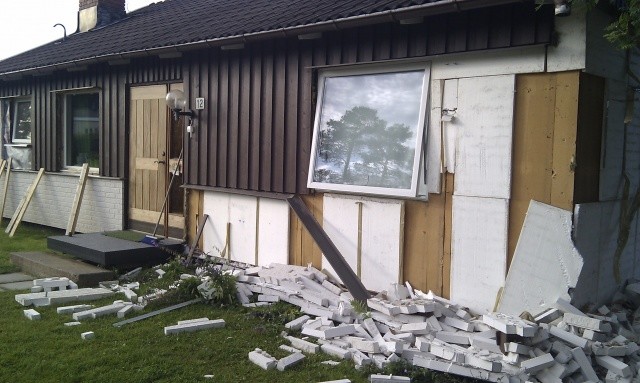

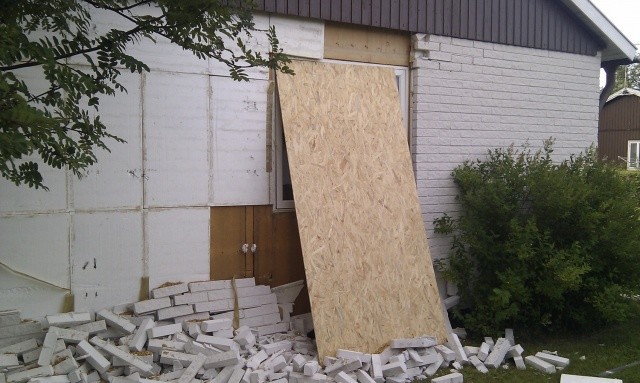




Now I have "cleaned" and it feels a bit better when it doesn't look like the house is about to collapse 
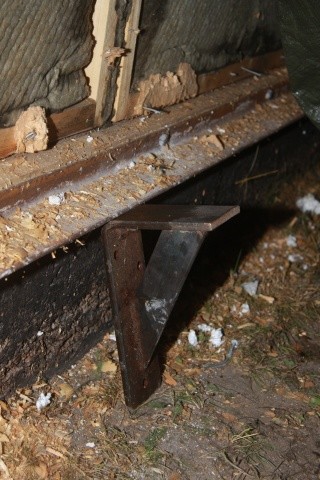
The entire brick facade was resting on an angle iron that over time has started to give way. I've noticed that the wall has bulged (for several years before we bought the house) by the living room window and I actually planned to address it in the spring. And it wasn't just the angle iron that was substandard. There were nails driven in that were then embedded in the mortar between the stones, but they were too short and probably only went in 1-2cm into the wooden beams. One wall has been redone before, and there the support at the bottom is turned the other way, it's thicker and longer in all directions and has a diagonal brace.
It was very lucky that no one was injured. Just 1½ hours earlier, children and the dog were running right around this area.
Anyone have an idea about additional insulation or any input on my suggestion? Also, any suggestions on what I should do at the bottom near the ground, today there are some hook screws that look terrible. Ground insulation with something durable on the outside?
Some pictures, in the last one you can see the angle iron.
The entire brick facade was resting on an angle iron that over time has started to give way. I've noticed that the wall has bulged (for several years before we bought the house) by the living room window and I actually planned to address it in the spring. And it wasn't just the angle iron that was substandard. There were nails driven in that were then embedded in the mortar between the stones, but they were too short and probably only went in 1-2cm into the wooden beams. One wall has been redone before, and there the support at the bottom is turned the other way, it's thicker and longer in all directions and has a diagonal brace.
It was very lucky that no one was injured. Just 1½ hours earlier, children and the dog were running right around this area.
Anyone have an idea about additional insulation or any input on my suggestion? Also, any suggestions on what I should do at the bottom near the ground, today there are some hook screws that look terrible. Ground insulation with something durable on the outside?
Some pictures, in the last one you can see the angle iron.


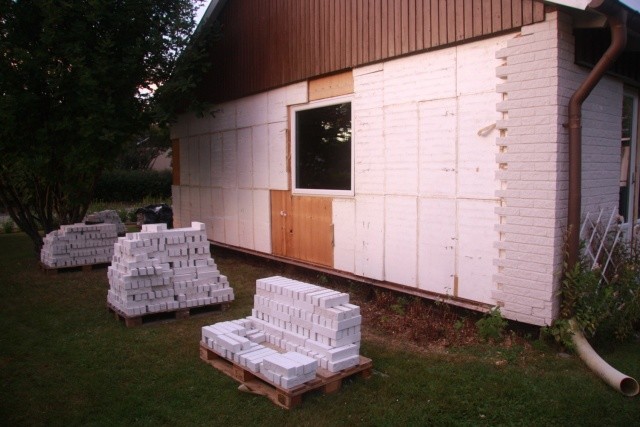


Bad when the facade brick crumbles. Probably time to tear down everything else and redo it.
I was an assistant when they built such walls. We had similar angle irons, but with half-meter long "suspenders" that were welded flat irons attached to the angle iron and screwed in with several coach screws, further up the wall. Then six-inch nails that were placed with at least 6 per square meter.
I was an assistant when they built such walls. We had similar angle irons, but with half-meter long "suspenders" that were welded flat irons attached to the angle iron and screwed in with several coach screws, further up the wall. Then six-inch nails that were placed with at least 6 per square meter.
Hanging the bricks on angle iron? It must be like playing the lottery. The material it's mounted on is quite flexible/springy. I would remove it and sell it for scrap. Then I would dig a bit around the house, drill and insert rebar, and cast a concrete ledge. Then the bricks would be mounted!
That's what we did about 30 years ago in our first house! And no bricks have fallen yet!
That's what we did about 30 years ago in our first house! And no bricks have fallen yet!
Now I've finished with other things, so I can really tackle this. I've done some research and concluded that it seems like a klimatskiva/board is the best to replace the writing material (I don't think it's asfaboard) and the styrofoam with. Now the wall is a bit oddly constructed with 120cm sections and a few cm gaps, so it becomes a bit awkward with the seams, but maybe it doesn't matter. The iron that sits at the bottom will remain but will be reinforced with another angle iron underneath. This solution was made on another wall that was about to meet the same fate and it has now stood for 20 years without a single crack. Clearly, it is best to cast a ledge as kamilenski suggests, but I can't begin with that now. There was an iron left from earlier, so it's just about fixing more.
Some pictures of the Skiten.
Some pictures of the Skiten.

Member
· Västra Götalands Län
· 529 posts
Don't forget to call your insurance company! A better example of an "unexpected, unforeseen event" is certainly hard to find!!
