
4,814 views ·
2 replies
5k views
2 replies
Tearing down interior ceiling, found broken arch, what to do?
Member
· Västra Götaland
· 3 posts
Hi!
First post here. I've encountered a problem during the renovation that I'm not really sure how to solve. I live in a condominium in a building constructed just before the last turn of the century. After removing a ceiling in the hallway, I found a ventilation pipe running straight through an arch, about 40 cm thick, where they had knocked out one of the supporting parts of the corner. Several cracks ran straight through the arch near the hole. It simply looked dangerous (picture attached). Therefore, I took down the two layers of bricks that had no support (second picture). A long time ago, there used to be some kind of small wood stoves in all the hallways of the house, which are now removed, so I have a hard time seeing that the arch has any load-bearing function today.
Should I - as the craftsmen did sometime in the 80s - simply ignore the arch and build it into a box? Rebuild it? How should one go about doing that? I'm extremely grateful for any tips/advice/ideas.
First post here. I've encountered a problem during the renovation that I'm not really sure how to solve. I live in a condominium in a building constructed just before the last turn of the century. After removing a ceiling in the hallway, I found a ventilation pipe running straight through an arch, about 40 cm thick, where they had knocked out one of the supporting parts of the corner. Several cracks ran straight through the arch near the hole. It simply looked dangerous (picture attached). Therefore, I took down the two layers of bricks that had no support (second picture). A long time ago, there used to be some kind of small wood stoves in all the hallways of the house, which are now removed, so I have a hard time seeing that the arch has any load-bearing function today.
Should I - as the craftsmen did sometime in the 80s - simply ignore the arch and build it into a box? Rebuild it? How should one go about doing that? I'm extremely grateful for any tips/advice/ideas.
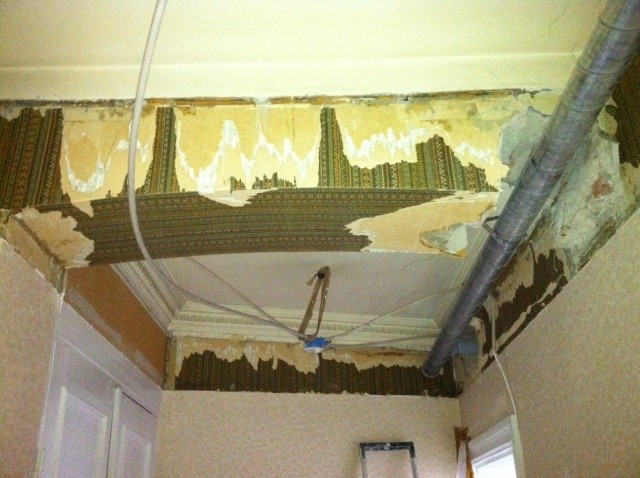
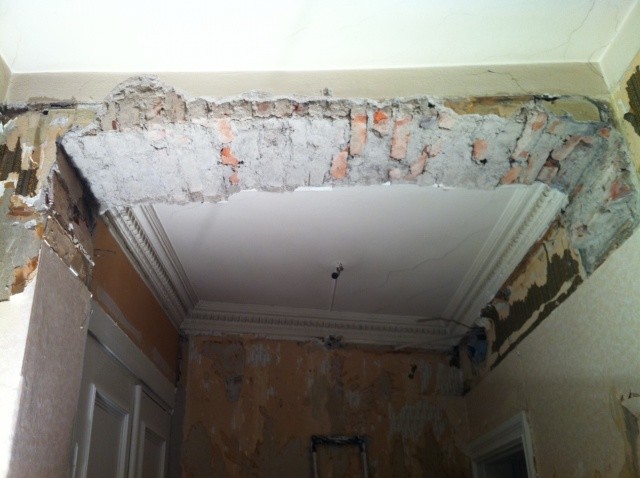

The first question is what kind of ventilation duct is there and does it have anything to do with your apartment?
The vault is really the association's problem, but if the vault has been damaged by a previous apartment owner, i.e., if the duct has been installed as a separate initiative, you may be liable to the association to fix the issue. In that case, I would almost think this could fall under the Sales Act, meaning you could claim compensation from the person who sold the apartment to you. There are rules there similar to those for hidden defects in properties (although these are two completely different laws).
It certainly looks unpleasant and could possibly fall down at any time. It's possible you shouldn't have removed bricks without consulting a structural engineer and the association. The vault is a part of the building's load-bearing structure, and you can't make alterations without the association's permission. If necessary, I don't think it would need to be very large or expensive to install one or a couple of steel beams for reinforcement.
Expect 5 - 600 SEK per meter of beam and maybe 2 men for a day to install them in place.
The vault is really the association's problem, but if the vault has been damaged by a previous apartment owner, i.e., if the duct has been installed as a separate initiative, you may be liable to the association to fix the issue. In that case, I would almost think this could fall under the Sales Act, meaning you could claim compensation from the person who sold the apartment to you. There are rules there similar to those for hidden defects in properties (although these are two completely different laws).
It certainly looks unpleasant and could possibly fall down at any time. It's possible you shouldn't have removed bricks without consulting a structural engineer and the association. The vault is a part of the building's load-bearing structure, and you can't make alterations without the association's permission. If necessary, I don't think it would need to be very large or expensive to install one or a couple of steel beams for reinforcement.
Expect 5 - 600 SEK per meter of beam and maybe 2 men for a day to install them in place.
Member
· Västra Götaland
· 3 posts
Thank you very much for your response! The ventilation pipe in the picture brings air into the living room and bedroom. I have temporarily removed it.
About 30 years ago, supply air was installed in all apartments in the building. Therefore, there are likely more apartments with the same problem above and below our apartment. However, no one else has removed their ceilings. I didn't dare keep it as it was, and I took it down after talking to the board. The arch was mostly just 100-200 kg of bricks hanging freely in the air... Cracks were found near the hole, but none at the attachment point on the left that remained. Hence, my hesitation about whether it had any load-bearing function. Houses from that time were often built with both a belt and suspenders. On both sides of the hall, to the right and left in the picture, are half-meter thick brick walls. The craftsmen who installed the pipes must have thought it through and gotten permission in some way...?
My first thought was to reinforce with mesh and mortar/plaster what's left now, given that it's just decoration. But if we can determine that it's a load-bearing arch, your suggestion certainly sounds better. How can one know?
I haven't thought about the responsibility issue. So, it might be the association's responsibility to take care of all the apartments?
About 30 years ago, supply air was installed in all apartments in the building. Therefore, there are likely more apartments with the same problem above and below our apartment. However, no one else has removed their ceilings. I didn't dare keep it as it was, and I took it down after talking to the board. The arch was mostly just 100-200 kg of bricks hanging freely in the air... Cracks were found near the hole, but none at the attachment point on the left that remained. Hence, my hesitation about whether it had any load-bearing function. Houses from that time were often built with both a belt and suspenders. On both sides of the hall, to the right and left in the picture, are half-meter thick brick walls. The craftsmen who installed the pipes must have thought it through and gotten permission in some way...?
My first thought was to reinforce with mesh and mortar/plaster what's left now, given that it's just decoration. But if we can determine that it's a load-bearing arch, your suggestion certainly sounds better. How can one know?
I haven't thought about the responsibility issue. So, it might be the association's responsibility to take care of all the apartments?
Click here to reply