
10,383 views ·
33 replies
10k views
33 replies
Tear down the ceiling and put up drywall?
Hello,
We are in the process of renovating the kitchen and thought we might replace the ceiling at the same time. Today it looks like this:


http://i.imgur.com/dKQEBMv.jpg
You can see pieces of the original ceiling underneath, and our first thought was to just tear down the wood ceiling and let the original ceiling remain (which probably looks the same as the rest of the house). The problem is likely that it's full of holes from screws/nails.
This is what the ceiling looks like in other rooms:

http://i.imgur.com/Pn8cW9w.jpg
Of course, one could tear down both the wood ceiling and the original ceiling, but the question is if there's any point in doing so? Or could we perhaps manage by just tearing down the wood ceiling and then putting drywall directly on the original ceiling (filling the gaps), i.e., the way the wood ceiling is attached today?
We would love to have an entirely white ceiling without traces or similar, but the question is if it's possible in a house where the structure is made of wood? We can see some walls where there has been so much movement that cracks have appeared in the wallpaper, though those wallpapers are probably from the 70s.
We are in the process of renovating the kitchen and thought we might replace the ceiling at the same time. Today it looks like this:
http://i.imgur.com/dKQEBMv.jpg
You can see pieces of the original ceiling underneath, and our first thought was to just tear down the wood ceiling and let the original ceiling remain (which probably looks the same as the rest of the house). The problem is likely that it's full of holes from screws/nails.
This is what the ceiling looks like in other rooms:
http://i.imgur.com/Pn8cW9w.jpg
Of course, one could tear down both the wood ceiling and the original ceiling, but the question is if there's any point in doing so? Or could we perhaps manage by just tearing down the wood ceiling and then putting drywall directly on the original ceiling (filling the gaps), i.e., the way the wood ceiling is attached today?
We would love to have an entirely white ceiling without traces or similar, but the question is if it's possible in a house where the structure is made of wood? We can see some walls where there has been so much movement that cracks have appeared in the wallpaper, though those wallpapers are probably from the 70s.
I've looked around a bit and there are ready-made panels to put up, which seems convenient. But then there are beveled gypsum boards, which seems to be an interesting solution. Does anyone have this and can show pictures of how it turned out?
Instructions: https://www.byggmax.se/gör-det-själv/vägg-golv-och-tak/bygg-innertak-med-gipsskivor
Product: https://www.byggmax.se/skivmaterial/gipsskivor/takgipsskiva-p07212
Instructions: https://www.byggmax.se/gör-det-själv/vägg-golv-och-tak/bygg-innertak-med-gipsskivor
Product: https://www.byggmax.se/skivmaterial/gipsskivor/takgipsskiva-p07212

We have removed it in the hallway, there were a few holes, but I filled a dosing syringe for liquid antibiotics with putty and pressed into the holes, and sanded lightly when it dried, then painted over. The marks are visible in backlight, but only if you look specifically for them, and I'm the only one who does that. So why not test it in a corner and see how you feel about it?
Yes, I'll make sure to take down some pieces and see what the condition of the roof is really like underneath. Otherwise, beveled plasterboards seem to look nice and are also quite easy to put up if I've understood correctly.
Now we have torn down the ceiling, this is what it looks like underneath:



















You can see here that the ceiling does not go all the way to the outer wall for some reason!? Then you can also see insulation and roof trusses. So you have to assume that these ceiling tiles actually also hold up the insulation, which makes it less fun to pull them down if you now replace the ceiling entirely. We can also see that the ceiling is probably laid through all the rooms, i.e., they are connected between the rooms.


You can see that there is also plastic







You can see here that the ceiling hangs down somewhat; it may be that the ceiling is not sitting all the way up as it should. You can push it up, but it flexes down again.






Link to high-resolution images: http://imgur.com/a/Ctsba
It is not very visible in the pictures, but the ceiling underneath is quite yellow with a lot of marks here and there. I suspect that if you want to fill and apply soft caulk between each tile, we're talking about extensive work. First, you have to sand the entire ceiling, hopefully with some sander where you can stand from the floor. Then you have to fill, sand again, apply a primer coat, and finally apply 2-3 layers of paint. You naturally wonder if it might be less work to put up a new ceiling?
How would you have done it here? Fixed the existing ceiling and added thick ceiling moldings to hide the gap to the outer wall. Or would you have installed a new ceiling, facade gypsum board?
You can see here that the ceiling does not go all the way to the outer wall for some reason!? Then you can also see insulation and roof trusses. So you have to assume that these ceiling tiles actually also hold up the insulation, which makes it less fun to pull them down if you now replace the ceiling entirely. We can also see that the ceiling is probably laid through all the rooms, i.e., they are connected between the rooms.
You can see that there is also plastic
You can see here that the ceiling hangs down somewhat; it may be that the ceiling is not sitting all the way up as it should. You can push it up, but it flexes down again.
Link to high-resolution images: http://imgur.com/a/Ctsba
It is not very visible in the pictures, but the ceiling underneath is quite yellow with a lot of marks here and there. I suspect that if you want to fill and apply soft caulk between each tile, we're talking about extensive work. First, you have to sand the entire ceiling, hopefully with some sander where you can stand from the floor. Then you have to fill, sand again, apply a primer coat, and finally apply 2-3 layers of paint. You naturally wonder if it might be less work to put up a new ceiling?
How would you have done it here? Fixed the existing ceiling and added thick ceiling moldings to hide the gap to the outer wall. Or would you have installed a new ceiling, facade gypsum board?
A flat ceiling in a wooden house is not unusual; it might move/crack if the house settles, but usually, it stops if the house stands fairly steadily...
But I don't think trying to plaster the boards that are there is a good idea, as they probably were never meant to be completely smooth. But adding regular ceiling drywall over them and then taping and plastering should work... It's certainly a lot of work but will likely result in a better finish. I don't think it's something very expensive to hire out, and painters are used to and quick at this, compared to a half-good result and lots of your own work (since it takes time if you're not experienced and have the right tools). There are also ceiling panels that look like the ones already in place. If you find them acceptable, I suspect they are easier to install, which is probably why they exist (because it surely looks nicer with a smooth ceiling, there's a bit of a "office feel" to these ceiling panels, at least I think so, but fortunately, everyone has different tastes).
But I don't think trying to plaster the boards that are there is a good idea, as they probably were never meant to be completely smooth. But adding regular ceiling drywall over them and then taping and plastering should work... It's certainly a lot of work but will likely result in a better finish. I don't think it's something very expensive to hire out, and painters are used to and quick at this, compared to a half-good result and lots of your own work (since it takes time if you're not experienced and have the right tools). There are also ceiling panels that look like the ones already in place. If you find them acceptable, I suspect they are easier to install, which is probably why they exist (because it surely looks nicer with a smooth ceiling, there's a bit of a "office feel" to these ceiling panels, at least I think so, but fortunately, everyone has different tastes).
Install new drywall panels. Available with beveled edges that are slightly smaller and easier to handle if you don't have a panel lift. Then plaster and sand all seams without tape at least 3 times until completely smooth. Then glue Microlite or equivalent fiber fabric on the ceiling. Then paint with ceiling paint. Guaranteed a nice, smooth, and crack-free ceiling.

Renovation rookie
· Dalarna
· 3 173 posts
By pure chance, I've begun to check out the types of ceilings people have at home since I noticed we had canvas ceilings. Imagine my surprise when I realized I had no clue at all about the type of ceilings people have 
Not even those with nice white-painted beadboard ceilings have caught my attention. As long as it's white, you can really go all out before anyone notices.
In other words, don't put your soul into making the ceiling a matter of detail. Efficiency and focus on the right things is my answer
Addition and clarification: repair damage and paint, I say.
Not even those with nice white-painted beadboard ceilings have caught my attention. As long as it's white, you can really go all out before anyone notices.
In other words, don't put your soul into making the ceiling a matter of detail. Efficiency and focus on the right things is my answer
Addition and clarification: repair damage and paint, I say.
Last edited:
Plastering this ceiling perfectly smooth was never my intention; however, plastering away holes and other defects could have been doable but probably quite demanding. Putting up drywall sounds like an easier solution, but on the other hand, you still have to plaster them (the screws) and probably also apply a soft sealant to avoid unsightly cracks. Now I'm talking about beveled panels where you get some form of grid pattern.
Sure, you can probably achieve completely smooth, but it's not fun if it were to crack, which feels like a risk.
So we'll have some form of grid pattern.
There are indeed prefabricated ceilings that are more like parquet panels, but I haven't looked into that yet.
What I'm a bit worried about is that the ceiling currently there doesn't seem entirely stable; it sags slightly, and if you press it upwards, you notice you can push it up by 1 cm or so where there are no beams. Despite that, it seems relatively thick, maybe 2 cm. One idea could be to install tongue and groove or something that you attach to the rafters, but that means the ceiling will eat up an additional 3-4 cm, I suspect.
Sure, if you want to do it thoroughly, you have to go up in the attic, remove all insulation above the kitchen, and then tear down the ceiling. You then have to put up something solid that extends a few centimeters to be stable enough to hold up without sagging.
Sure, you can probably achieve completely smooth, but it's not fun if it were to crack, which feels like a risk.
So we'll have some form of grid pattern.
There are indeed prefabricated ceilings that are more like parquet panels, but I haven't looked into that yet.
What I'm a bit worried about is that the ceiling currently there doesn't seem entirely stable; it sags slightly, and if you press it upwards, you notice you can push it up by 1 cm or so where there are no beams. Despite that, it seems relatively thick, maybe 2 cm. One idea could be to install tongue and groove or something that you attach to the rafters, but that means the ceiling will eat up an additional 3-4 cm, I suspect.
Sure, if you want to do it thoroughly, you have to go up in the attic, remove all insulation above the kitchen, and then tear down the ceiling. You then have to put up something solid that extends a few centimeters to be stable enough to hold up without sagging.
Sounds interesting, you say beveled? You mean not those that are a bit rounded and form a grid pattern? see: https://www.byggmax.se/skivmaterial/gipsskivor/takgipsskiva-p07212JDKahn said:Put up new drywall. There are ones with beveled edges that are a bit smaller and easier to handle if you don't have a panel lift. Then spackle and sand all the joints without tape at least 3 times until completely smooth. Then glue microlite or equivalent fiber fabric to the ceiling. Finally, paint with ceiling paint. Guaranteed to be a nice smooth and crack-free ceiling.
So what you do is buy completely flat drywall that is beveled on the edges, put them up, spackle with regular spackle (not soft caulk) and sand 3 rounds. Don't use tape but instead apply microlite or similar fiber fabric over the entire ceiling? Wouldn't that create a texture like this:

Because that's not particularly nice.
This one is affordable: https://www.byggmax.se/färg/målningstillbehör/glasfiberväv/målarfilt-p18550
Same thing as microlit but withstands more irregularities. The result is nice, but prime with a really cheap paint. It absorbs quite well.
I'm using it throughout the house, both ceiling and walls.
Same thing as microlit but withstands more irregularities. The result is nice, but prime with a really cheap paint. It absorbs quite well.
I'm using it throughout the house, both ceiling and walls.
Yes, that was the board I was referring to.snowjim said:Sounds interesting, you said beveled? You mean not the ones that are slightly rounded and form a grid pattern? see: [link]
So what you do is buy completely flat plasterboards that are beveled at the edges against each other, mount them, fill with regular filler (not soft sealant) and sand 3 times. Do not use strips but instead apply microlite or similar fibrous fabric over the entire ceiling? Won't it then create texture like this:
Because that's not very nice.
Unfortunately, old plaster "tires" after many years even if there's no weight on top. (personal experience) It seems a bit strange not to have something sturdier between the rafters and the plasterboard. Some type of sturdier board alternatively battens. In my ceilings, there was chipboard directly against the rafters and then plasterboard on top of that. So when I screwed on the new boards, the "sag" was automatically resolved with a few extra screws in the middle of the boards.
There is completely smooth fiberglass fabric without texture https://www.byggmax.se/färg/målningstillbehör/glasfiberväv/målarfilt-p18550
As the previous speaker said, you can prime with the slightly cheaper paint because it absorbs well the first time, but don't skimp on the real paint because it's much better with a quality paint with real pigment. I myself have Scotte R2.
NOTE. Do the ceiling before you install the kitchen. Even if you're careful when painting the ceiling, paint will get on the walls and floor, so you save a lot of time and work by not having to cover and mask. Start with the ceiling and then the walls. In addition, it looks much nicer.
I'm attaching a picture from parts of my ceiling so you can see the finished result.
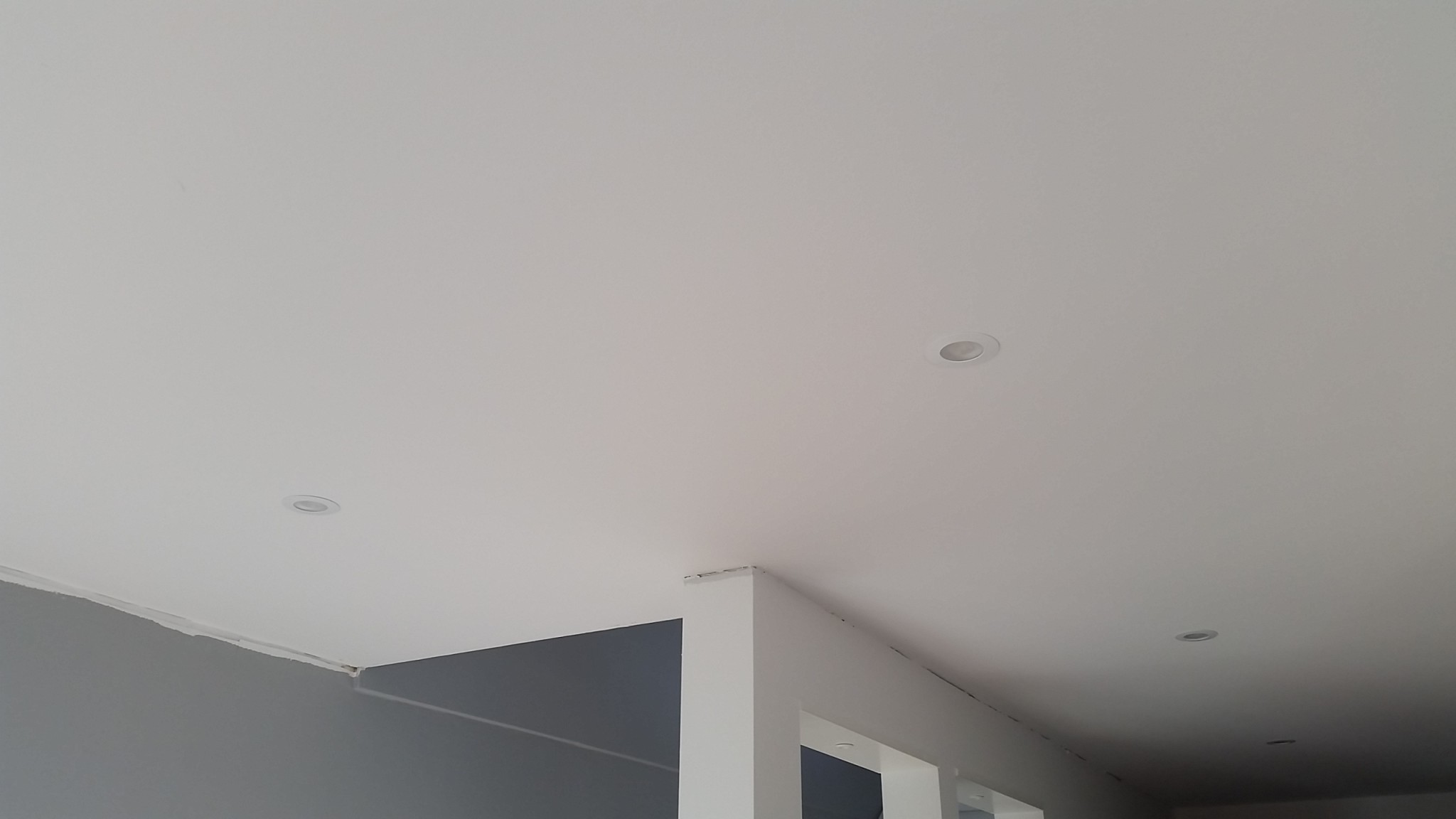
That looks really nice, that's how I would like to have it!
I need to figure out if the ceiling truly supports the insulation. I recall when I looked up from the attic under the insulation, it appeared to be chipboard.

You say that I am linking to the right board, but it has rounded edges? That is, it forms a grid pattern when you put it up. Do you then fill this in manually with filler? Why not choose boards that fit seamlessly together if you want a smooth ceiling? Or do you let the fiberglass fabric handle the transition without filling in beneath it? I suspect that the fiberglass fabric is supposed to help manage movements in the house so the ceiling doesn't crack?
I need to figure out if the ceiling truly supports the insulation. I recall when I looked up from the attic under the insulation, it appeared to be chipboard.
You say that I am linking to the right board, but it has rounded edges? That is, it forms a grid pattern when you put it up. Do you then fill this in manually with filler? Why not choose boards that fit seamlessly together if you want a smooth ceiling? Or do you let the fiberglass fabric handle the transition without filling in beneath it? I suspect that the fiberglass fabric is supposed to help manage movements in the house so the ceiling doesn't crack?