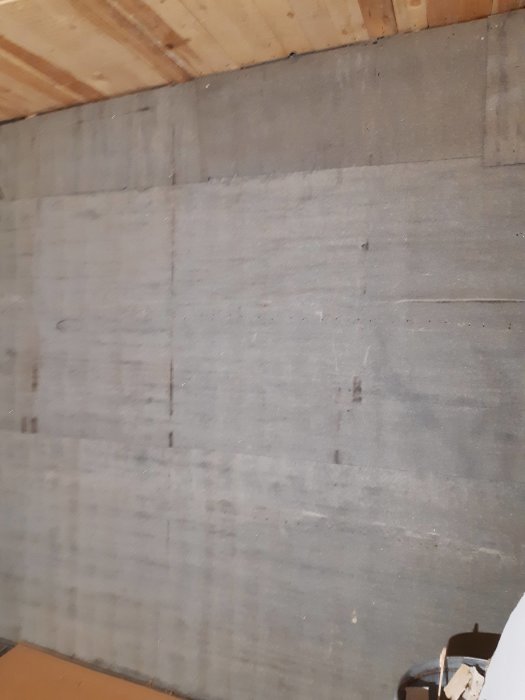
I am in the process of tearing down paneling and ceiling boards in a couple of bedrooms in a 60s summer house to install new electrical wiring and put up OSB+gypsum. Behind the old paneling, there is a type of tar paper that looks like roofing felt. I assume it's just a matter of tearing it off since it smells like tar paper. But what function does it serve? I guess it works as wind barrier. Is there any reason not to tear it down?
Old school vapor barrier/vapor brake. I would let it stay, it serves roughly the function that diffusion-tight vapor barrier plastic does today.
Today, we build houses to be as vapor-tight (diffusion-tight) as possible from the inside, often with better ventilation. We achieve this with a vapor-tight plastic that sits inside the wall construction and behind the framework for interior cladding (OSB + plasterboard).
In the past, houses were built diffusion-open but with paper like this to slow down moisture from migrating into the wall construction. The idea was natural ventilation throughout the house, and you cranked up the heat properly, allowing the house to dry out by itself.
Note that if you don't have plastic in your house today, you should think twice before adding it. Almost everything you read about mold problems in houses comes from improperly installed membranes/vapor barriers.
For example, if you were to tear this off and add a modern plastic vapor barrier, what would happen then? Well, since parts would be vapor-tight but others wouldn't, the moisture that would otherwise have passed through this paper would instead creep along it until it found somewhere to escape, i.e., where the plastic ends. This leads to much less moisture load behind the plastic but much more around the edges of the plastic.
Wooden houses can effectively be built diffusion-open, as has been done for hundreds of years. Wood can breathe (i.e., absorb and release moisture) MANY times before it gets damaged. I'm not a wooden house fanatic; modern methods ARE better. But ONLY if they are used in the exactly right way.
Thanks for the response. Yes, I understand the issue with moisture/vapor barrier/no vapor barrier. Now it's a holiday home mainly used in spring/summer/autumn, but we have base heat on during the winter and winter water. However, since we aren't there often in the winter, the moisture load in that season is quite small, and at other times, a door or window is almost always ajar. Additionally, I have an exhaust fan in the bathroom that runs when we are there.
Click here to reply
Vi vill skicka notiser för ämnen du bevakar och händelser som berör dig.