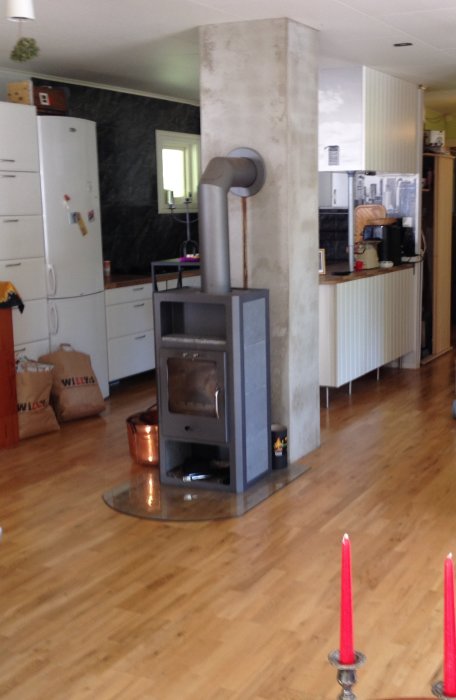
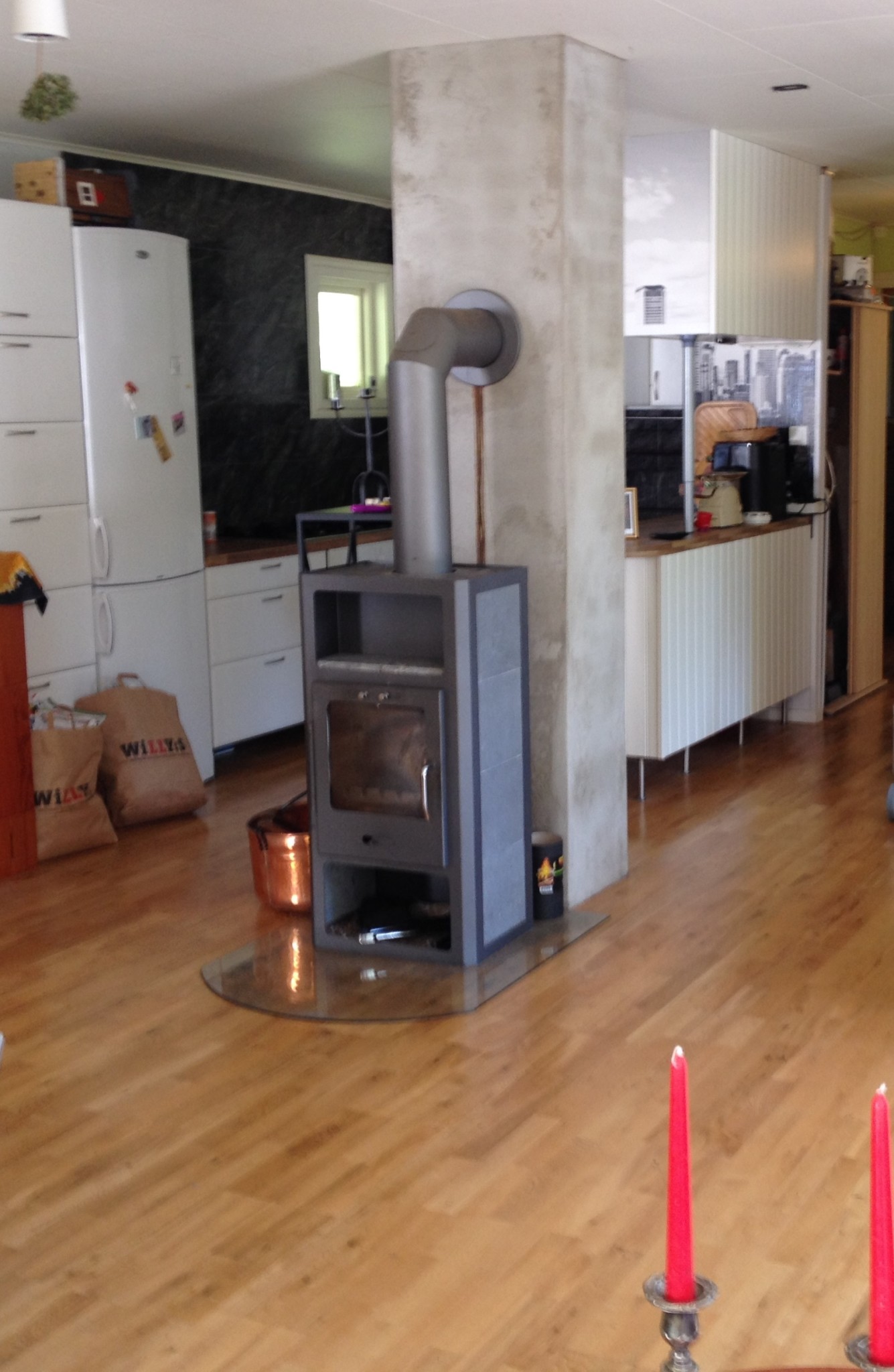
We will need to redo the roof of the house in the spring, and then we started considering moving the fireplace to open up the space and get a better placement for the fireplace. I've read a bit and understood that some chimneys can be part of the load-bearing structure, but how do I know if that's the case here?
The construction is such that there are chimney pipes within the chimney stack, so it is mostly there for decoration now (unless it is load-bearing, of course) and there are no vents in the stack. What we would do in the new location is have a company run suitable chimney pipes all the way up and skip a chimney stack.
What is the smoothest way to dismantle the existing stack ourselves, and how long might it take? The "attic" has only about 50cm in height, and the opening is at the far end of the gable, so we can't get in there. So I guess the simplest way is to lift off the roof around the chimney, but then the question is how do we cover the roof in the meantime to prevent rain, moisture, and unnecessary debris from coming in? And how long might it take until we can temporarily seal the roof? I'm guessing the chimney is about 4m from floor to top.
What else should we consider? Is a demolition permit needed? Is there a risk of asbestos in the mortar (Finnish-made vacation house from '72), and is it easy to test for it if so?
Can anyone give a rough estimate of what it might cost if we hire someone to take down the chimney stack?
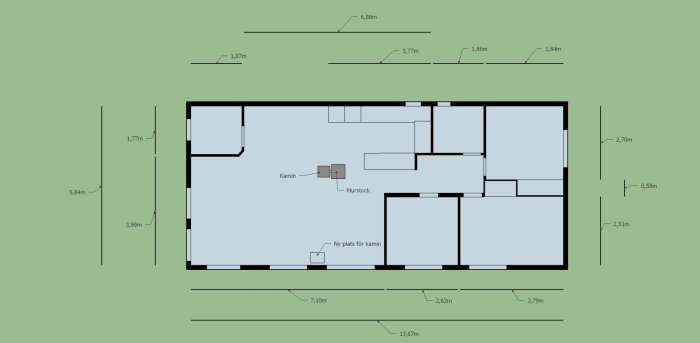
If you look at the drawing, it doesn't seem that the chimney is part of the load-bearing structure. Check the attic to see if there are beams going into the chimney. If not, the chimney is not load-bearing at all. Now, I read that there was no possibility to get inside, but maybe it's possible to make a hole in the ceiling?
You dismantle it from the top, stone by stone, and when you reach the roof, it's a good idea to use a large tarp that lies over the roof ridge and is tied to the eaves, so it stays in place during rain and wind.
Since asbestos has no function in mortar, it's a minimal risk that this would be the case for you.
There is no need for a construction/demolition permit, but a building notification is usually required for both demolition and reconstruction/new installation of a chimney.
Before a rebuilt/new chimney is put into operation, it must be inspected by a chimney sweep and approved by the municipality.
About six years ago, we demolished our masonry chimney containing flue pipes from two fireplaces, four ventilation channels, and one exhaust channel, but only the exhaust channel and one flue pipe were used. We installed a new exhaust channel and a new chimney with the new fireplace.
We started from the top, chipping away one stone at a time; when we reached the outer roof, we continued downward from the outside with a few layers before moving into the attic. Upon reaching the attic floor, we continued downward from the attic; we got about 1 meter below the ground floor ceiling before moving inside.
Over six tons of bricks and mortar were removed; the house is one story with a basement, the fireplace was in the basement, and the chimney's surface was about 600*1200.
It is built with brick because before it was made into a nice chimney, it was an enormous reinforced mass built up at the front with a minimal hole to light a fire in. So half of the chimney is later constructed vertically with bricks from the large mass.
The reason we want to demolish it and then just have chimney pipes is because the flue takes up so much space without any benefit since it doesn't get warm.
Click here to reply
Vi vill skicka notiser för ämnen du bevakar och händelser som berör dig.