I would think that some kind of insulation board, rodent-proofed on the edges, between the existing foundation and the new foundation/slab is suitable.
It probably does. It counts as insulation, right? I've seen in other threads that there's been styrofoam in between, sometimes thicker, sometimes thinner. Styrofoam is the favorite material for foundations today. (It's just me who, in principle, believes that plastic doesn't belong in houses, except where no sensible substitutes exist, i.e. electrical materials.)
I am probably more afraid that the slab will slide if it's not properly anchored.
With support on only two sides, on clay soil, with a heavy building, it feels like a risky construction.
You should ensure that the ground is properly grounded, not just on top of clay soil.
I'm thinking about the elevation of the ground level, and that it's only supported at two outer edges. Just pouring a 40m2 slab with a 100mm thickness will weigh around 10 tons.
Barns are usually constructed with simpler principles and with a "if it works, it works" attitude, so if a couple of columns have moved 10-15cm, it's not the end of the world, and it's always possible to dig out and replace the stone foundation afterward.
It's not quite the same principle with a slab on grade and a residential house on top, I mean.
But like many others, I'm an amateur in this context. I'd rather build a little extra than risk anything.
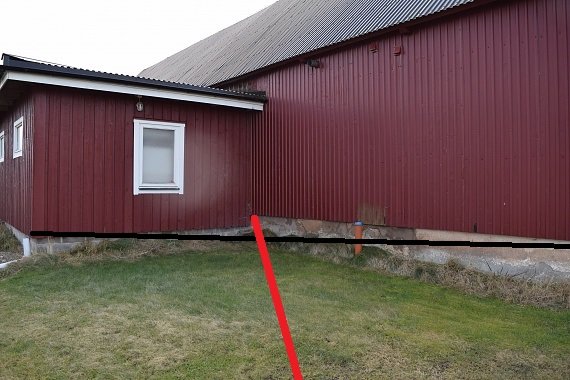
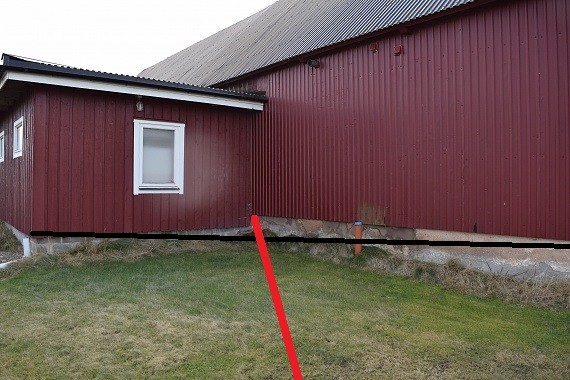
Can you cross-measure according to the picture first measure the black diagonal then measure the red diagonal to determine where the new outer corner should be?
Otherwise, you can take a look along the walls of the extension and the gable of the house, and aim for a point where they meet.
Feel free to use a string for assistance.
And don't assume that the old building and the extension are built perfectly at 90°!
Vi vill skicka notiser för ämnen du bevakar och händelser som berör dig.