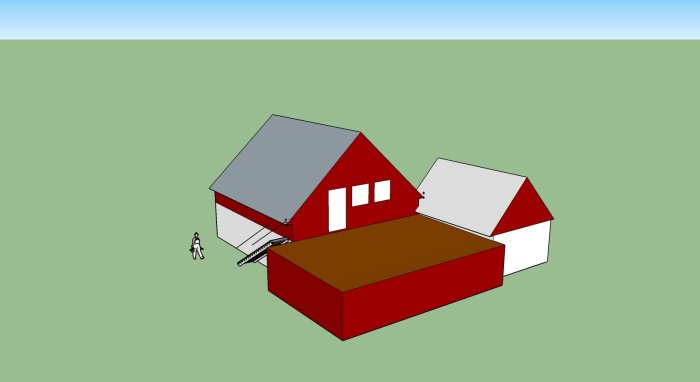
You can sight out from the outer part of the extension with a long string.
If you attach the string to the far outer corner, stretch it out 10m, you can move it towards the foundation line; when it is even all the way, your 10m long string is an extension of the existing foundation.
Considering the existing barn, I think it's precise enough. Make sure the foundation wall between the extension and the new construction is aligned, and the rest will fall into place nicely afterward. As for the roof, you'll need some sheet metal work to make the connections look neat regardless.
The one between the extension and the barn is probably not worth calculating from, it's simply not precise enough to assume anything.
What is worth preserving is the foundation wall of the extension, which should align with the new extension's foundation wall.
You can measure it with a long straightedge or mason's twine. Mason's twine is still used today on professional constructions.
edit:
When the outer foundation walls are in line with each other, you can set the last side against the barn using the 3-4-5 rule. After that, you can diagonally measure the two outer walls on the new construction, towards the intended inner corner. But it may very well differ by 10cm towards that corner.
Which of the buildings in that picture is the barn and the extension you mentioned in the first post? I interpreted the pictures in the first post, and your picture with the cross measurement as if you were going to build an extension equivalent to the area that the extension was.
With the picture you just shared, I understand the challenge better. You might need to start by measuring everything with a long tape measure, set wooden profiles, and then stretch strings.
After that, you can fine-tune the diagonals and length measurements by moving the mason's string a bit at a time.
Only if you lay a proper foundation. You need to get a solid foundation and be able to backfill so the elements stay firm.
Since you're going to have such high elements, with a lot of backfill inside, a sturdy foundation is needed.
Okay, nothing to do but to lower the edging elements. They are the type with a cement board on.
If I lower the edging elements, I have to build a row of leca on top of the slab so that the cladding boards can follow the same height as the garage foundation.
How do you then plaster the leca block and cement board so they have the same appearance the easiest way..?
Vi vill skicka notiser för ämnen du bevakar och händelser som berör dig.