
6,884 views ·
26 replies
7k views
26 replies
Supporting pillar for bay window that didn't turn out so well...

Member
· Västragötaland
· 1 035 posts
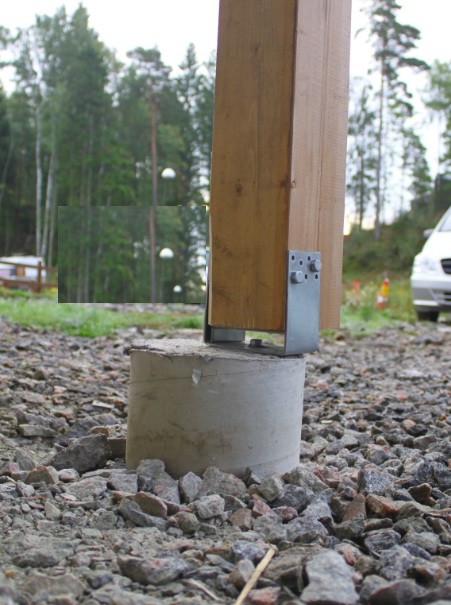
However, TS doesn't seem satisfied, so I assume he didn't design the base to sit at an angle? It will probably hold for the roof's snow loads, but for any lateral impact, it will be weaker than if it were centered. I can't say how much weaker, but maybe the carpenter has calculated that and taken it into account.
I also believe it will hold for most common loads as long as there is some mass outside the base...
But it wouldn't have been difficult to place it directly underneath, if you put it that way. In our case, if we could place all four pillars with just a few cm tolerance, this should be super easy. If our bases had been set that crooked, it wouldn't have worked at all since we have pillars that are as thick as the bases and attached at multiple points.
I also believe it will hold for most common loads as long as there is some mass outside the base...
But it wouldn't have been difficult to place it directly underneath, if you put it that way. In our case, if we could place all four pillars with just a few cm tolerance, this should be super easy. If our bases had been set that crooked, it wouldn't have worked at all since we have pillars that are as thick as the bases and attached at multiple points.

Do we know if the pillar is tilted or does it look like it's sitting at an angle?mariatherese said:However, the TS doesn't seem satisfied, so I assume he didn't design the footing to sit at an angle?
It surely holds for the roof's snow loads, but for any lateral impact, it becomes weaker than if it were centered. I can't answer how much weaker, but maybe the carpenter has calculated and taken it into account.
Now I actually also believe that it holds for most common loads if there is just a little mass outside the footing...
But it wouldn't have been difficult to place it directly underneath, so to speak. If in our case we could place all four pillars with just a few cm tolerance, then this should be a piece of cake. If our footings had been positioned so crookedly, it wouldn't have worked at all because we have pillars that are as thick as the footings and are fastened at several points.
If it's misplaced, then naturally it should be moved; if it's properly positioned, then it's a matter to resolve for appearance's sake...

What a funny comment!Enk Projektet said:
This is a forum, the purpose is to ask questions and get answers judged based on the info we receive.
But I can say with quite high certainty that:
an apparently crooked pillar with a splinter, in a non-centered post shoe, is not professional.
Of course, there is an infinitesimal risk that a house constructor has envisioned that solution. (they can also be less professional).
Ah well... I'll wait and see...Villa vista said:What a funny comment!
This is a forum, the purpose is to ask questions and get answers judged based on the info we receive.
But I can say with quite high certainty that:
an apparently slanted pillar with a chip, in a non-centered pole shoe is not professional.
Of course, there is a nonexistent small risk that a house constructor has envisioned that solution. (they can also be less professional).

I'm writing heremariatherese said:
 haven't had time to check in here for a while.
But the casting is done correctly according to the original drawings. So that part is right. However, during the journey, we agree to adjust it slightly. The recasting hasn't been done yet and the carpenter wants to be finished. We then agree not to attach the post in the casting since it will be moved and recast a bit, as I think it's slightly too high. However, it's correct according to the drawings again. So far, everything is ok.
But instead, they attach it and thus make holes in the post at the edge and unfortunately also manage to create a chip that isn't fixed. So now, when the plinth is recast and the old one is removed, the post will have visible holes and a damaged edge.
What bothers me is that they don't fix the mistakes after themselves. For example, if a corner gets damaged, etc.
I'm not buying a house for a couple of million where the carpenter comes with "we don't get paid for that, or we don't have time."
I actually don't think the house supplier is particularly impressed with this craftsmanship either. I guess they don’t want people reading blogs to associate this appearance with their brand...
But I think this will resolve, not a big problem directly. Previous mistakes have largely been fixed along the journey. It's more that one becomes sad and disappointed with the carpenter who disregards the finer details or what many customers actually value the most in the end and spread further, namely the finish.
It will be painted white. Yes, there will likely be a deck or step outside the door, but I still want a correct casting performed and one that isn't too high so I don't have to adjust the stairs to it later.AndersS said:What should it look like when it's finished?
The post should be covered with some outer board to gain a slightly larger dimension that harmonizes with the corner board seen to the right, and I would also paint it the same color. It looks a bit flimsy, I think.
And as previously mentioned, there should probably also be a step and a surface outside the door that will hide the plinth and the lower part of the post.
The post looks crooked, but hopefully, it's an optical illusion depending on how the photo was taken.

If your problem is being built away anyway, does it really matter?
There's probably nothing wrong with the function.
More strange, I think, is that it's the fransskruvar that support the "pole" and not the shoe.
There's probably nothing wrong with the function.
More strange, I think, is that it's the fransskruvar that support the "pole" and not the shoe.
Click here to reply