
3,769 views ·
4 replies
4k views
4 replies
Supporting lintel in main wall and is the wall load-bearing?
Hello!
My question concerns a house from the late 40s, with a plank frame. A new larger kitchen is to be built, where two walls will be taken down. The ceiling height is 2.5m, so there is some space for beams. The house has a total of four floors, including an attic and a basement. The kitchen is to be located on the entrance floor, meaning it is standing on the basement, with two furnished floors above.
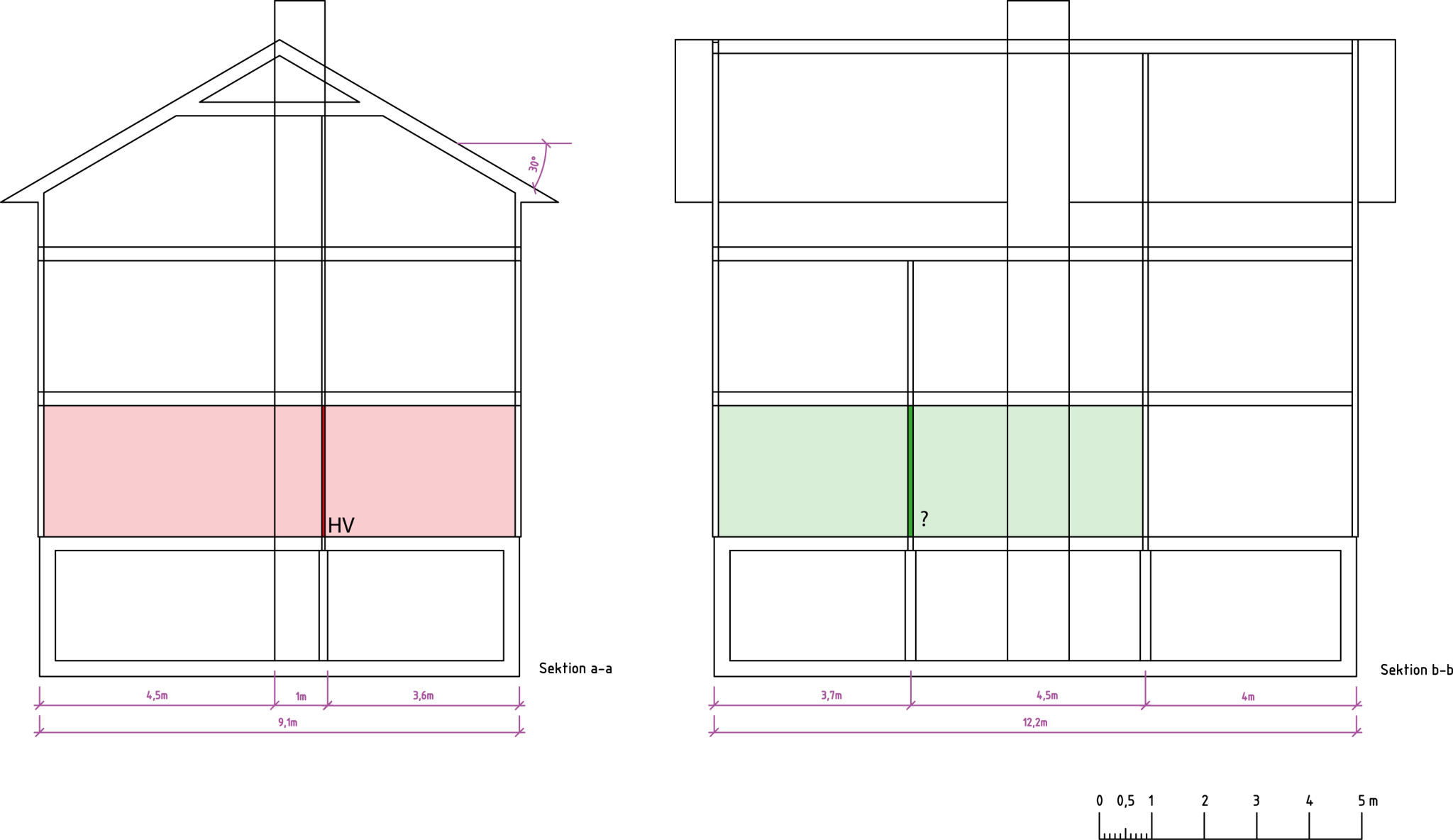
One is a part of the load-bearing wall which will have an opening of about 3.5m, where 60 cm of the wall can be left on each side (one side of which is against the chimney). This wall is marked HV, and colored red.
The other wall runs in the same direction as the joists and rafters, and here I'm uncertain. The wall appears internally the same as the load-bearing wall, and I'm wondering if it is structurally significant in the house. The walls in this direction do not seem to align completely in the section (but this could also be due to inaccurate drawings). This wall is marked with a question mark and colored green.
Assuming the correct calculation of the beam heights, I'm wondering if it's necessary to retain a piece of "frame" on the green wall marked with a question mark. And if anyone possibly has a clear calculation model for the dimensions of the steel beam (as it likely needs to be) marked red and HV.
The house is located in Gothenburg.
All the best, I hope someone knowledgeable has good input
My question concerns a house from the late 40s, with a plank frame. A new larger kitchen is to be built, where two walls will be taken down. The ceiling height is 2.5m, so there is some space for beams. The house has a total of four floors, including an attic and a basement. The kitchen is to be located on the entrance floor, meaning it is standing on the basement, with two furnished floors above.
One is a part of the load-bearing wall which will have an opening of about 3.5m, where 60 cm of the wall can be left on each side (one side of which is against the chimney). This wall is marked HV, and colored red.
The other wall runs in the same direction as the joists and rafters, and here I'm uncertain. The wall appears internally the same as the load-bearing wall, and I'm wondering if it is structurally significant in the house. The walls in this direction do not seem to align completely in the section (but this could also be due to inaccurate drawings). This wall is marked with a question mark and colored green.
Assuming the correct calculation of the beam heights, I'm wondering if it's necessary to retain a piece of "frame" on the green wall marked with a question mark. And if anyone possibly has a clear calculation model for the dimensions of the steel beam (as it likely needs to be) marked red and HV.
The house is located in Gothenburg.
All the best, I hope someone knowledgeable has good input


Hello and welcome to the Byggahus forum!
I have actually owned a 2 1/2-story house with a basement and plank frame in Gothenburg myself, so the question doesn't feel entirely unfamiliar. Even if the opening in the load-bearing wall isn't that large, you still have to account for the load from two above floors. I recommend hiring someone who can make a more precise calculation based on exact dimensions. I calculate the line load on the load-bearing wall on the ground floor to just under 30 kN/m, which leads to a substantial support beam. With glulam, we end up with 140x405 mm or alternatively 215x360 mm. With steel, an HEA 220. With your ceiling height, I don't think steel is necessary. It's also more expensive and complicated.
Plank walls can't be made too long, so I don't think you should remove the other wall entirely. Transverse partition walls are often located on the wall on the floor below. The best approach is to leave a section inside the outer wall like on the drawing, saving a part of the plank wall near the ceiling and placing a smaller beam underneath.
I have actually owned a 2 1/2-story house with a basement and plank frame in Gothenburg myself, so the question doesn't feel entirely unfamiliar. Even if the opening in the load-bearing wall isn't that large, you still have to account for the load from two above floors. I recommend hiring someone who can make a more precise calculation based on exact dimensions. I calculate the line load on the load-bearing wall on the ground floor to just under 30 kN/m, which leads to a substantial support beam. With glulam, we end up with 140x405 mm or alternatively 215x360 mm. With steel, an HEA 220. With your ceiling height, I don't think steel is necessary. It's also more expensive and complicated.
Plank walls can't be made too long, so I don't think you should remove the other wall entirely. Transverse partition walls are often located on the wall on the floor below. The best approach is to leave a section inside the outer wall like on the drawing, saving a part of the plank wall near the ceiling and placing a smaller beam underneath.
Thank you so much for such a detailed response. It helps me tremendously!J justusandersson said:Hello and welcome to the Byggahus forum!
I have actually owned a 21/2-story house with a basement and plank frame in Gothenburg myself, so the question doesn't feel completely foreign. Even if the opening in the main wall isn't that large, you have to account for the load from the two overlying floors. I recommend hiring someone who can perform a more accurate calculation based on exact dimensions. I calculate the line load on the main wall at approximately 30 kN/m, which leads to a substantial relieving beam. With glulam, we're looking at 140x405 mm or 215x360 mm. With steel, an HEA 220. With your ceiling height, I don't think steel is needed. It's also more expensive and complicated.
Plank walls cannot be made too long. Therefore, I don't think you should completely remove the other wall. Transverse partition walls are often based on the wall in the floor below. The best is to leave a piece inside the outer wall as in the drawing, save a bit of the plank wall closest to the ceiling, and place a smaller beam underneath.
Quick follow-up questions!J justusandersson said:Hello and welcome to the Byggahus forum!
I have actually owned a 2 1/2-story house with a basement and plank frame in Gothenburg, so the question doesn't feel entirely unfamiliar. Even if the opening in the load-bearing wall is not so large, you have to account for the load from two upper floors. I recommend hiring someone who can conduct a more precise calculation based on exact dimensions. I estimate the line load on the load-bearing wall on the ground floor to be just under 30 kN/m, which leads to a substantial relieving beam. With glulam, we're looking at 140x405 mm or alternatively 215x360 mm. With steel, an HEA 220. With your ceiling height, I don't think steel is necessary. It is also more expensive and complicated.
Plank walls cannot be made too long. Therefore, I don't think you should remove the other wall entirely. Cross walls often also rest on the wall in the floor below. The best is to leave a section within the outer wall as in the drawing, save a portion of the plank wall closest to the ceiling, and place a smaller beam underneath.
1. Leaving a section of the wall marked with a question mark. Is it important regardless of whether the plank is horizontal or vertical?
2. The best would be if that wall could be as short as possible, so how long is "a small section" in your opinion?
If the house was built in the 1940s, it is made of standing planks. You can also identify this in other ways. When the timber is lying horizontally, it is not usually referred to as planks because it involves thicker dimensions. Leaving a piece of the wall intact is important in both cases. Planks are usually 6-8 inches wide, so at least two planks in width.
Click here to reply