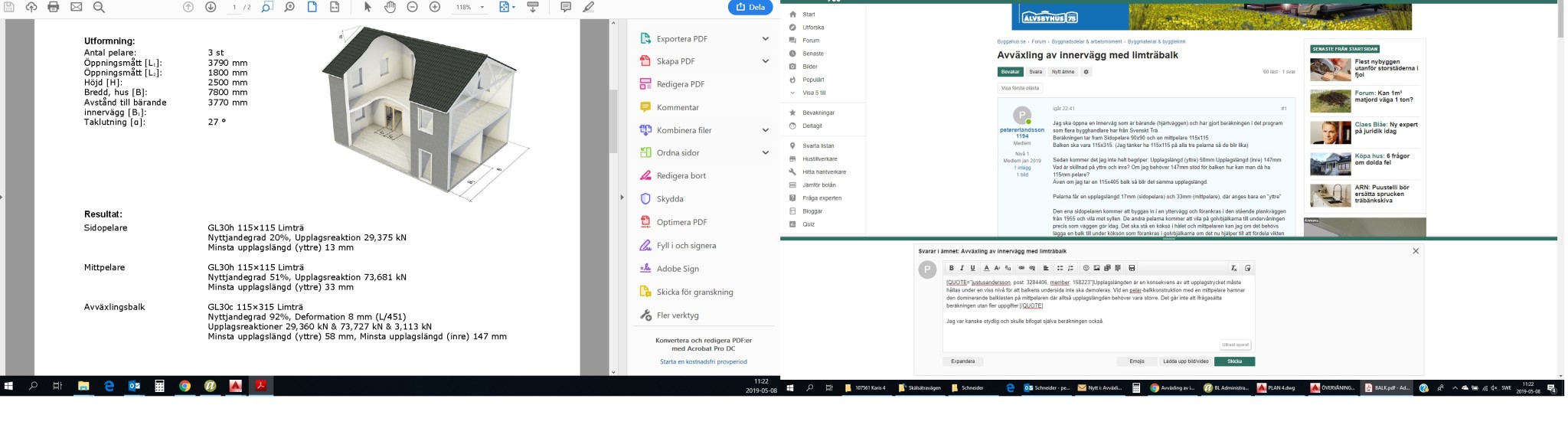
I am going to open an interior wall that is load-bearing (the heart wall) and have done the calculations in the program that several building suppliers have from Svenskt Trä. The calculation suggests Side pillars 90x90 and a center pillar 115x115. The beam should be 115x315. (I plan to have 115x115 on all three pillars so they are the same)
Then comes what I don't quite understand: Support length (outer) 58mm Support length (inner) 147mm. What is the difference between outer and inner? If I need 147mm of support for the beam, how can there be 115mm pillars? Even if I choose a 115x405 beam, the support length remains the same.
The pillars have a support length of 17mm (side pillars) and 33mm (center pillar), where only an "outer" is indicated.
One of the side pillars will be built into an exterior wall and anchored into the standing plank wall from 1955 and rest against the sill. The other pillars will rest on the floor beams of the lower floor just as the wall does today. There will be a kitchen island in the opening, and if needed, I can add an additional beam under the kitchen island that is anchored to the floor beams if it helps distribute the weight somewhat.
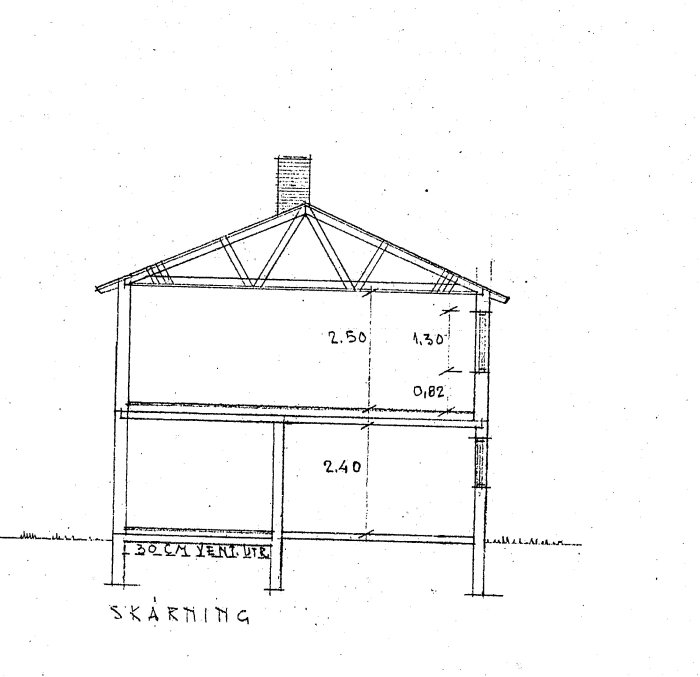
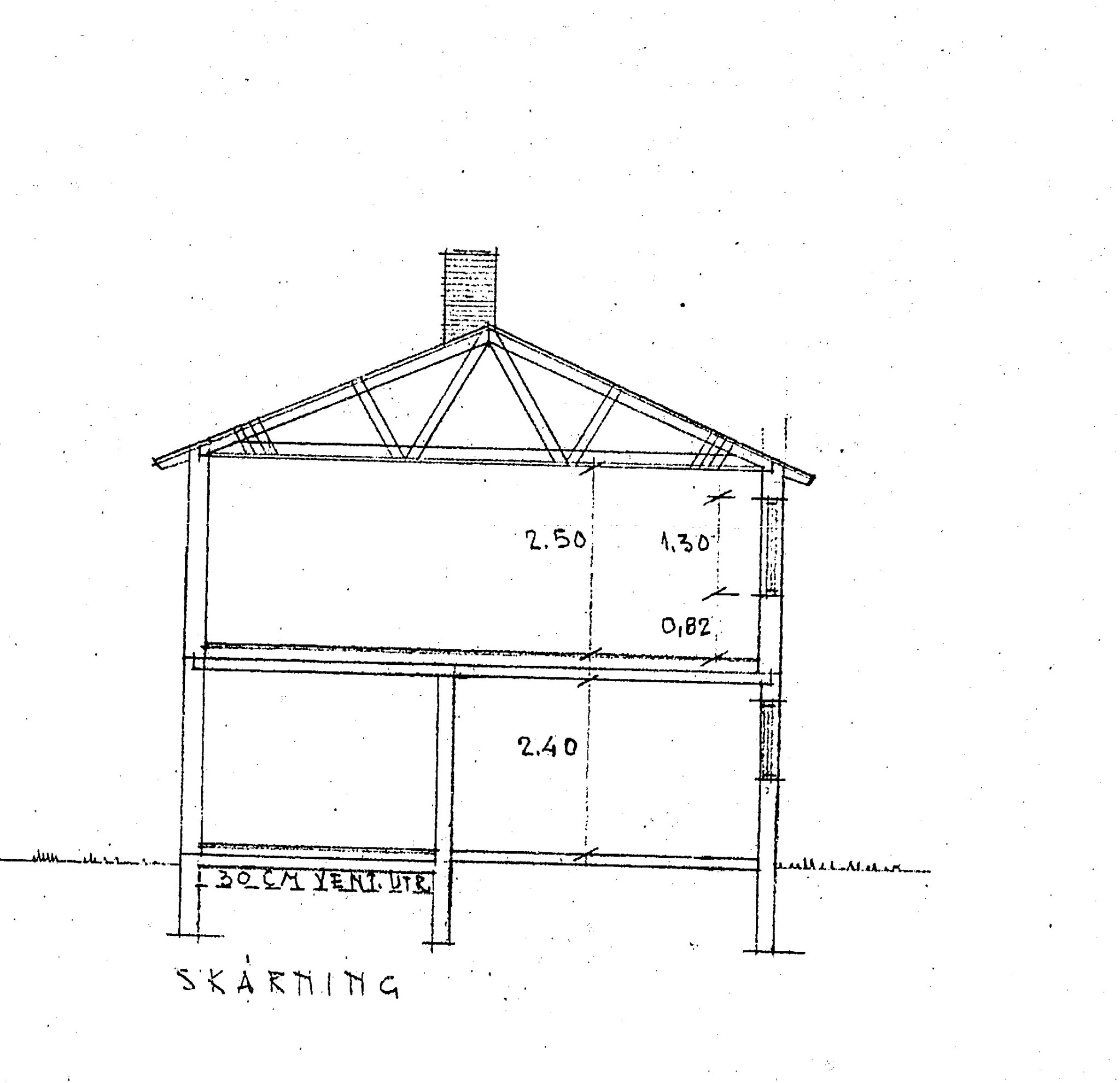
Attached is the old technical description from the building permit 1955.
The support length is a consequence of the need to keep the bearing pressure below a certain level to prevent the underside of the beam from being damaged. In a beam-column structure with a central column, the dominant beam load is placed on the central column, where the support length needs to be greater. The calculation cannot be questioned without further information.
The bearing length is a consequence of the bearing pressure needing to be kept below a certain level so that the bottom of the beam is not demolished. In a column-beam construction with a central column, the dominant beam load is on the central column where, therefore, the bearing length needs to be greater. The calculation cannot be questioned without more information.
I might have been unclear and should have attached the actual calculation as well.
There is a calculation error since the numbers don't add up. When I check the beam dimension using the exploded view, it's reasonable, although I would suggest a slightly larger beam, 115x360, to further limit deflection. The central pillar absolutely doesn't need to be larger than 115x115. However, it's logical that you get the same support length requirement when testing a higher beam since the loads on the beam remain the same. I assume there is a reason why the central pillar shouldn't be centered.
There is an error in the calculation since the figures do not add up. When I check the beam dimension using the exploded view, it is reasonable, although I would suggest a slightly larger beam, 115x360, to further limit the deflection. The central post definitely does not need to be larger than 115x115. That you get the same requirement for bearing length when you try a higher beam is logical since the loads on the beam are still the same. I assume there is an explanation for why the central post should not be in the middle.
The central post becomes a "necessary evil" and will stand right next to the kitchen island. Ideally, I would have avoided it, but the opening is about 5600mm, so the beam becomes unreasonably heavy, and it will feel like there's still a half wall there. I made a similar renovation in my old house where we opened 5200mm, with the difference that the beam was placed on top of the roof trusses, which were then "braced" up against the beam. That solution was designed by an engineer who prescribed 115x360 with just 115x115 posts at the ends. We used a 115x405 for practical reasons (stock item at Bauhaus), and even the construction bands were stronger than prescribed. The calculation program at the hardware stores does not allow beams longer than 5000 on two posts. I might need to find an engineer who can make more precise calculations, so perhaps the central post can be avoided.
If you increase the width of the glulam beam, it is entirely possible to solve it without a central pillar. With the same values for the distributed load as before, a 5.6 m long 215x405 mm beam is sufficient.
If you increase the width of the glulam beam, it is quite possible to solve it without a central pillar. With the same distributed load values as before, a 5.6 m long 215x405 mm beam is sufficient.
If I were to choose a steel beam instead, what would the measurements be? I'm thinking of either encasing or painting the beam regardless, so an encased steel beam could work just as well. However, I can't find any calculation place online to know which beam to use.
You can drill holes in the steel at appropriate places or weld on extra flanges. It is always tricky to combine steel and wood. It will be lower but more expensive. Then you also have to consider the fire insulation.
Reviving my thread again...
Now it's been two years and I think I've figured out that the wall isn't even load-bearing.
The wall consists of vertical raw wood on both sides and horizontal beams not even 2" at about c/c 60.
I can insert a PVC pipe along the entire wall for several meters. The only vertical beams are at the door openings.
It says in the description you started the thread with that the load-bearing inner wall is made of 2-inch plank, not a stud wall. Isn't that what you found?
It says in the description you began the thread with that the load-bearing interior wall is made of 2-inch planks, not a stud wall. Isn't that what you found?
It says in the technical description from 1954 that load-bearing interior walls are made of 2" vertical plank. However, there doesn't seem to be a load-bearing interior wall as it is built of only vertical paneling and horizontal studs. The wall is completely empty inside, I can slide in an entire conduit pipe (3m) along the length of the wall.