
3,913 views ·
6 replies
4k views
6 replies
Support old roof beams with steel beams?
Hello,
We live in and are gradually renovating an older house, built in "1909", which in many ways does not appear to have always looked like this, with extensions over the years, it seems. It's a 1.5-story house with an upper floor that perhaps wasn't always an upper floor. The construction is essentially a timber-framed building.
My question concerns the relieving or rather supporting of the intermediate floor joists in the gable room on the ground/upper floor, where there is a sag and bounce in the joists. The room on the ground floor measures internally about 5500x3300, where the longer dimension is between the long sides of the house and in the direction of the existing ceiling joists.
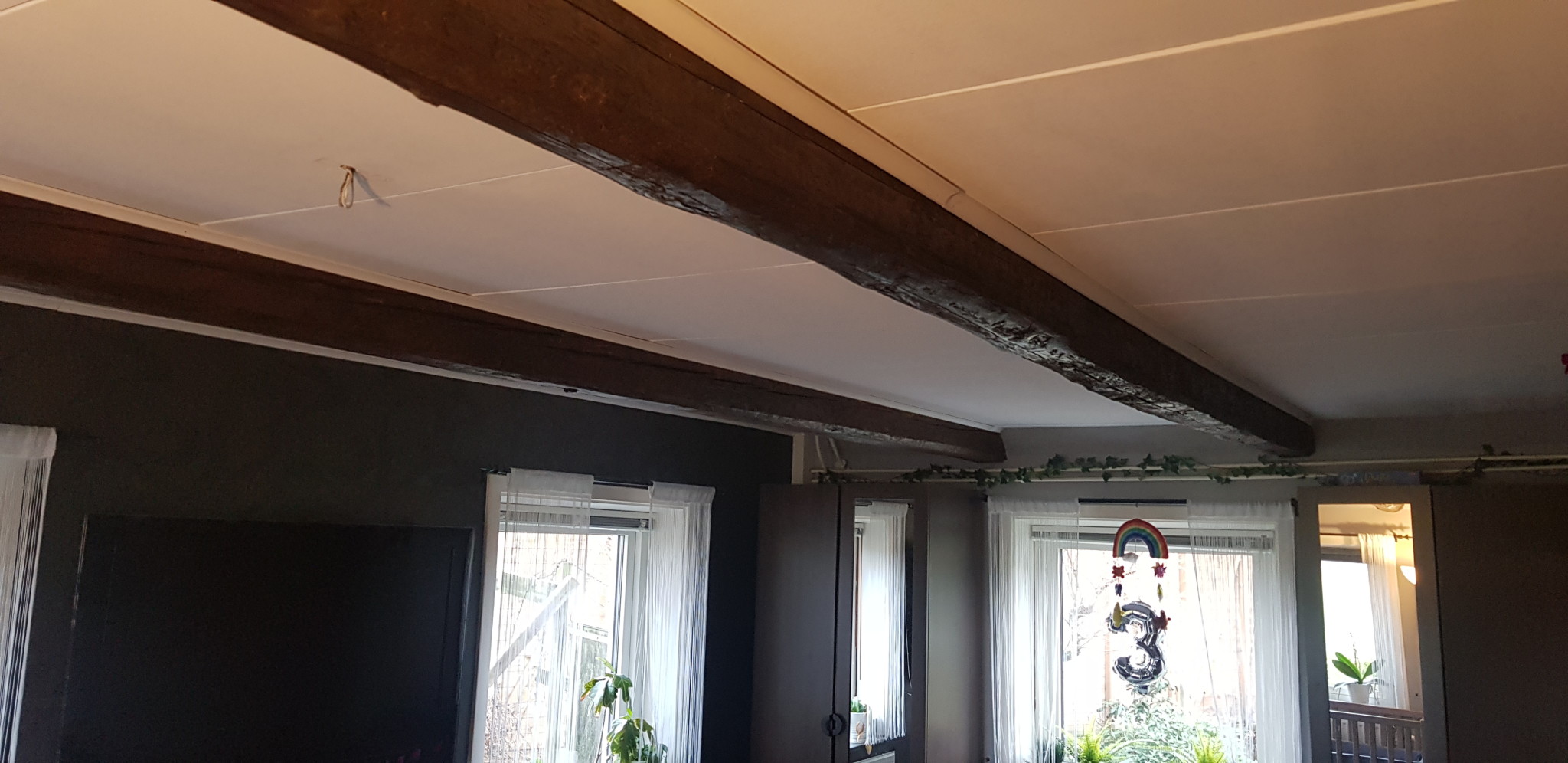
The ceiling joists are two in number and are made of timber logs, about 150x150 mm. Currently, there is no support for these other than the bearings in/on the outer walls of the house.
The room on the upper floor measures internally between the knee wall spaces corresponding to 4200x3300 mm.
We now want to provide support to the intermediate floor to level it and achieve a less shaky floor on the upper floor. As of now, the intermediate floor consists only of the mentioned joists, and on top of these are two(?) layers of old rough-hewn planks, with plasterboard on the underside, which constitutes the ceiling in the ground floor room, and chipboard on the floor in the upper floor room. The floor surface has been removed by the previous owner. The room on the upper floor has so far only been used for simple storage, but with a growing number of children, it will now be renovated into a bedroom/playroom. The existing rough-hewn planks/chipboard and plaster ceiling will be demolished and replaced with new materials.
My idea is to retain the existing joists and support them with a steel beam in the middle, between the gable exterior wall and a brick interior wall, which was probably a former exterior wall. Here, as mentioned, there is an interior free span of about 3300 mm, with an intended bearing in the wall of about 150-200 mm per side. The beam will then be encased.
What would be a reasonable dimensioning of the steel beam, and what type of beam? HEA, HEB, VKR, other? The ceiling height on the ground floor isn't very high currently, so it's important to keep the height of the beam down, not least to avoid headaches and bumps on the forehead. The existing joists currently support the floor, but considering the sagging, some of its dead weight will of course be transferred to the steel beam, though it's unclear how much.
Grateful for input and ideas! Attached is a picture from the room on the ground floor.
Best regards, Daniel
We live in and are gradually renovating an older house, built in "1909", which in many ways does not appear to have always looked like this, with extensions over the years, it seems. It's a 1.5-story house with an upper floor that perhaps wasn't always an upper floor. The construction is essentially a timber-framed building.
My question concerns the relieving or rather supporting of the intermediate floor joists in the gable room on the ground/upper floor, where there is a sag and bounce in the joists. The room on the ground floor measures internally about 5500x3300, where the longer dimension is between the long sides of the house and in the direction of the existing ceiling joists.
The ceiling joists are two in number and are made of timber logs, about 150x150 mm. Currently, there is no support for these other than the bearings in/on the outer walls of the house.
The room on the upper floor measures internally between the knee wall spaces corresponding to 4200x3300 mm.
We now want to provide support to the intermediate floor to level it and achieve a less shaky floor on the upper floor. As of now, the intermediate floor consists only of the mentioned joists, and on top of these are two(?) layers of old rough-hewn planks, with plasterboard on the underside, which constitutes the ceiling in the ground floor room, and chipboard on the floor in the upper floor room. The floor surface has been removed by the previous owner. The room on the upper floor has so far only been used for simple storage, but with a growing number of children, it will now be renovated into a bedroom/playroom. The existing rough-hewn planks/chipboard and plaster ceiling will be demolished and replaced with new materials.
My idea is to retain the existing joists and support them with a steel beam in the middle, between the gable exterior wall and a brick interior wall, which was probably a former exterior wall. Here, as mentioned, there is an interior free span of about 3300 mm, with an intended bearing in the wall of about 150-200 mm per side. The beam will then be encased.
What would be a reasonable dimensioning of the steel beam, and what type of beam? HEA, HEB, VKR, other? The ceiling height on the ground floor isn't very high currently, so it's important to keep the height of the beam down, not least to avoid headaches and bumps on the forehead. The existing joists currently support the floor, but considering the sagging, some of its dead weight will of course be transferred to the steel beam, though it's unclear how much.
Grateful for input and ideas! Attached is a picture from the room on the ground floor.
Best regards, Daniel

150x150 corresponds in stiffness to 45x225 and 5.5 m is way too large a span for these, especially concerning deflection. Placing a steel beam under the joists in the middle is a solution, though not particularly attractive. HEA 120 should suffice. However, I would suggest another solution: Insert glulam beams between the existing joists. Preferably 140x225 mm. Then screw-glue a strong K-plywood board (at least 25 mm) on top of the glulam beams.
Thank you, Justus! Yes, there is little doubt that the existing joists cannot handle this span and an additional load from above. There are indications that they were previously bolted up to a beam that lay perpendicular to these, in the middle, but the person who chose to furnish the space upstairs clearly thought that beam was in the way and simply sawed it off close to the walls.J justusandersson said:150x150 corresponds in stiffness to 45x225 and 5.5 m is way too large a span for these, especially considering the deflection. Placing a steel beam under the joists in the middle is one solution, though not particularly aesthetically pleasing. HEA 120 should suffice. However, I would suggest another solution: Insert glue-laminated beams between the existing joists. Ideally 140x225 mm. Then screw and glue a strong K-plywood board (min 25 mm) on top of the glue-laminated beams.
Thanks for the input and tips; I agree that a beam under the joists is not optimal and can easily look a bit dull, but I've come to the thought that with the right cladding, it should be possible to achieve a decent appearance, provided it doesn't become too high. An HEA 120 with its relatively modest ~115 mm in height wouldn't make it completely impossible to look good, or well, "less ugly"

Of course, I like the idea of new glue-laminated beams and have considered this before, but as we also want to preserve a bit of the old style with partially visible original joists in the rooms on the ground floor, it's challenging to achieve that with extra beams or possible reinforcing beams mounted on the existing ones.
Have a nice evening!
That is the usual method in these older houses. The cross beam rested on the partition walls and there were probably studs quite close by that took the load. In some cases, I've seen a simpler load-bearing structure built from it, similar to a truss, which can then carry large weights.M Mr.Eriksson said:
But all such things are, of course, in the way for those who want to furnish the upper floor. But it is not the first time that unaware homeowners cut away "unnecessary" beams..
Construction veteran
· Norrland
· 342 posts
Sorry if I’m hijacking the thread a bit, but I find these threads about constructions and the solutions quite interesting. Out of pure curiosity, how much does that plywood help reinforce the glulam beam? What dimensions would you need to achieve in a glulam beam to match the idea you gave?J justusandersson said:150x150 corresponds in stiffness to 45x225, and 5.5 m is far too large a span for these, especially concerning deflection. Placing a steel beam under the joists in the middle is a solution, though not very attractive. HEA 120 should suffice. However, I would suggest another solution: Install glulam beams between the existing joists. Preferably 140x225 mm. Then screw-glue a sturdy K-plywood board (min 25 mm) on top of the glulam beams.
I guess my thought was to compensate for the large c/c distance between the glulam beams with a sturdy screw-glued plywood board. Additionally, point loads are better distributed between the beams. Of course, you can also consider the board material as an elevation of the beams, provided the gluing is properly executed. The actual effect is probably better, but it's easiest to assume the same width.
Construction veteran
· Norrland
· 342 posts
Okay, I get what you meanJ justusandersson said:I guess my idea was to compensate for the large c/c distance between the laminated beams with a strong screw-glued plywood board. Additionally, point loads are better distributed between the beams. Of course, you can also factor in the board material as an enhancement of the beams, provided the gluing is properly executed. The actual effect is probably better, but it's easiest to assume the same width.
as I said, this is always interesting!
Click here to reply