
7,478 views ·
16 replies
7k views
16 replies
Support beam with HEA beam
Hello, I am planning to remove the wall between the kitchen/living room and the lounge/living room and install a HEA beam. Is there anyone who can calculate which HEA beam I need? The measurement is 4140mm, snow zone 3, single-story house with a basement (load-bearing wall in the basement above this wall).
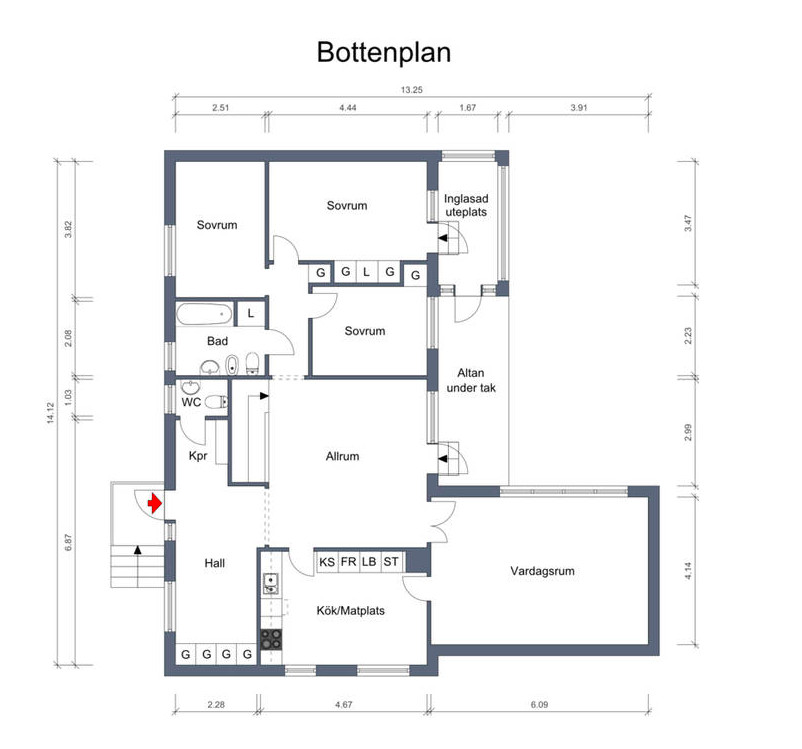

More drawings are needed to understand the roof structure. Sections through both the main part and the living room extension are necessary.
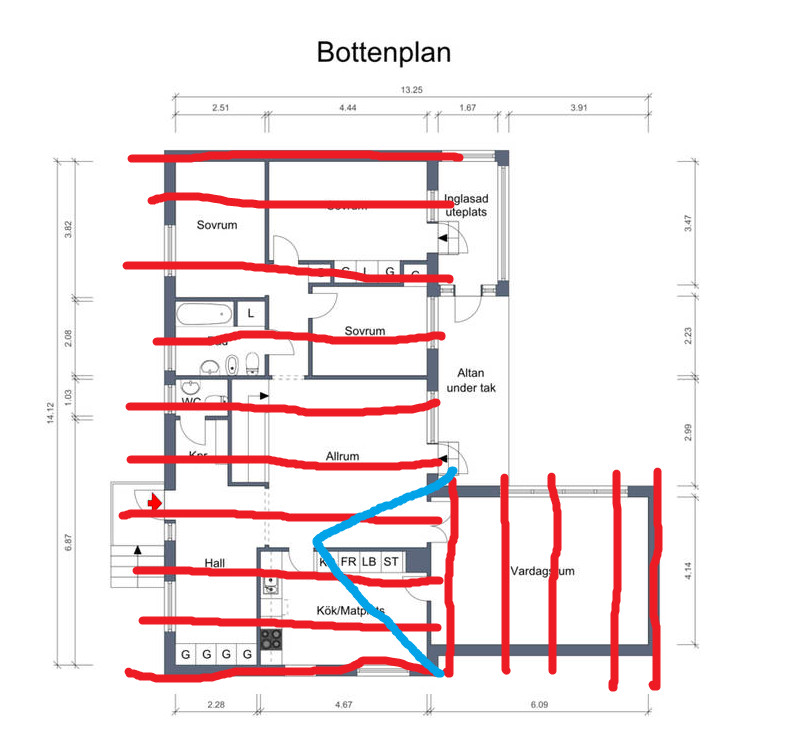
With a span of 4.15 m and a distributed roof load of approximately 15 kN/m, HEA 180 is a borderline case. I would choose HEA 200.
I can't quite figure out how the roof could be sloped in that direction if the trusses are lying the other way.. but maybe I'm misunderstanding you. However, truss roofs are made to be self-supporting, which would mean you don't need to make adjustments. However, I think there is too little information in the thread to give good advice.
+ if the truss runs in the same direction as the wall, then the wall should not be load-bearing (in that case, it would only be load-bearing for that particular truss, and according to the drawing, the others have no support in the form of a wall underneath them)
+ if the truss runs in the same direction as the wall, then the wall should not be load-bearing (in that case, it would only be load-bearing for that particular truss, and according to the drawing, the others have no support in the form of a wall underneath them)
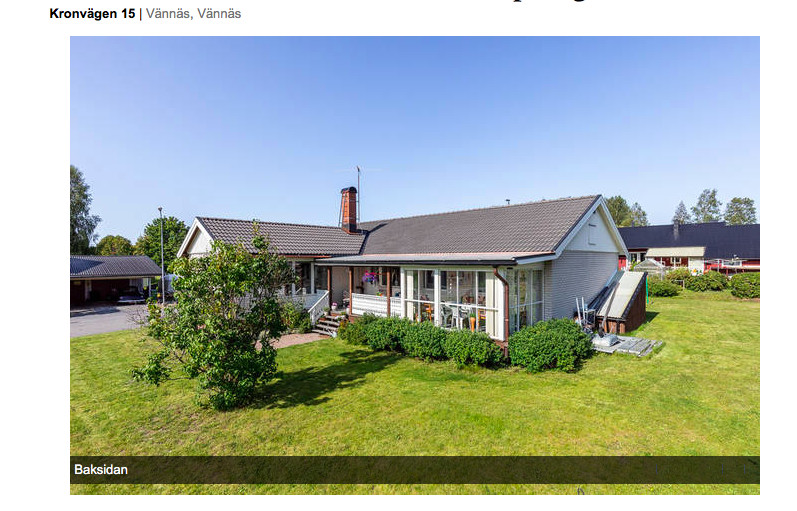
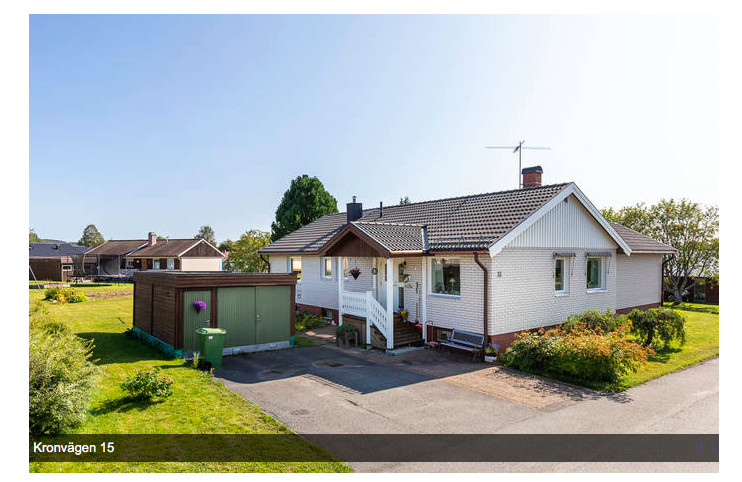
Can't you climb up to the attic and measure the dimensions of the rafters? And take a picture? 

richardtenggren
Ingen-gör
· Norrlandet
· 6 615 posts
richardtenggren
Ingen-gör
- Norrlandet
- 6,615 posts
I am soon about to replace an existing beam in my garage, where I have chosen an IPE instead of HEA. It is one of the supports that will be replaced by a beam. This is because I have space for a taller beam and can reduce the weight significantly, to the same bending moment of inertia. The IPE I looked at weighs 70% of the weight of a comparable HEA beam, which results in 70% of the cost of an HEA. Another advantage is that the flange width is smaller, which can be suitable for integration into the wall.
I mostly wanted to point out that there are several beam profiles available, and I understand our eminent justus is aware of this, but it bears mentioning.
I mostly wanted to point out that there are several beam profiles available, and I understand our eminent justus is aware of this, but it bears mentioning.
I have looked at HEA, HEB, and IPE beams, Ipe becomes too high for the same load-bearing capacity.
A blacksmith said he could weld 2 extra webs (10mm) on a HEA 100 and prestress it a few millimeters and the load-bearing capacity would be the same as HEA 200. Is that really true? I am really skeptical about it!
A blacksmith said he could weld 2 extra webs (10mm) on a HEA 100 and prestress it a few millimeters and the load-bearing capacity would be the same as HEA 200. Is that really true? I am really skeptical about it!
That extra life and overload increase strength is clear, but I strongly doubt that it is possible to transform an HEA 100 into an HEA 200 in that way. The moment of inertia for HEA 100 is 349 and for HEA 200 is 3692 (x10^4 mm4). The difference is mainly explained by the height difference.
richardtenggren
Ingen-gör
· Norrlandet
· 6 615 posts
richardtenggren
Ingen-gör
- Norrlandet
- 6,615 posts
It does not align with his proposal, as justus says.
But I took the moment of inertia for HEA100 and added two flat bars at 10*90 (I deducted a few millimeters for the joint, depending on how he envisioned it) and compared it with HEA200.
The moment of inertia for the flat bars is calculated using this formula:
Ix=bh^3/12
This gave Ix,liv=0.608*10^6
Ix,hea100=3.492*10^6
Ix,hea200=36.92*10^6
Thus, Ix,hea200 >> Ix,hea100 + 2*Ix,liv
If you calculate a solid with the dimensions from an HEA100, you are still far off... it is the increase in height that gives the result, due to h^3.
But I took the moment of inertia for HEA100 and added two flat bars at 10*90 (I deducted a few millimeters for the joint, depending on how he envisioned it) and compared it with HEA200.
The moment of inertia for the flat bars is calculated using this formula:
Ix=bh^3/12
This gave Ix,liv=0.608*10^6
Ix,hea100=3.492*10^6
Ix,hea200=36.92*10^6
Thus, Ix,hea200 >> Ix,hea100 + 2*Ix,liv
If you calculate a solid with the dimensions from an HEA100, you are still far off... it is the increase in height that gives the result, due to h^3.
Last edited:
With a span of 4.15 m and a distributed load of 15 kN/m, an HEA 180 experiences a deflection of 11 mm and an HEA 200 of 7.5 mm. (Span/300 = 13.8 mm in this case) The deflection is calculated using the formula 5qL^4/384EI, where q is the distributed load, L is the span, E is the modulus of elasticity for the material, and I is the moment of inertia for the chosen profile. 15 kN/m is an estimate of snow load and self-weight based on your drawings. It is, of course, an overview calculation. When you submit a construction notification, you should have a structural engineer who can see the house in reality check the calculations.

When we went through our upcoming construction during a consultation in 2009, our newly appointed quality manager frowned and said, "here we should probably put an HEA 200 beam."P Patrik71 said:
It was done, it lies completely hidden in the attic floor structure, and the attic floor is very stable and secure.
We had an open section with a width of 5140 mm, where there was not supposed to be an internal wall,
and where the steel beam did the job.
Which it did with flying colors