
8,770 views ·
28 replies
9k views
28 replies
SUPER HEAVY wall-mounted shelf. Madness or feasible?
I'll have to look into that but "what kind of concrete." I remember from when I mounted the TV that it was very hard on the outside, but quite porous/light concrete inside (1940s house).Düsseldorff said:


In concrete walls, even light concrete, this should not be any problem at all.
It is especially important that the upper screw in the bracket has good anchorage in the wall.
Shelves in white melanin are usually quite weak, so you need to place the brackets fairly close together to prevent them from bending down. You should probably not have more than 30 kg between two brackets if evenly distributed and 70-80 cm apart.
The risk sometimes is that there will be many brackets and it becomes tricky to set up if you have several shelves.
In those cases, I like, for example, Elfa's top-mounted shelf systems. You typically mount the fixture high up on the wall with several screws, and then it's basically done; you then hang the hang tracks and brackets on it. Very easy to assemble and position and supports many more kilos because you get less moment from the load on the shelves that "pulls out" on the mounting screws since the screws are positioned where they help the most - at the top.
I have probably up to 1 ton of load in such a system on an OSB+Gypsum wooden wall in the garage without problems. With several hang tracks, of course.
It is especially important that the upper screw in the bracket has good anchorage in the wall.
Shelves in white melanin are usually quite weak, so you need to place the brackets fairly close together to prevent them from bending down. You should probably not have more than 30 kg between two brackets if evenly distributed and 70-80 cm apart.
The risk sometimes is that there will be many brackets and it becomes tricky to set up if you have several shelves.
In those cases, I like, for example, Elfa's top-mounted shelf systems. You typically mount the fixture high up on the wall with several screws, and then it's basically done; you then hang the hang tracks and brackets on it. Very easy to assemble and position and supports many more kilos because you get less moment from the load on the shelves that "pulls out" on the mounting screws since the screws are positioned where they help the most - at the top.
I have probably up to 1 ton of load in such a system on an OSB+Gypsum wooden wall in the garage without problems. With several hang tracks, of course.
If you have lightweight concrete, it is very important that you buy special lightweight concrete plugs. Regular "straight" plugs have very poor strength because lightweight concrete has low compressive strength.
We have wall-mounted bookshelves in a Siporex house, using Elfa's bracket system (see images). The plugs are Fischer's "twisted" variant; they also have a specified maximum tensile strength, see https://www.ahlsell.se/products/infastning/plugg/lattbetongplugg/122522
The advantage of Elfa's brackets (or equivalent from Biltema/Jula) is that they provide substantial length, resulting in low horizontal moment forces on the screws. And, of course, flexibility if you want to move the shelves (maybe not important for you).
The bracket variant that "hangs" from a horizontal metal strip may be a bit more sensitive to load, as you usually have fewer screws in total.
We have wall-mounted bookshelves in a Siporex house, using Elfa's bracket system (see images). The plugs are Fischer's "twisted" variant; they also have a specified maximum tensile strength, see https://www.ahlsell.se/products/infastning/plugg/lattbetongplugg/122522
The advantage of Elfa's brackets (or equivalent from Biltema/Jula) is that they provide substantial length, resulting in low horizontal moment forces on the screws. And, of course, flexibility if you want to move the shelves (maybe not important for you).
The bracket variant that "hangs" from a horizontal metal strip may be a bit more sensitive to load, as you usually have fewer screws in total.

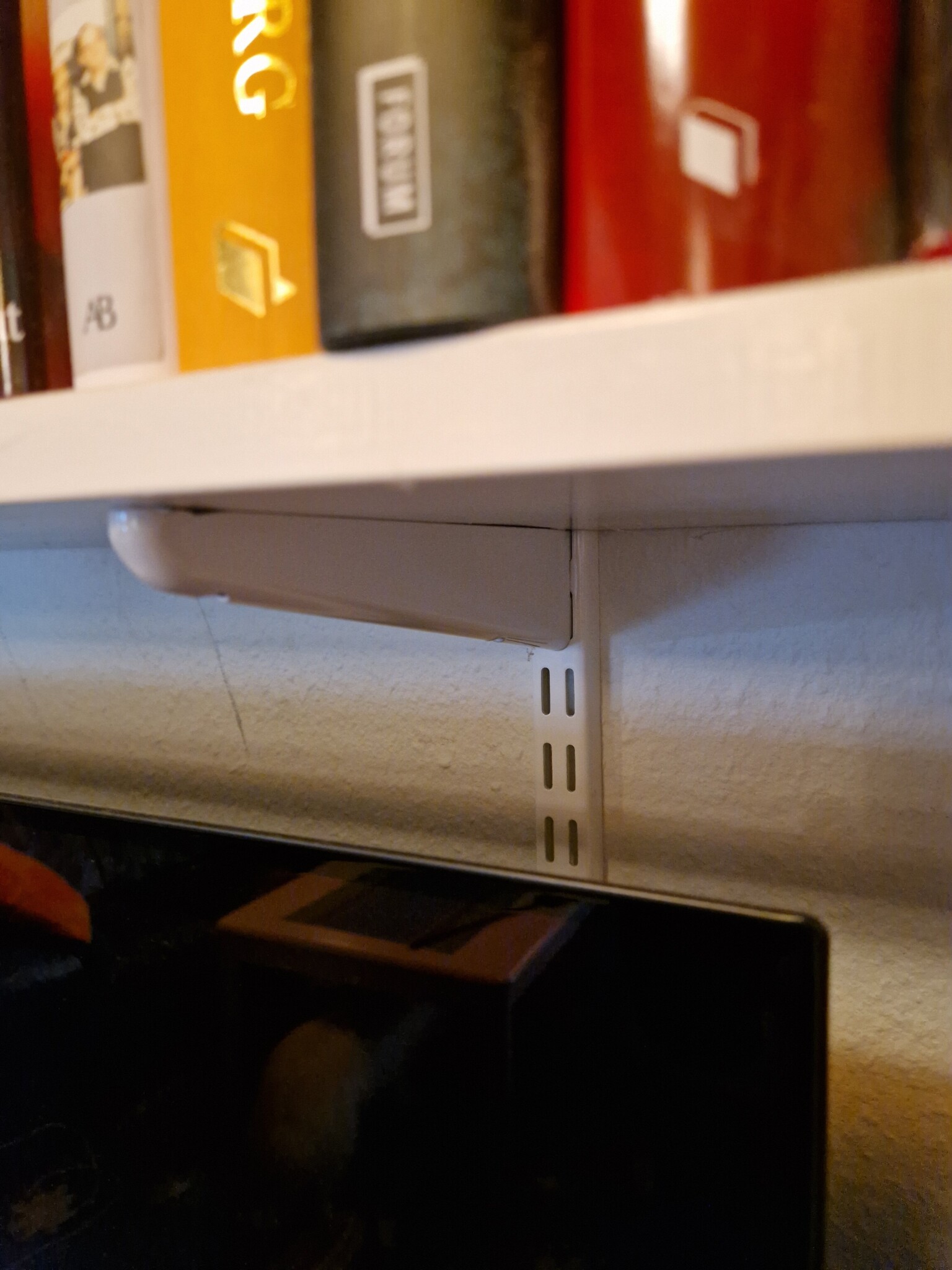



I wouldn't even attempt with aerated concrete, yes I know that technically it's possible, but I only have bad experiences trying to mount shelves that need to bear heavy loads in aerated concrete.. in that case, I would choose a system that stands on the floor.
However, if it's real concrete, then in the worst-case scenario you can use expansion bolts and you can load enormous amounts, but even regular simple plugs make it secure without you needing to worry.
Incidentally, I still have a box of ridiculously expensive Fischer aerated concrete plugs after a failed attempt to mount shelves in aerated concrete in an apartment I once lived in.. hence my skepticism
However, if it's real concrete, then in the worst-case scenario you can use expansion bolts and you can load enormous amounts, but even regular simple plugs make it secure without you needing to worry.
Incidentally, I still have a box of ridiculously expensive Fischer aerated concrete plugs after a failed attempt to mount shelves in aerated concrete in an apartment I once lived in.. hence my skepticism
And if I understand the Elfa system correctly, it is perfectly fine to install tracks, set brackets, and then put any shelf you want on the brackets? It doesn't specifically have to be Elfa shelves for functionality, I assume?E eplgh said:If you have aerated concrete, it is very important that you buy special aerated concrete plugs. Regular "straight" plugs have very poor strength because aerated concrete has poor compressive strength.
We have wall-mounted bookshelves in a siporex house and use the Elfa bracket system (see pictures). The plugs are Fischer's "twisted" variant, they also have a specified maximum tensile strength, see [link]
The advantage of Elfa brackets (or the equivalent from Biltema/Jula) is that they provide a good length, so there are low horizontal moment forces on the screws. And, of course, flexibility if you want to move the shelves (might not be important for you).
The bracket variant that "hangs" from a horizontal metal strip can be a bit more sensitive to load, as you usually have a fewer number of screws in total.
I didn't mean to nitpick, I was just curious about how much they weigh, it's always good to add a little extra margin in calculations like you did.J johannlindgren said:
Double records take up twice the space, so it should be roughly the same, right?
I personally buy rails and brackets at biltema, and shelves at byggmax...

With a concrete wall, it works without a problem as long as you use enough brackets with deep, good plugs. And have strong shelf material, such as thick planks (requires deep brackets).
But it can look a bit "ugly" if you're aiming for a light, airy feel.
But it can look a bit "ugly" if you're aiming for a light, airy feel.
A long time ago, we lived in an apartment in a building constructed in 1938. The interior walls consisted of slag. In the area, there was an old-fashioned hardware store with older staff who could answer most questions. When I was going to mount a wall-hung cabinet that the bathroom sink would rest on, I was recommended to use rubber expanders with a spacer outside the expander so that its pressure would be roughly in the middle of the wall.
https://www.sifvert-skruv.se/produkt/gummiexpander/
https://www.sifvert-skruv.se/produkt/gummiexpander/
And easier to get it straight. As long as the hanging track is straight, everything underneath will also be straight. And it's convenient to vary the widths of the shelves if you want to.J johannlindgren said:
Click here to reply