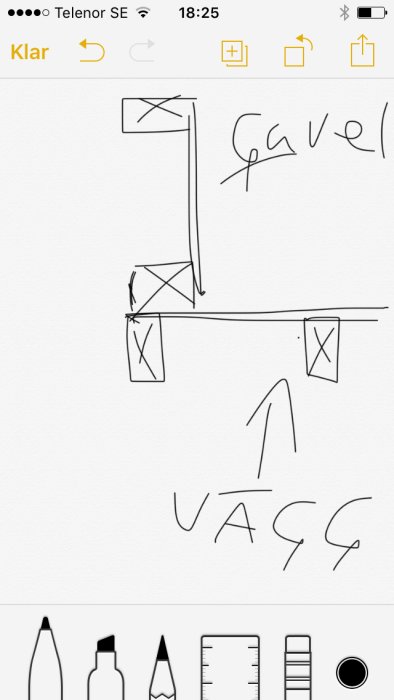
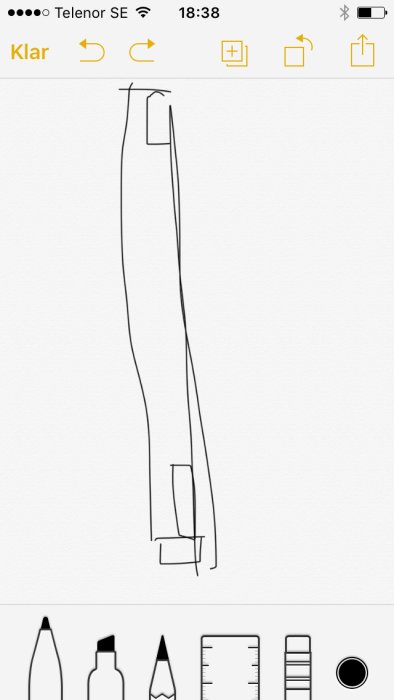
Build entire wall blocks with a layer of some sensible economical sheet material like OSB or plywood. Studs combined with such material act like wall-high composite boards. Holes for doors and windows barely weaken if the frame goes all the way around.
It can handle a 5m post spacing without issues. Let the bottom beam in the wall be the sill plate. Install the floor with a frame inside the wall and joists mounted with joist hangers.
Platform construction would also work if supported in the middle during construction.
Regards, Findus
PS. Strictly speaking, 45x70 is sufficient for the wall frame. The rafters should be checked more closely depending on the type. DS
Build entire wall blocks with a layer of some sensible economic sheet material like OSB or plywood. Studs in combination with such material become wall-high masonite beams. Holes for doors and windows barely weaken it if the stud frame goes all the way around.
It handles 5m pier spacing without any problem. Let the bottom plate in the wall be the sill. Install the floor with a frame inside the wall and beams mounted with joist hangers.
Platform construction would also work if it's supported in the middle during construction.
Regards, Findus
PS. Strictly speaking, 45x70 is sufficient for the wall frame. The trusses should be checked more closely depending on the type. DS
Are you thinking of framing the wall conventionally and then covering it on the inside and outside with OSB in other words? OSB that you glue then...
Glue is not needed if it is properly screwed/nailed. Look at the number of nails in a corresponding truss. There are ridiculously many more on a wall block. And shear force on all of them.
Lay OSB overlapping and in a different pattern on the outside, so it holds for a 5-meter pier spacing.
When you build the blocks, place the panels on the inside first. It doesn't weigh much, so it's easy for 2 people to raise. Place the gable block inside.
Run around with a level and brace everything so it's straight. Install the trusses so that the structure can be covered. Then throw in insulation and place the panels on the outside.
I have placed "hammarband" both at the top and bottom of the long walls on the inside when building things like this. They have been holiday cottages, so I have set the door and window flush with the inner wall to make room for shutters in the outer reveals.
Hope you've got a bit more info. I'm sitting with just an iPhone and struggling to prevent autocorrect from making a mess of the post.
Glue is not needed if it's properly screwed/nailed. Look at the number of nails in a corresponding truss. There are ridiculously many more on a wall block. And shear moments on all of them.
Have OSB laid horizontally and overlapping and other patterns on the outside so it can withstand a pillar distance of 5 meters.
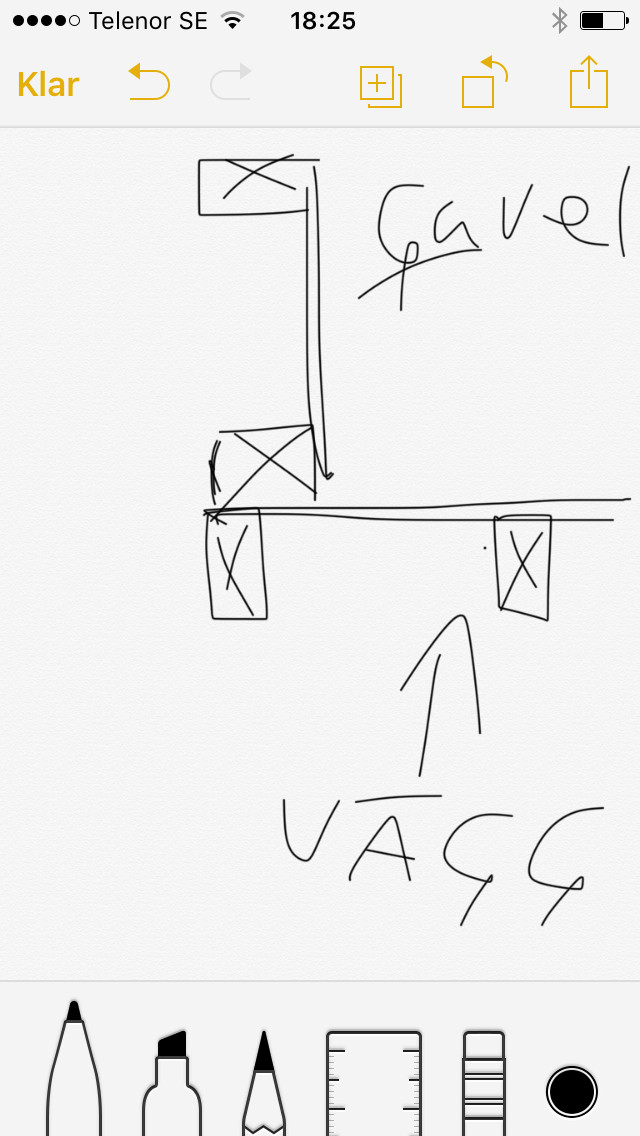
When building the blocks. Attach the boards on the inside first. It doesn't weigh much, so it's easy to raise with 2 people. You place the gable block inside.
[image]
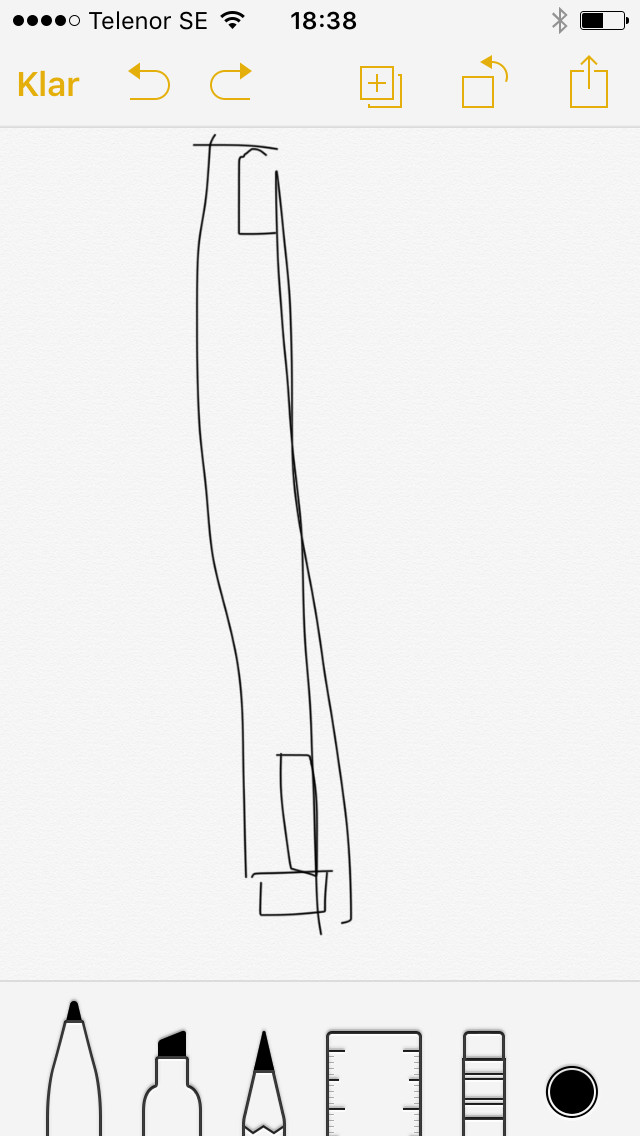
Run around with a level and brace up so everything is straight. Install the trusses so that it’s possible to cover the construction. Then you throw in insulation and put the boards on the outside.
[image]
I have put "hammarband" both up and down in the long walls on the inside when I have built something like this. These have been sport cottages, so I have set the door and window flush with the interior wall to make room for shutters in the outer reveals.
Hope you got a little more info. Just sitting with an iPhone and fighting to prevent autocorrect from making a mess of the post.
Best regards, Findus
Sounds really great, Findus. Will definitely take a closer look at this. pretty cool solution.
Just out of curiosity, did you have a vapor barrier inside the Osbn then? Thought maybe in sports cabins you might not use a vapor barrier if they're going to be unheated...
No differential lock and good ventilation. It works. The largest thing I've built with the method is 6x4.3 meters. I spent on glulam for the wall plates then. Don't want joints.
Poor ventilation is worse than none.
Good ventilation is better than none.
The problem with "no ventilation" is the assumption that spaces can be sealed so well that no air exchange occurs. Experience suggests that it is not possible. Not even tightly welded pipes are free from condensation, which eventually causes them to rust from the inside.
The concept of "preserving air untouched for future generations" works as long as it's managed with dehumidifiers or moisture absorbers. But it is not a passive system. It requires more knowledge and engagement than proper ventilation.
Next time you turn off a refrigerator, wipe it, throw in a moisture absorber, and close it instead of, as you usually do, leaving the door slightly open.
If it’s just as fresh, then leaving it slightly open wins, since moisture absorbers cost money.
The problem with "no ventilation" is the assumption that it's possible to seal spaces so well that no air exchange occurs.
That's why some kind of dehumidification is needed.
But if you can get the house, or the refrigerator, reasonably sealed, then no ventilation at all might be the best choice. The problem with unheated houses and high ventilation is that the relative humidity is over 95% on most days during the winter months, and then the black mold starts to grow.
I have tried, I had the garage loft completely open without gable ends, that is, more ventilation than that is not possible, result - lots of black mold.
The reason unheated summer cottages and so forth manage reasonably well is that when the sun shines, it becomes warmer inside the cottage than outside, and that vapor pressure difference drives out a bit of moisture each time, and all the material in the house/cottage can handle a certain amount of moisture buffering.
If you look, you'll see that it's becoming increasingly popular among boat and caravan owners to instead of ventilating their prized possession as much as possible, seal the object as tightly as possible and instead leave a drying agent inside.
There is growing consensus that there is less mold and musty odor by spring then.
Alternatively, you can place a spirorörr in the mast hole with a black-painted top. It can be used year after year. Costs nothing beyond the initial investment and ventilates properly.
Paradigms tend to swing back and forth. Right now, it seems the blockers have the upper hand. When their faulty constructions backfire, the tide turns, and the herd follows another singular truth. Perhaps then, I'll begin to argue for the other side . In the physical reality I live in, there is no one path. Any idiocy can work as long as everything is well-made and all ideas combine into a functional whole.
I prefer systems that work when those managing them are incompetent or lazy. I have no control over the future, so sooner or later that will be the case. That's why I like seasonal measures like "make sure the dampers and all the inner doors are open when you close the cabin." "It's good if you turn off the fridge with the door slightly open." "If you miss the fridge, you'll have to buy new batteries next year." If the main function is passive, the consequences of errors are smaller.
PS. Speaking of consensus. When Einstein published a pivotal work, the scientific elite gathered and signed a long list with many prominent names. Faced with this list, Einstein said, "If I were wrong, it would have sufficed for one of you to sign." DS
Click here to reply
Vi vill skicka notiser för ämnen du bevakar och händelser som berör dig.



findus42 said:
Build entire wall blocks with a layer of some sensible economic sheet material like OSB or plywood. Studs in combination with such material become wall-high masonite beams. Holes for doors and windows barely weaken it if the stud frame goes all the way around.