
15,244 views ·
52 replies
15k views
52 replies
Steel beam over a 4.2 meter opening
How did you arrive at 3.9kN/m, sounds very little.J justusandersson said:If you consider snow zone 2.5 (e.g., Gävle), a line load on the beam of about 3.9 kN/m arises. If you set L/600 as the max for deflection (since doors are particularly sensitive), an HEA 140 might suffice. A glulam beam of 190x225 could also work. I estimate the cost of the glulam beam to be about 70% of the steel beam.
However, I can't understand how the roof with its 45x120 rafters can hold. Is there any supporting element that you haven't shown in the drawing?


3.9 kN/m was under the assumption that it was snow zone 2.5. Now we have concluded that it is snow zone 3.5, and the values have become significantly higher.
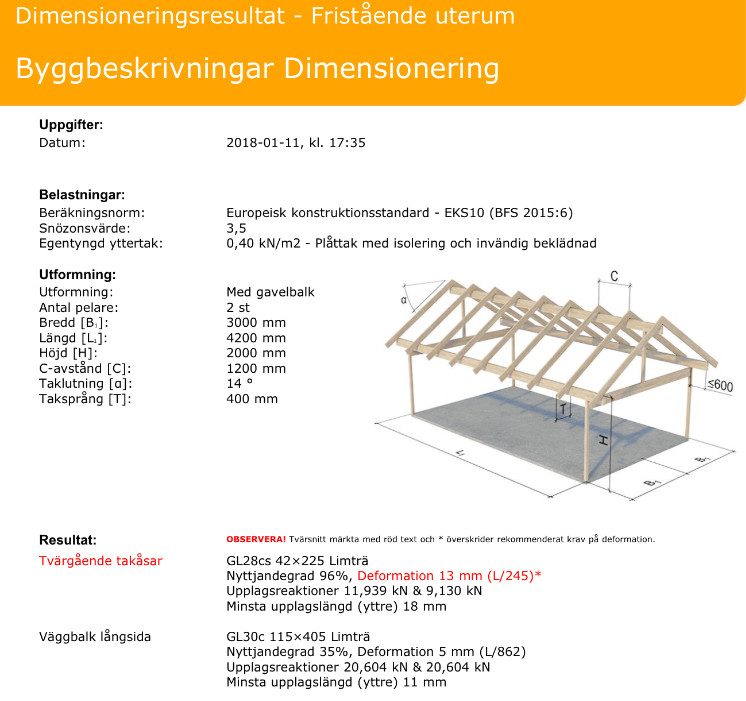
So, it wasn't as simple as adding the loads. However, the fact remains that based on the table for glulam beams and the one I was recommended (115x405), the load is low even in snow zone 3.5. And that dimension corresponds to HEA 200-220, as mentioned earlier. Attached is an image from the table; now the garage is not detached but attached to a stone house, and all other walls in the garage are brick, thus a solid gable on the opposite side of the house. What load factor is reasonable to consider? For example, glulam beam 90x360 results in a load of 55% and deflection L/489, 115x315 gives 56% and L/431.

When you want to compare different dimensions (of the same strength class) and their properties in terms of deflection, you can compare their moment of inertia. It is a purely geometrical quantity calculated by the formula widthxheight^3/12. You can use any unit you like as long as you are consistent. Personally, I prefer cm out of old habit. 115x315 then has the value 29954 cm4, 90x360 34992 cm4, and 115x405 63662 cm4. If you have information about a glulam dimension, you can easily calculate alternative dimensions with, for example, a lower height. The wider the glulam beam you choose, the more material is required, which affects the price.
I had that in mind when I wrote the comment, as I get the line load to 7.9 kN with snow load at 2.5 kN/sqm including the dead weight. Are you designing according to Eurocode?J justusandersson said:
The current roof half is 3x5.5 m, i.e., 16.5 sqm. Snow load of 3.5 + self-weight 0.5 = 4 kN/sqm. 16.5x4=66 kN, half of which is taken up by the ridge beam and half by the wall with the doors. 33/5.5 = 6 kN/m. I have used this value in my latest calculations.
Eurocode or not, it doesn't matter as this is more or less a practical problem..
It's not that simple when you calculate the load. You have to differentiate between characteristic and design loads, as you are only using characteristic loads in your calculation. Additionally, you need to use various safety factors that increase the loads.J justusandersson said:
Depends on which material parameters you are comparing with, depending on which design loads you are calculating (norm).
As I mentioned above, it entirely depends on which determining material parameters are used. In BKR the safety was on the material, in eurocode it is on the load. The most important thing is to be consistent and not mix standards.