
15,246 views ·
52 replies
15k views
52 replies
Steel beam over a 4.2 meter opening
I have read countless forum threads on the subject and there doesn’t seem to be a simple answer. Since all constructions require their specific solution, I hope to get some good advice along the way from all the skilled members!
I have a built-on, masonry garage in the basement (concrete floor) that was built in 1963. Today, there are two garage doors that are on their last legs and are also somewhat narrow (2250) for a modern car. I have therefore considered whether it is possible to use a steel beam to assist with the load-bearing for a larger door of 4200 mm. A glulam beam would be too high and would block the daylight opening. The roof construction is built from the outside in:
Seamed metal, underlay felt, 22 mm rough boards, 120 mm insulation (studs 45x120, cc 1200), 22 mm rough boards, 13 mm gypsum.
I have never dealt with steel beams but have understood that many recommend H (HEA, HEB) or I-beam, and that there are different strength classes for these. My desire is to have two posts attached inside the masonry wall on either side of the opening and place the beam on top of these, which would then serve as support upwards against the ceiling, and allow me to remove the middle stud that currently exists between and in line with the doors, as well as the extra stud that is centered between the doors but 500 mm into the garage. The roof overhang is 200 mm.
I am attaching a couple of sketches and hope that someone can come up with some wise ideas =)
I have a built-on, masonry garage in the basement (concrete floor) that was built in 1963. Today, there are two garage doors that are on their last legs and are also somewhat narrow (2250) for a modern car. I have therefore considered whether it is possible to use a steel beam to assist with the load-bearing for a larger door of 4200 mm. A glulam beam would be too high and would block the daylight opening. The roof construction is built from the outside in:
Seamed metal, underlay felt, 22 mm rough boards, 120 mm insulation (studs 45x120, cc 1200), 22 mm rough boards, 13 mm gypsum.
I have never dealt with steel beams but have understood that many recommend H (HEA, HEB) or I-beam, and that there are different strength classes for these. My desire is to have two posts attached inside the masonry wall on either side of the opening and place the beam on top of these, which would then serve as support upwards against the ceiling, and allow me to remove the middle stud that currently exists between and in line with the doors, as well as the extra stud that is centered between the doors but 500 mm into the garage. The roof overhang is 200 mm.
I am attaching a couple of sketches and hope that someone can come up with some wise ideas =)
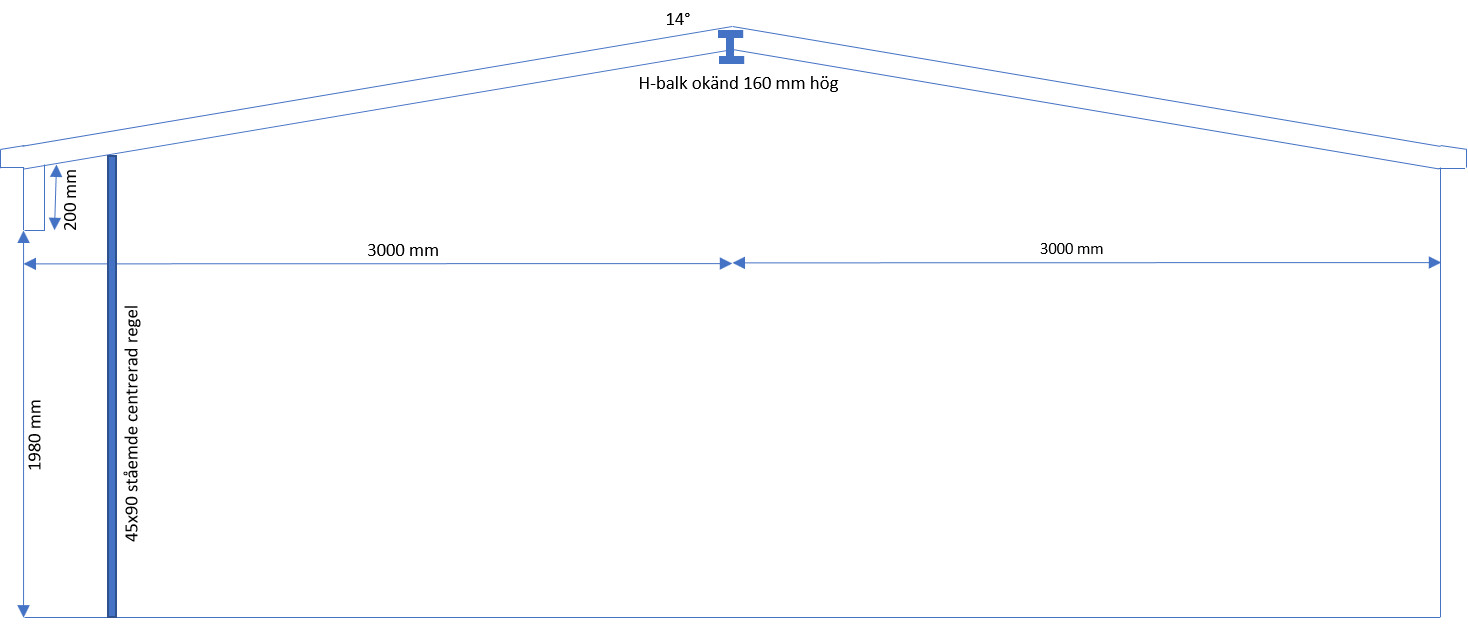

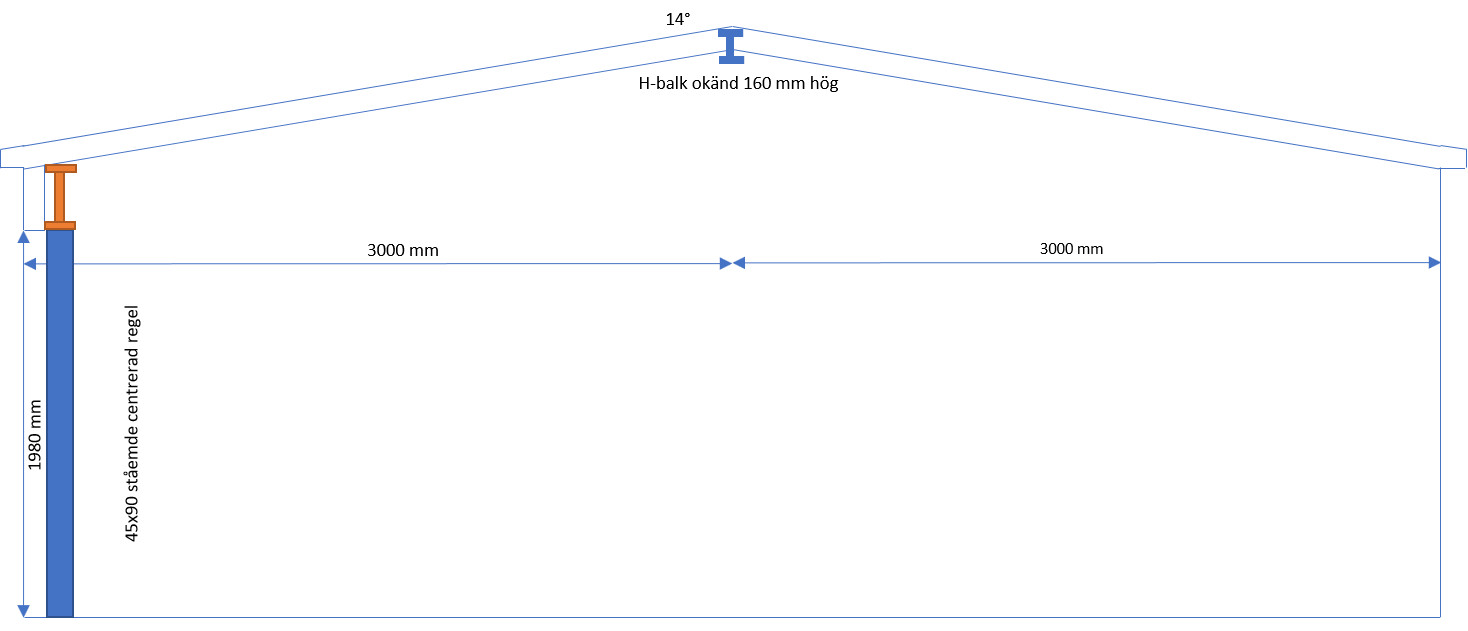
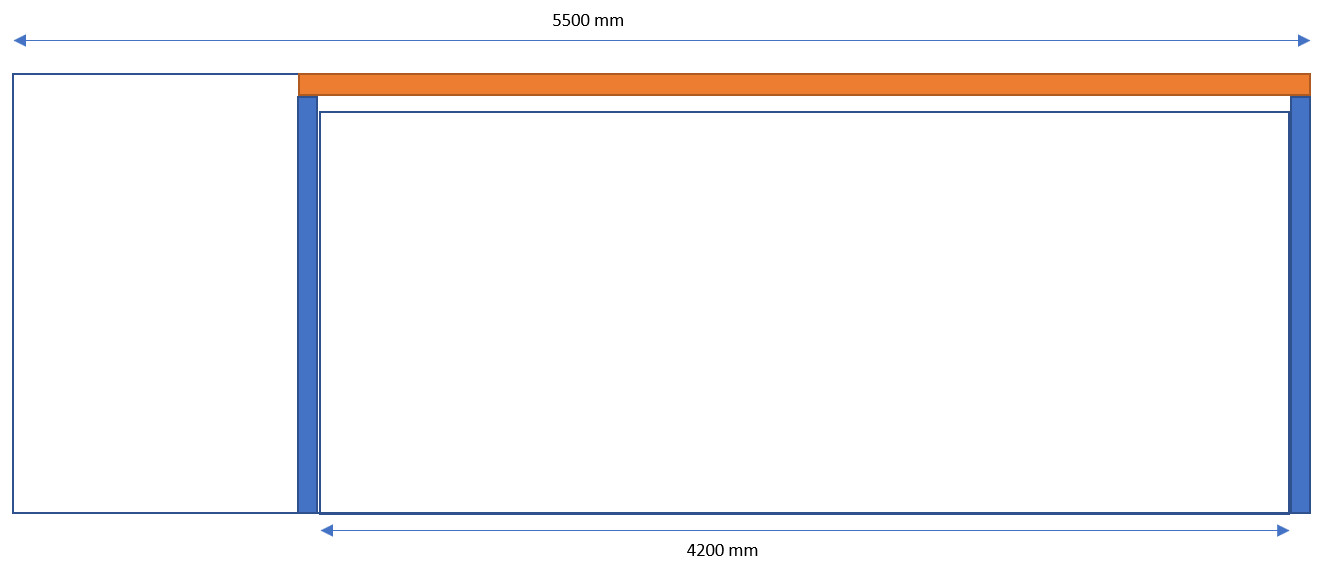
Hi, no, the opening is at the eaves, images 3 and 4 show how I would like it (image 4 is directly from the front where the doorway will be, under the eaves). Currently, there are 2 openings of 230 cm each with a center rule that I want to remove.
Last edited:

If you consider snow zone 2.5 (Gävle, for example), a line load on the beam of around 3.9 kN/m occurs. If you set L/600 as the max for deflection (since doors are particularly sensitive), then an HEA 140 might suffice. It would also work with a glulam beam of 190x225. I estimate the cost of the glulam beam to be about 70% of the steel beam.
However, I cannot understand how the roof with its 45x120 rafters can hold. Is there any bearing element that you have not shown on the drawing?
However, I cannot understand how the roof with its 45x120 rafters can hold. Is there any bearing element that you have not shown on the drawing?
Thank you for your reply,
I am in snow zone 3-3.5, so I thought I'd aim for the higher end.
I haven't torn down and seen the entire construction, but I replaced the roofing felt and sheet metal this summer and took the opportunity to replace the fascia boards. At that point, I could see straight into the cavities, so to speak, but there was insulation, so I didn't see much more than the fact that there were 45x120 joists. It's possible that there is something more load-bearing further in. The steel beam at the ridge is the only visible one, cast in on the free side of the garage and recessed and bolted into the house at that end.
To maintain the height in the doorway, I was thinking if I could place the beam directly on the inside of that wall, it would then, due to the wall's thickness, extend about 200 mm extra outwards, meaning the beam would be approximately 400 mm in from the eaves, but perhaps that doesn’t affect much?
I am in snow zone 3-3.5, so I thought I'd aim for the higher end.
I haven't torn down and seen the entire construction, but I replaced the roofing felt and sheet metal this summer and took the opportunity to replace the fascia boards. At that point, I could see straight into the cavities, so to speak, but there was insulation, so I didn't see much more than the fact that there were 45x120 joists. It's possible that there is something more load-bearing further in. The steel beam at the ridge is the only visible one, cast in on the free side of the garage and recessed and bolted into the house at that end.
To maintain the height in the doorway, I was thinking if I could place the beam directly on the inside of that wall, it would then, due to the wall's thickness, extend about 200 mm extra outwards, meaning the beam would be approximately 400 mm in from the eaves, but perhaps that doesn’t affect much?
The beam load actually increases since it then has to support a slightly larger portion of the roof area.hordak said:
With snow zone 3.5, you probably need to increase the dimension, to HEA 160 or alternatively 210x225.
Is it possible to reason in terms of the bigger/heavier the better here? (Thinking about things like weight, etc.). I have 200 mm of free height above the door openings (which will hopefully become just one opening now), and I would have room for an HEA/IPE200...
No, I don't think so, everything is just getting heavier and more expensive. There is no benefit from the extra rigidity. An HEA 200 weighs 42.3 kg/m. With a price per kilo of 25 SEK/kg including VAT, it becomes 1058 SEK/m.
Ok, thank you, and thanks to all of you for the great answers!
Just as an extra check, I got the dimensions 115x405 for the glulam beam from Beijer, which unfortunately is too high. Does that dimension seem to match well with what HEA 140/160 can handle?
Just as an extra check, I got the dimensions 115x405 for the glulam beam from Beijer, which unfortunately is too high. Does that dimension seem to match well with what HEA 140/160 can handle?
Glulam 115x405 matches HEA 200-220 in terms of deflection. What's interesting about glulam compared to steel is that you can increase the width instead of the height. It's more flexible. If you got that information from Beijers, I wouldn't trust it at all. They have probably used an app without understanding all the parameters.
Haha, thanks for the tip! Of course, they need to know a bit about a lot, but it's better to ask someone who knows a lot about what you're asking about 
I took a look at a dimension table for glulam, admittedly for a shed with a lean-to roof but if I split the garage at the ridge, it becomes a lean-to
Anyway, with the given dimensions (with a depth of 3000, i.e. to the ridge), a 115x405 gives a deflection of L/721, utilization degree of 39%, and breaking strength of 21,560
I took a look at a dimension table for glulam, admittedly for a shed with a lean-to roof but if I split the garage at the ridge, it becomes a lean-to
Anyway, with the given dimensions (with a depth of 3000, i.e. to the ridge), a 115x405 gives a deflection of L/721, utilization degree of 39%, and breaking strength of 21,560
Quick follow-up question, is the deflection calculated in the y-direction?
And as usual, once you start writing more comes along
The garage roof area is about 36 sqm, total wall length about 24 meters, of which over 6 meters consist of the house to which the garage is connected.
I'm thinking that the total load will be 36x3.9 kN = about 140 kN and the line load thus /24 = 5.85 kN, or am I on the proverbial bike now?
And as usual, once you start writing more comes along
The garage roof area is about 36 sqm, total wall length about 24 meters, of which over 6 meters consist of the house to which the garage is connected.
I'm thinking that the total load will be 36x3.9 kN = about 140 kN and the line load thus /24 = 5.85 kN, or am I on the proverbial bike now?
I would probably say z-axis, since it is a three-dimensional figure.
If the total roof load is 140 kN, half ends up on the ridge beam and a quarter on each of the front and back façades.
If the total roof load is 140 kN, half ends up on the ridge beam and a quarter on each of the front and back façades.
Ah, that's why z is involved, thanks for the clarification. Considering that the intended beam is loaded with 35 kN and the line load is vertical - in the same direction as gravity to avoid saying one thing and meaning another =) And it's in that direction you've calculated the deflection?
Yes.