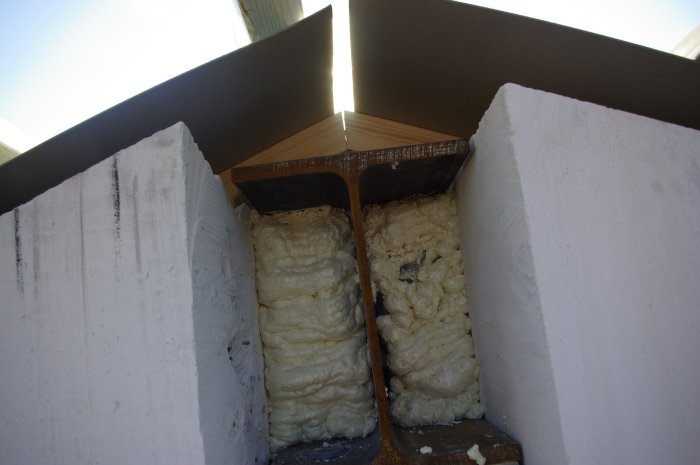
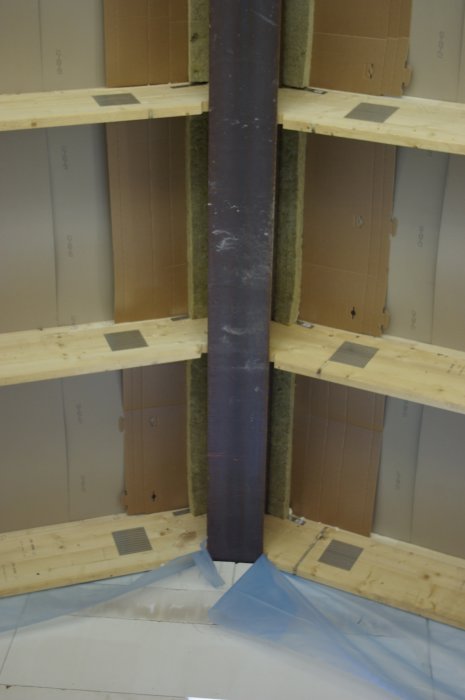
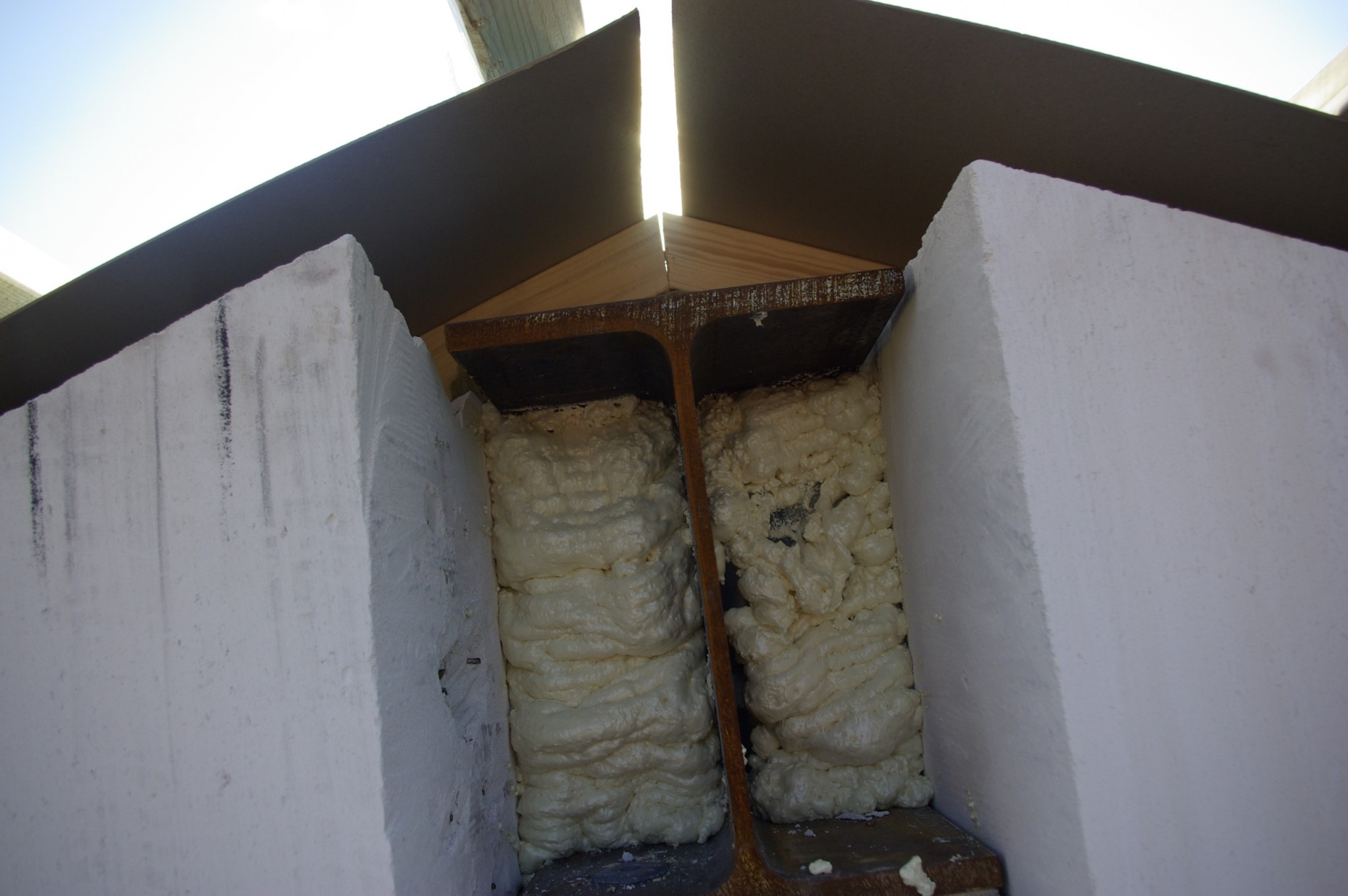
The designer suggested 75 mm of stone wool/mineral wool on and down the sides of the steel beam, and the person responsible for control believes it should be enough. Someone else I spoke to at Norisol thought the beam should be clad with lamella mat with tight seams, because if there is condensation, it could drip from the beam. But as mentioned, the person responsible for control, who is supposed to be knowledgeable and also has the qualification for advanced constructions and is a teacher at the School of Architecture, says it should be enough...
eaves on the gables? So that the roof extends a bit beyond the facade?
According to the facade drawings, it should be that way, but I haven't seen a drawing specifically for that.
Should there be any roof overhang on the gables and how will they solve it?
If the roof overhang isn't excessively long, extending the raw boards will suffice. The ridge beam doesn't need to extend beyond the exterior of the wall!
Hello. Steel is the absolute best solution, it withstands longer spans and doesn't build as much; glulam for the equivalent length would be extremely thick, and it doesn't look good. We are a bit behind in Sweden and actually still use a lot of glulam, despite the superior properties of steel.
Someone mentioned the fire properties, which aren't as different as lobbyists try to suggest. Lay 1-2 layers of plasterboard and it's fine.
A bit behind in Sweden? As if steel beams were a new invention. I agree that it's preferable in this case, but I prefer glulam 9 times out of 10!
A bit behind in Sweden? As if steel beams were a new invention. I agree that it's preferable in this case, but I prefer glulam 9 times out of 10!
And the tenth time you'll find at my place. During an extension, they needed to span an opening of 6 meters and chose wood. But since they didn't want to take too much ceiling height, it was too low. So much sagging that the outer roof sags a bit and it had to be clad again so you wouldn't see the sagging in the ceiling.
With steel, there wouldn't have been the slightest problem. If only I had been there when it was done...
As I see it, the advantages are that the beam is more slender, which might not affect your house if you're going to insulate so much that the glue-laminated beam would be covered anyway. The fire properties are somewhat worse, but you avoid fireproof coating since the house is considered its own cell (I think). The biggest advantage, however, is that you avoid organic materials, which otherwise would be in contact with a frame that can carry enormous amounts of moisture.
Personally, I don't understand why one would want to mix in organic materials if you're building a stone house otherwise.
Good point, but the trusses are probably wood, right?
No idea, probably, but there are other alternatives even though they become somewhat more expensive and harder to handle during assembly for a gable roof.
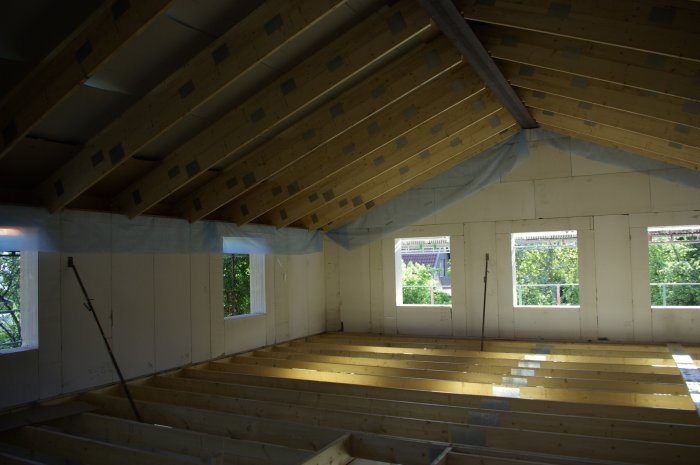
Yes, the beam was quite substantial... where it is now, it's difficult to access and measure it. Here you can see pictures from today as the roof starts getting in place. You can also see the insulation above the beam, 70 mm, to break the thermal bridge, and parts of the air gap.
I was worried that it would be difficult to attach the drywall to the ceiling, but the concern is probably unfounded. It seems easy to do thanks to the construction of the trusses - you don't need to attach anything to the steel beam itself. Except for the trusses, of course, but they are already in place.
Love the space!